

How analytics drives smarter marketing decisions

Many marketers struggle to justify their budgets or pinpoint which campaigns truly deliver results. Without clear data, decisions rely on intuition rather than evidence, leading to wasted spend and missed opportunities. Marketing analytics transforms this guesswork into measurable, actionable insight by revealing what works, why it works, and how to optimize future efforts. This guide explores the four types of analytics, essential methodologies like multi-touch attribution and marketing mix modeling, common challenges including data quality and ethical concerns, and practical tips to leverage analytics for maximum impact and ROI.
Table of Contents
- Key takeaways
- Understanding the four types of marketing analytics
- Key methodologies that power marketing analytics
- Overcoming challenges and ethical considerations in marketing analytics
- Practical tips to leverage marketing analytics for better results
- Learn how Tech Moths supports data-driven marketing success
- Frequently asked questions
Key Takeaways
| Point | Details |
|---|---|
| Four analytics types | Marketing analytics progress from describing what happened to prescribing actions through four levels: descriptive, diagnostic, predictive, and prescriptive. |
| Attribution and MMM | Multitouch attribution and marketing mix modeling help quantify channel impact and inform budget allocations. |
| Data quality matters | Data quality and governance directly affect model effectiveness and the reliability of insights. |
| Descriptive to prescriptive progression | Progressing from descriptive to prescriptive analytics guides organizations from reactive reporting to proactive strategy. |
| Start with descriptive and diagnostic | Begin with solid descriptive and diagnostic analytics before investing heavily in predictive models. |
Understanding the four types of marketing analytics
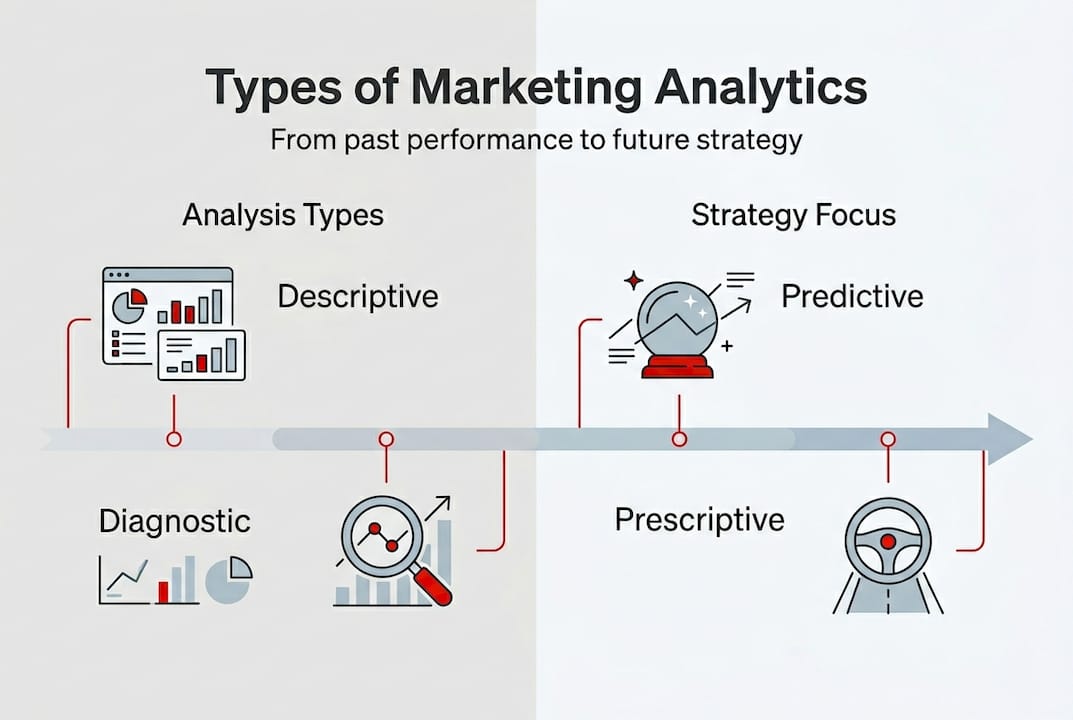
Marketing analytics encompasses four primary types: descriptive, diagnostic, predictive, and prescriptive. Each builds on the previous level, creating a framework that moves from hindsight to foresight.
Descriptive analytics answers “what happened?” by summarizing past campaign performance through metrics like conversion rates, click-through rates, and revenue generated. You examine dashboards showing email open rates or social media engagement to understand historical results. This foundational layer provides the raw material for deeper analysis.

Diagnostic analytics digs into “why did it happen?” by identifying root causes behind performance patterns. When a campaign underperforms, diagnostic tools help you isolate whether the issue stems from targeting, creative messaging, timing, or channel selection. This type reveals correlations and relationships that descriptive data alone cannot explain.
Predictive analytics forecasts “what will happen?” by applying statistical models and machine learning to historical data. You can anticipate customer churn, estimate lifetime value, or project campaign ROI before launching. These forecasts enable proactive resource allocation and risk mitigation, understanding the role of data analytics business outcomes.
Prescriptive analytics recommends “what should we do?” by suggesting optimal actions to achieve specific goals. Advanced algorithms evaluate multiple scenarios and identify the best path forward, whether that means reallocating budget, adjusting bid strategies, or personalizing content. This highest level of analytics transforms insight into action.
Progressing through these four types guides you from reactive reporting to proactive strategy. Most organizations start with descriptive analytics and gradually build capability toward prescriptive insights as data maturity increases.
Pro Tip: Start by mastering descriptive and diagnostic analytics before investing heavily in predictive models. Solid foundational understanding prevents misinterpreting advanced forecasts.
Key methodologies that power marketing analytics
Multi-touch attribution uses algorithms for credit distribution across customer touchpoints, unlike single-touch models that assign all credit to one interaction. This methodology recognizes that conversions rarely result from a single ad or email. Instead, customers engage with multiple channels before purchasing.
Common multi-touch models include linear (equal credit to all touchpoints), time decay (more credit to recent interactions), and algorithmic (data-driven weighting). Each offers different perspectives on channel effectiveness. Algorithmic attribution provides the most nuanced view by analyzing actual conversion patterns rather than applying predetermined rules.
Marketing mix modeling analyzes the impact of various marketing inputs on sales at a macro level. This top-down approach examines how TV spend, digital advertising, promotions, and seasonality collectively drive business outcomes. MMM excels at measuring offline channels and understanding long-term brand-building effects that attribution models miss.
A/B testing supports controlled experimentation to optimize creative elements, messaging, and user experience. You isolate variables like subject lines, call-to-action buttons, or landing page layouts to measure their individual impact on conversion rates. This methodology provides causal evidence rather than correlational insight.
Predictive modeling anticipates customer behavior to improve targeting and reduce acquisition costs. Predictive ROI modeling reduced CPA by 22% in e-commerce applications by identifying high-value prospects early in the funnel. These models leverage historical purchase data, browsing behavior, and demographic attributes to score leads.
Real-time analytics enables agile decision-making by processing data as it arrives rather than in batch reports. You can monitor campaign performance hour by hour, adjusting bids or pausing underperforming ads immediately. This responsiveness prevents budget waste and capitalizes on emerging opportunities, similar to strategies in digital marketing strategy 2026 planning.
| Methodology | Best Use Case | Key Advantage | Limitation |
|---|---|---|---|
| Multi-touch attribution | Digital channel optimization | Comprehensive journey view | Requires complete tracking |
| Marketing mix modeling | Total marketing impact | Measures offline channels | Aggregate-level only |
| A/B testing | Tactical optimization | Establishes causality | Limited to controlled variables |
| Predictive modeling | Targeting and personalization | Anticipates behavior | Needs historical data |
| Real-time analytics | Campaign monitoring | Immediate adjustments | Can encourage overreaction |
Pro Tip: Combine multiple methodologies rather than relying on a single approach. Multi-touch attribution and MMM together provide both granular and strategic perspectives.
Overcoming challenges and ethical considerations in marketing analytics
Data quality below 80% risks model performance by producing misleading accuracy metrics and poor sensitivity to minority classes. Imbalanced datasets where conversions represent only 1-2% of observations can cause models to appear accurate while failing to identify actual converters. This challenge requires careful sampling techniques and evaluation metrics beyond simple accuracy.
Fragmented customer journeys complicate attribution when users switch between devices, clear cookies, or interact through channels you cannot track. Attribution models are approximate, not truly causal, because they cannot perfectly reconstruct every touchpoint. Privacy regulations like GDPR and CCPA further limit tracking capabilities, forcing marketers to work with incomplete data.
Strong data governance establishes standards for collection, storage, and usage that improve quality and ensure compliance. Unified customer data platforms consolidate information from disparate sources, reducing fragmentation and enabling more complete analysis. These foundational investments pay dividends across all analytics initiatives, as explored in enterprise analytics create business strategy frameworks.
AI hallucinations and black-box risks threaten valid insights when algorithms generate plausible but incorrect patterns or when complex models resist interpretation. Analytics is limited by data silos, interpretability issues, and ethical concerns including bias and privacy violations. You must validate AI outputs against business logic and maintain transparency in how models reach conclusions.
Ethical marketing requires actively identifying and mitigating bias in training data and model predictions. Algorithms can perpetuate discriminatory patterns if historical data reflects past inequities. Protecting user privacy means collecting only necessary data, securing it properly, and respecting opt-out preferences. Building trust through ethical practices creates sustainable competitive advantage.
- Implement regular data quality audits to identify and correct issues before they compromise models
- Use privacy-preserving techniques like differential privacy and federated learning where appropriate
- Establish clear guidelines for AI use that require human review of significant decisions
- Train teams on recognizing and addressing algorithmic bias in marketing applications
- Document data lineage and model assumptions to maintain transparency and accountability
Practical tips to leverage marketing analytics for better results
Prioritize data governance and unified platforms such as customer data platforms to establish reliable foundations. Without clean, integrated data, even sophisticated models produce unreliable results. CDPs consolidate customer information from websites, CRM systems, email platforms, and advertising channels into single customer views that enable accurate analysis.
Start from descriptive analytics progressing to prescriptive approaches rather than jumping directly to advanced techniques. Build organizational capability incrementally by ensuring teams understand what happened and why before attempting to predict what will happen. This staged approach prevents misapplication of complex models and builds confidence in analytics.
Use a test-and-learn mindset to validate insights through controlled experiments before committing major resources. A/B testing specific hypotheses generated by analytics confirms whether correlations translate into causal relationships. This disciplined approach separates signal from noise and prevents costly mistakes based on spurious patterns.
Foster cross-functional collaboration combining marketing domain expertise, analytical skills, and technical infrastructure knowledge. Cross-team collaboration for success requires breaking down silos between marketing, analytics, and IT departments. Marketers understand customer psychology and campaign context, analysts bring statistical rigor, and technologists enable data infrastructure.
Leverage AI for pattern recognition and automation while keeping humans central to strategy and interpretation. Combine marketing mix modeling with machine learning to handle data processing at scale while applying business judgment to recommendations. AI excels at identifying complex patterns humans would miss, but cannot replace strategic thinking about brand positioning or customer relationships.
- Establish data governance policies covering quality standards, privacy compliance, and access controls before scaling analytics initiatives
- Invest in unified customer data platforms that consolidate fragmented sources into coherent customer profiles
- Begin with descriptive analytics to build foundational understanding, then progress through diagnostic, predictive, and prescriptive stages
- Implement systematic A/B testing programs that validate analytical insights through controlled experiments
- Create cross-functional analytics teams that blend marketing expertise, statistical skills, and technical capabilities
- Deploy AI for automating data processing and pattern recognition while maintaining human oversight of strategic decisions
- Triangulate findings across multiple methodologies like attribution, MMM, and testing to build confidence in conclusions
Pro Tip: Document your analytics methodology and assumptions clearly so future team members understand how insights were generated and can identify when approaches need updating, similar to techniques in role of ai algorithms in marketing recommendations engines.
Learn how Tech Moths supports data-driven marketing success
After exploring how analytics transforms marketing effectiveness, you might wonder how to implement these strategies in your organization. Tech Moths offers tailored approaches that integrate analytics frameworks for marketing excellence across diverse sectors.
Our platform provides insights on data governance best practices, predictive modeling applications, and unified platform selection that help you navigate complex analytical challenges. Whether you’re optimizing personalized learning tactics boost student loyalty in educational contexts, addressing access to different levels of education, or exploring education opportunities in turbulent times, our content equips you with frameworks applicable across industries. We bridge educational insights with practical marketing applications, helping you build analytics capabilities that drive measurable business results.
Frequently asked questions
What is the primary benefit of multi-touch attribution compared to single-touch?
Multi-touch attribution uses algorithms for credit distribution providing better insights than single-touch models that assign all conversion credit to one interaction. This comprehensive approach recognizes that customers typically engage with multiple channels before converting, revealing the true contribution of each touchpoint. Single-touch models oversimplify the customer journey by crediting only the first or last interaction, potentially leading to misguided budget allocation decisions.
How can businesses improve data quality for marketing analytics?
Establish strong governance policies covering data quality and governance frameworks that define standards for collection, validation, and maintenance. Use customer data platforms to unify fragmented sources from websites, CRM systems, and advertising channels into consistent customer records. Ensure privacy compliance through proper consent management and security measures that maintain trustworthy datasets while respecting user preferences.
What role does AI play in marketing analytics, and what are its limits?
AI helps automate pattern recognition but can’t solve causal issues alone and risks hallucinations in modeling when generating plausible but incorrect insights. AI excels at processing vast datasets and identifying complex patterns humans would miss, yet cannot fully replace human judgment for understanding cause and effect relationships. Human-AI collaboration proves essential, with machines handling data processing while people provide strategic context and ethical oversight, as detailed in role of ai algorithms in marketing recommendations engines.
How do marketing mix modeling and attribution differ in approach?
Marketing mix modeling takes a top-down, aggregate approach analyzing how total marketing spend across channels impacts overall sales, excelling at measuring offline channels and long-term brand effects. Attribution models work bottom-up from individual customer journeys, assigning conversion credit to specific touchpoints and optimizing digital channel performance. MMM requires less granular tracking but provides strategic insights, while attribution offers tactical optimization guidance for digital campaigns where detailed tracking exists.
Why is cross-functional collaboration critical for analytics success?
Marketing analytics requires domain expertise to frame relevant questions, statistical skills to analyze data rigorously, and technical capabilities to build infrastructure that captures and processes information. No single person typically possesses all three skill sets at expert levels. Cross-functional teams combining marketers who understand customer behavior, analysts who apply proper methodologies, and technologists who enable data platforms produce more reliable insights and practical recommendations than siloed efforts.
