

Competitive advantage explained: outperform rivals in 2026

Most business leaders believe competitive advantage is simply about offering the lowest price. That’s a dangerous oversimplification. True competitive advantage encompasses a spectrum of strategies, from unique product features to superior customer service, operational excellence, and innovative technology deployment. Understanding these varied approaches is essential for any organization seeking to strengthen its market position and achieve sustainable growth. This comprehensive guide will walk you through the core concepts, proven frameworks, and practical strategies that enable businesses to consistently outperform competitors and capture greater market share.
Table of Contents
- Key takeaways
- What is competitive advantage and why it matters
- Core frameworks to explain competitive advantage
- Enhancing competitive advantage through innovation and technology
- Practical steps to build and sustain your competitive advantage
- Enhance your competitive edge with TechMoths solutions
- Frequently asked questions
Key Takeaways
| Point | Details |
|---|---|
| Broad view of advantage | Competitive advantage encompasses more than price and includes unique features, service, operations, and technology deployment. |
| Porter generic strategies | Porter identifies cost leadership, differentiation, and focus as the core paths to outperform rivals. |
| Resource based VRIO | The resource based view emphasizes internal capabilities evaluated through the VRIO framework to sustain advantage. |
| Innovation and SMEs | Innovation and performance mediate sustained advantage, particularly for small and medium sized enterprises. |
| AI and engineering edge | Artificial intelligence and engineering excellence can dramatically boost competitive edge and profitability. |
What is competitive advantage and why it matters
Competitive advantage represents the unique attributes allowing firms to outperform competitors through superior efficiency, quality, or distinctive offerings. It’s the reason customers choose your product over alternatives, even when prices are similar or slightly higher. Without competitive advantage, businesses become commodity providers competing solely on price, a race to the bottom that erodes margins and threatens long-term viability.
The impact of competitive advantage extends far beyond simple market share. Companies with strong competitive positioning enjoy higher profit margins, greater customer loyalty, improved bargaining power with suppliers, and enhanced resilience during economic downturns. These advantages compound over time, creating barriers that make it increasingly difficult for rivals to catch up.
Many entrepreneurs mistakenly believe competitive advantage requires massive capital investment or groundbreaking innovation. In reality, advantage can emerge from operational excellence, superior customer service, strategic partnerships, or simply executing the basics better than everyone else. The key is identifying what makes your organization uniquely valuable to customers and protecting that differentiation.
Strategic decision-making becomes clearer when you understand your competitive advantage. Every investment, partnership, and operational change should either strengthen your existing advantage or build new ones. Leaders who lack this clarity often chase trends, copy competitors, or spread resources too thin across conflicting priorities.
“Competitive advantage is not about being better at everything. It’s about being meaningfully different in ways that matter to your customers and difficult for rivals to replicate.”
Consider these common sources of competitive advantage:
- Superior product quality or innovative features that solve customer problems better
- Lower cost structures enabling competitive pricing while maintaining healthy margins
- Exceptional customer service creating loyalty and positive word-of-mouth
- Proprietary technology or processes that competitors cannot easily duplicate
- Strong brand reputation built through consistent delivery and strategic marketing
- Strategic location or distribution networks providing market access advantages
Core frameworks to explain competitive advantage
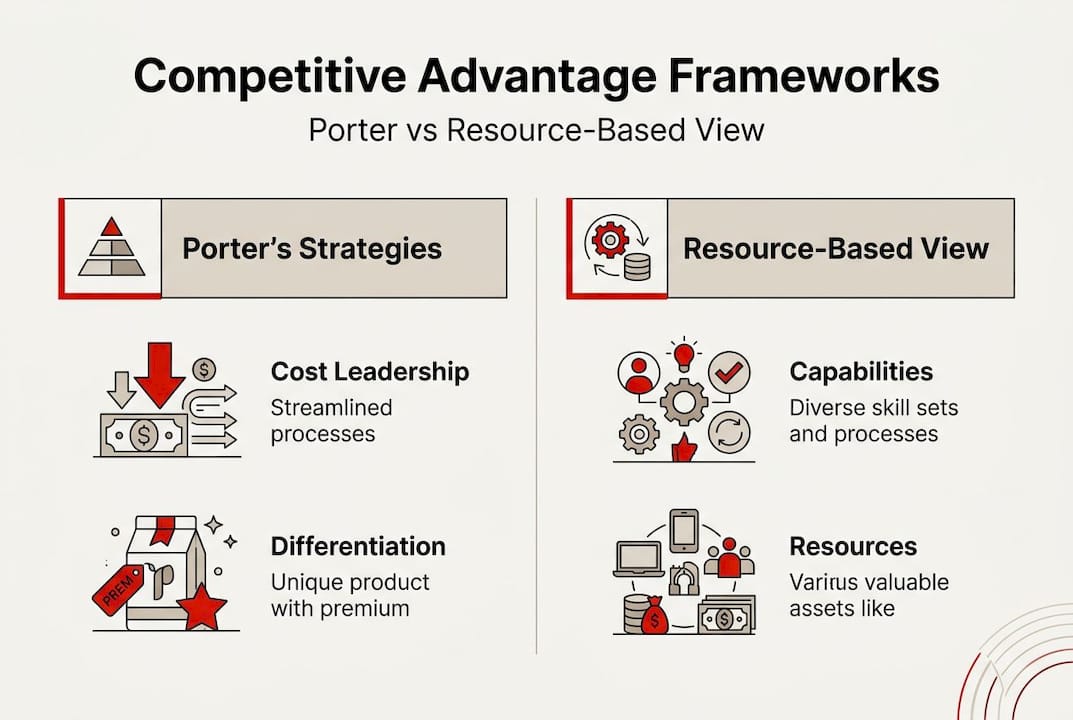
Two dominant frameworks help business leaders analyze and build competitive advantage: Michael Porter’s generic strategies and the Resource-Based View. Understanding both perspectives provides a complete picture of how companies achieve superior market performance.
Porter identified three generic strategies that enable competitive advantage: cost leadership, differentiation, and focus. Cost leadership means achieving the lowest production and delivery costs in your industry, allowing you to undercut competitors on price while maintaining profitability. Walmart exemplifies this approach through sophisticated supply chain management and massive purchasing power. Differentiation involves creating products or services perceived as unique, allowing premium pricing. Apple demonstrates this through design excellence and ecosystem integration. Focus strategies target specific market segments, applying either cost or differentiation approaches to niche audiences.
The Resource-Based View takes a different angle, examining internal capabilities rather than external market positioning. This framework uses the VRIO criteria to evaluate resources: Valuable (does it help you exploit opportunities or neutralize threats?), Rare (do few competitors possess it?), Inimitable (is it costly or difficult for others to copy?), and Organized (is your company structured to capture its value?). Resources passing all four tests create sustained competitive advantage.
| Framework Aspect | Porter’s Generic Strategies | Resource-Based View |
|---|---|---|
| Primary focus | External market positioning | Internal capabilities and resources |
| Strategic question | Where should we compete? | What unique resources do we possess? |
| Advantage source | Market structure and positioning | Valuable, rare, inimitable resources |
| Implementation | Choose cost, differentiation, or focus | Develop and protect key resources |
| Typical metrics | Market share, pricing power | Resource uniqueness, capability gaps |
Modern competitive strategy increasingly recognizes that both views complement rather than contradict each other. Dynamic capabilities, which integrate these perspectives, emphasize organizational agility in rapidly changing markets. Companies need both clear external positioning and strong internal resources to sustain advantage in hypercompetitive environments.
Pro Tip: Avoid getting stuck in the middle by trying to simultaneously pursue cost leadership and differentiation. This strategic confusion typically results in higher costs than cost leaders and less differentiation than focused competitors. Choose your positioning clearly, then align all resources and decisions to support that choice.
The most successful organizations combine external positioning with internal resource development. They identify attractive market positions, then systematically build the capabilities needed to defend those positions. This dual focus appears in companies like Amazon, which leverages both cost efficiency through logistics excellence and differentiation through customer experience innovation. For businesses developing their approach, exploring best marketing strategy principles and digital marketing strategy 2026 trends can reveal positioning opportunities.
Enhancing competitive advantage through innovation and technology
Technology and innovation have become central to building and maintaining competitive advantage in 2026. Organizations that effectively leverage these tools consistently outperform rivals across profitability, growth, and market positioning metrics.

Artificial intelligence delivers measurable competitive benefits. Research shows AI-enhanced competitive intelligence increases profitability by 18-22% compared to traditional approaches. This advantage stems from superior market sensing, faster strategic adaptation, and more accurate competitive positioning. Companies using AI for competitive analysis identify emerging threats earlier, spot market opportunities faster, and make more informed strategic decisions.
Engineering excellence provides even more dramatic advantages. Organizations with strong engineering capabilities generate 3.2x higher revenue growth and maintain competitive positioning 40% longer than peers. This advantage compounds over time as technical capabilities become deeply embedded in products, processes, and organizational culture. Technical excellence creates barriers that competitors cannot quickly overcome, even with significant investment.
| Technology Factor | Competitive Impact | Sustainability |
|---|---|---|
| AI-enhanced intelligence | 18-22% profitability increase | Medium (2-3 years before commoditization) |
| Engineering excellence | 3.2x revenue growth, 40% longer positioning | High (deeply embedded capabilities) |
| Innovation capability | Mediates advantage through performance | High (continuous renewal) |
| Digital infrastructure | Enables rapid scaling and adaptation | Medium (requires ongoing investment) |
Innovation serves as a critical mediator between strategy and competitive advantage. Studies of small and medium enterprises demonstrate that innovation mediates competitive advantage through improved organizational performance. Companies that consistently innovate adapt faster to market changes, deliver superior customer value, and create new revenue streams that competitors struggle to match.
However, technology adoption carries risks. Over-reliance on data and algorithms can create blind spots, particularly in uncertain or rapidly evolving markets. Companies must balance technological capabilities with human judgment, maintaining focus on factors they can control and verify. Excessive algorithmic dependence sometimes leads to strategic myopia, where organizations optimize for measurable metrics while missing broader competitive shifts.
Pro Tip: When investing in technology for competitive advantage, prioritize controllability and reliability over sophistication. The most powerful competitive tools are those you deeply understand, can adapt quickly, and integrate seamlessly with existing capabilities. Avoid chasing every new technology trend without clear strategic alignment.
Successful technology deployment requires alignment with broader business strategy. Understanding the role of AI in business, tracking AI trends 2026, and managing AI-generated content effectively all contribute to building sustainable technological advantages. The key is integrating these tools into coherent strategies rather than treating them as isolated initiatives.
Consider these practical applications of technology for competitive advantage:
- Predictive analytics identifying customer needs before competitors recognize emerging trends
- Automation reducing costs while improving quality and consistency
- Personalization engines delivering customized experiences at scale
- Advanced engineering creating products competitors cannot easily replicate
- Digital platforms enabling network effects that strengthen with growth
Practical steps to build and sustain your competitive advantage
Building competitive advantage requires deliberate action, not wishful thinking. Follow these practical steps to assess your current position and systematically strengthen your competitive standing.
- Conduct an honest competitive assessment. Map your current position against key rivals across dimensions that matter to customers: price, quality, features, service, convenience, and brand perception. Identify where you genuinely excel and where you lag. This clarity prevents self-deception about your actual competitive standing.
- Choose your strategic positioning explicitly. Decide whether you’ll compete primarily on cost efficiency, unique differentiation, or focused specialization. This choice should reflect both market opportunities and your organizational capabilities. Communicate this positioning clearly throughout your organization so every decision supports the chosen strategy.
- Apply VRIO analysis to your resources. Systematically evaluate your key assets, capabilities, and resources using the VRIO framework. Identify which resources create temporary advantages and which have potential for sustained differentiation. Focus investment on developing and protecting resources that score highly across all four VRIO dimensions.
- Build innovation capabilities systematically. Create processes for generating, evaluating, and implementing new ideas. Business strategies impact competitive advantage through innovation and performance, particularly in smaller organizations where agility provides natural advantages. Establish clear metrics linking innovation activities to business outcomes.
- Leverage technology strategically. Identify specific competitive gaps that technology can address, then invest deliberately in solutions aligned with your strategic positioning. Avoid technology for its own sake. Every digital investment should strengthen your chosen competitive advantage or build new defensible capabilities.
- Monitor and adapt continuously. Competitive advantage erodes over time as rivals copy successful strategies and markets evolve. Establish regular reviews of your competitive position, tracking both your performance and competitor moves. Adapt your strategy before erosion becomes crisis.
Sustaining advantage requires protecting what makes you unique while continuously improving. Build organizational capabilities that are difficult to replicate: deep customer relationships, proprietary knowledge, cultural attributes, or network effects. These intangible assets often provide more durable advantages than easily copied operational practices.
Key practices for maintaining competitive advantage:
- Invest continuously in employee development to build unique organizational capabilities
- Protect intellectual property and proprietary processes through appropriate legal mechanisms
- Strengthen customer relationships through personalized service and loyalty programs
- Monitor competitor moves without becoming reactive or losing strategic focus
- Reinvest profits in strengthening core advantages rather than diversifying prematurely
Digital marketing and social media have become essential tools for building and communicating competitive advantage. Exploring personalized learning tactics and implementing effective social media business growth strategy approaches help organizations reach target audiences, demonstrate unique value, and build communities around their brands. These channels provide cost-effective ways to establish thought leadership and differentiate from competitors.
Remember that competitive advantage is never permanent. Markets evolve, customer preferences shift, and new competitors emerge with innovative approaches. The goal is not achieving perfect, eternal advantage but rather building organizational capabilities for continuous adaptation and renewal. Companies that embrace this mindset treat competitive strategy as an ongoing process rather than a one-time decision.
Enhance your competitive edge with TechMoths solutions
Building sustainable competitive advantage requires more than theoretical knowledge. It demands practical tools, strategic insights, and continuous learning adapted to your specific market context.
TechMoths offers comprehensive resources to help organizations strengthen their competitive positioning through education, strategic thinking, and practical implementation guidance. Whether you’re developing internal capabilities, exploring new market opportunities, or adapting to rapidly changing competitive landscapes, our platform provides actionable insights tailored to business leaders and entrepreneurs.
Explore our personalized learning tactics to build organizational capabilities that competitors cannot easily replicate. Discover strategies for addressing access to different levels of education to develop your team’s strategic thinking. Learn how to identify education opportunities in turbulent times that strengthen your competitive position even during market uncertainty. Our content helps you translate competitive advantage concepts into concrete actions that drive measurable business results.
Frequently asked questions
What is the difference between cost leadership and differentiation?
Cost leadership means achieving the lowest production and delivery costs in your industry, enabling competitive pricing while maintaining profitability. Differentiation involves creating products or services with unique features that customers value enough to pay premium prices. Cost leadership works best in price-sensitive markets with standardized products, while differentiation succeeds when customers prioritize quality, features, or brand over price. Attempting both simultaneously typically fails because cost reduction often compromises the investments needed for differentiation, leaving you stuck in the middle with neither advantage.
How can small businesses apply the VRIO framework effectively?
Small businesses should use the VRIO framework as a diagnostic tool to identify and protect unique internal resources. Start by listing your key assets, capabilities, and resources, then systematically evaluate each using the four criteria: valuable, rare, inimitable, and organized. Focus investment on resources scoring high across all dimensions, as these create sustained competitive advantage. Small businesses often find advantage in customer relationships, specialized knowledge, or operational flexibility rather than scale-dependent resources. The framework helps prioritize limited resources toward capabilities that genuinely differentiate you from competitors.
What risks should companies watch for when relying on AI for competitive advantage?
Excessive dependence on AI and algorithms can lead to strategic blind spots, particularly in uncertain or rapidly evolving markets. AI over-reliance creates algorithmic myopia, where companies optimize measurable metrics while missing broader competitive shifts or customer needs that data doesn’t capture. Maintain balance by combining AI insights with human judgment, focusing on factors you can control and verify. Ensure AI systems align with your strategic positioning rather than dictating strategy based solely on data patterns. The most effective approach integrates AI as a tool supporting human decision-making, not replacing strategic thinking entirely.
How long does competitive advantage typically last?
Competitive advantage duration varies dramatically based on industry dynamics, the source of advantage, and competitive intensity. Advantages based on easily copied operational practices may last only months, while those rooted in proprietary technology, strong brands, or unique organizational capabilities can persist for years or decades. Most advantages erode gradually as competitors learn, adapt, and innovate. The key is building renewable advantages through continuous innovation and capability development rather than expecting any single advantage to provide permanent protection. Organizations should plan for 2-3 year advantage cycles in fast-moving industries, longer in stable sectors with high barriers to entry.
