

Role of Data Analytics: Transforming Business Decisions

Many professionals believe data analytics is just about crunching numbers or creating reports, but that view falls short of its real power. The difference between simple data collection and true analytics can shape how organizations solve problems and make decisions. This article clarifies what data analytics truly involves, uncovers common myths, and shows how evidence-based analysis leads to smarter strategies and stronger performance across industries.
Table of Contents
- Defining Data Analytics And Common Misconceptions
- Major Types Of Data Analytics Explained
- How Data Analytics Drives Decision-Making
- Real-World Use Cases Across Industries
- Risks, Challenges, And Best Practices For Analysts
Key Takeaways
| Point | Details |
|---|---|
| Understanding Data Analytics | Data analytics is about analyzing data to derive insights, not just reporting numbers. It requires ongoing examination and context for informed decision-making. |
| Transforming Decision-Making | Leveraging analytics enables evidence-based strategies, allowing organizations to transition from intuition-driven decisions to data-driven insights. |
| Types of Data Analytics | Familiarizing yourself with descriptive, diagnostic, predictive, and prescriptive analytics helps tailor your approach and aligns insights with specific business needs. |
| Prioritizing Data Quality | Ensuring high-quality data through regular audits and integration is crucial, as poor data leads to unreliable insights and misguided decisions. |
Defining Data Analytics and Common Misconceptions
Data analytics sounds simple on the surface, but many professionals misunderstand what it actually involves. Let’s clarify what it is and debunk the myths holding back organizations.
What Data Analytics Really Is
Data analytics is the process of analyzing data to identify trends and insights that inform decision-making. It goes far beyond simply collecting numbers or generating reports. The field involves collecting, transforming, organizing, and interpreting data to draw meaningful conclusions and make predictions.
Think of it as detective work. You’re examining evidence, finding patterns, and building a case for action.
The Misconception Gap
Many organizations treat data analytics like a checkbox on their operational list. They assume collecting data automatically produces better decisions. That’s not accurate.
Misconceptions arise from a lack of understanding about how data is captured, processed, and linked. When teams don’t grasp data provenance and quality issues, they reach wrong conclusions and make costly mistakes.
Here are common myths that mislead teams:
- “More data equals better decisions” — Volume means nothing without quality and relevance
- “Analytics is just reporting” — Reporting shows what happened; analytics explains why and predicts what’s next
- “One analysis solves everything” — Data requires ongoing examination, not one-time snapshots
- “Analytics is only for big corporations” — Teams of any size benefit from structured data interpretation
- “The numbers speak for themselves” — Data requires context, domain knowledge, and critical thinking
Why This Distinction Matters
Your data analyst isn’t a report generator. They’re a strategist interpreting signals buried in your operational data. Understanding this difference transforms how you deploy analytics resources.
When leadership grasps what analytics actually is, they ask better questions. Instead of “What happened?” they ask “Why did it happen?” and “What should we do about it?”
Effective data analytics requires deep knowledge of data quality, provenance, and aggregation methods—not just access to raw numbers.
The Real Skill
True analytics professionals combine technical skills with business acumen. They understand statistics, tools, and databases. But they also translate findings into business language and challenge assumptions.
Data analysts spend as much time validating data sources as analyzing them. They question whether the data actually represents what leadership thinks it does.
Pro tip: Start by auditing your current data sources for quality and accuracy before investing in new analytics tools or hiring analysts—garbage data produces garbage insights regardless of sophistication.
Major Types of Data Analytics Explained
Data analytics isn’t one-size-fits-all. Organizations use different analytical approaches depending on what they need to understand. Knowing these four types helps you deploy analytics strategically.
The Four Core Types
The four major types of data analytics are descriptive, diagnostic, predictive, and prescriptive. Each answers a different business question and moves you closer to actionable insight. Think of them as a progression from understanding the past to shaping the future.
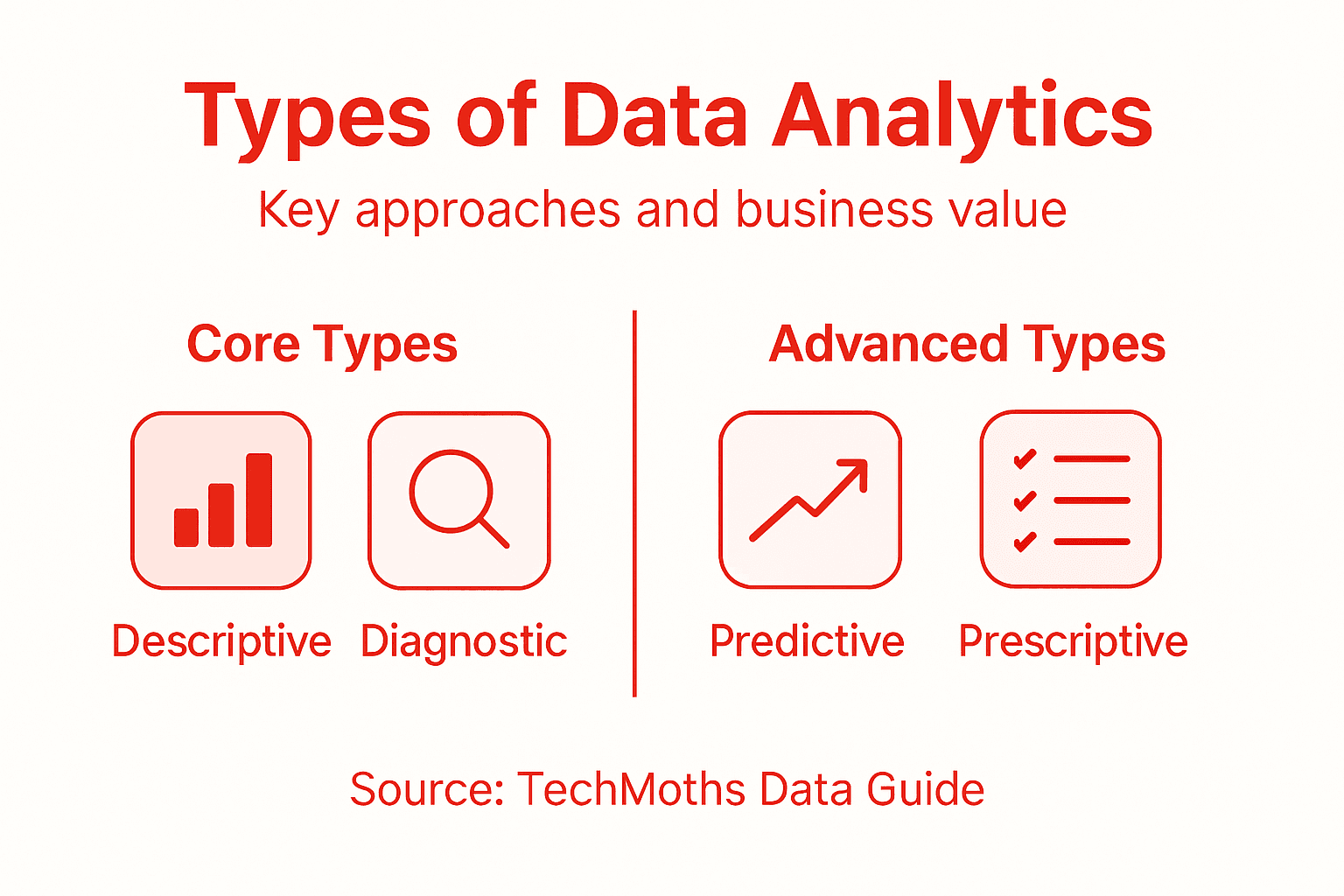
Descriptive analytics answers the most basic question: “What happened?” It summarizes historical events using dashboards, reports, and key metrics.

Diagnostic analytics goes deeper, asking “Why did it happen?” It investigates the causes behind those events, uncovering patterns and relationships in your data.
Predictive analytics forecasts “What will happen next?” using historical data and statistical models to anticipate future trends and outcomes.
Prescriptive analytics recommends “What should we do?” by suggesting specific actions based on predictions and business constraints.
Here’s a comparison of the four types of data analytics and how each supports business goals:
| Analytics Type | Key Question | Example Use | Business Value |
|---|---|---|---|
| Descriptive | What happened? | Monthly sales reporting | Historical tracking |
| Diagnostic | Why did it happen? | Root cause of revenue drop | Informed troubleshooting |
| Predictive | What will happen? | Sales forecasts for next quarter | Planning and preparation |
| Prescriptive | What should we do? | Promotion strategy adjustments | Optimized outcomes |
Why Each Type Matters
Your organization likely needs all four, but at different stages of maturity. Most teams start with descriptive—basic reporting on sales, traffic, or operations. That’s valuable but insufficient for competitive advantage.
Diagnostic work separates good analysts from great ones. They’re asking why your revenue dropped or why customer churn increased, not just observing that it happened.
Predictive and prescriptive analytics require more sophisticated skill and data quality. Here’s the progression most mature organizations follow:
- Level 1: Descriptive — Historical reporting and basic metrics
- Level 2: Diagnostic — Root cause analysis and pattern identification
- Level 3: Predictive — Forecasting and trend projection
- Level 4: Prescriptive — Recommendations and optimization
Practical Application
Consider a retail company. Descriptive analytics reveals sales dropped 15% last month. Diagnostic digs into inventory turnover, staffing, and marketing spend to find the cause. Predictive forecasts next quarter’s demand based on seasonal patterns. Prescriptive recommends adjusting inventory levels and promotional timing.
Data analysts who master all four types become strategists, not technicians.
Organizations that progress beyond descriptive analytics gain competitive advantages through forecasting accuracy and optimized decision-making.
Your team doesn’t need to implement all four immediately. Start with descriptive and diagnostic to build data literacy and quality. Then layer in predictive capabilities as your foundation strengthens.
Pro tip: Begin by mapping your current business questions to these four types—you’ll quickly identify which analytics capabilities create the most impact for your organization’s specific challenges.
How Data Analytics Drives Decision-Making
Data analytics doesn’t sit in a vacuum. Its real power emerges when organizations use insights to make better decisions faster. This is where analytics shifts from interesting to transformative.
From Uncertainty to Confidence
Traditional decision-making relied on intuition, experience, and guesswork. Leaders made calls based on gut feeling and hoped outcomes matched their predictions. That approach created risk and often missed opportunities.
Data analytics transforms decision-making by enabling evidence-based strategies in both public and private sectors. Instead of debating what might happen, you examine what actually did happen and what patterns suggest about the future.
This shift from intuition to evidence changes everything. Your decisions become defensible, repeatable, and measurable.
How Analytics Enables Better Decisions
Analytics drives decision-making through specific mechanisms. When you understand your data, you can allocate resources more effectively, identify operational inefficiencies, and respond to market changes faster than competitors.
Consider operational efficiency. Analytics reveals where time and money leak. Manufacturing companies spot production bottlenecks. Retail organizations identify underperforming locations. Service teams uncover which processes consume disproportionate resources.
Here’s how analytics supports decision-making across business functions:
- Strategy — Identify market opportunities and competitive threats before they become obvious
- Operations — Optimize workflows and eliminate waste through pattern identification
- Finance — Forecast revenue accurately and allocate budgets to high-impact initiatives
- Marketing — Target customers effectively by understanding preferences and behavior
- Human Resources — Reduce turnover by identifying flight risks and improving retention
The Performance Connection
Big data analytics capability significantly improves decision-making within organizations by uncovering patterns and operational insights that inform strategic choices. Better decisions lead directly to better results.
Organizations that embed analytics into their decision processes outperform those relying on intuition. The gap widens over time as data-driven organizations compound advantages through continuous learning.
Analytics transforms decision-making from a one-time event into a continuous cycle of learning and improvement.
Real-World Impact
Your data analyst isn’t producing reports for a shelf. They’re feeding decision-makers the intelligence needed to reduce risk and seize opportunities. Every insight should connect to a specific decision your organization faces.
When analytics works well, leaders stop asking “What should we do?” in isolation. They ask “Based on what our data shows, what should we do?”
Pro tip: Before requesting an analysis, define the decision it will inform—this focuses your analyst’s work and ensures the output actually drives action rather than generating interesting but unused insights.
Real-World Use Cases Across Industries
Data analytics isn’t theoretical. Every major industry applies it daily to solve concrete problems and drive measurable results. Understanding these real-world applications shows you what’s possible in your own organization.
Healthcare: Precision and Prevention
Hospitals and clinics use analytics to improve patient outcomes dramatically. Predictive models identify outbreak risks before they spread, allowing public health teams to intervene early. Physicians leverage precision medicine approaches that tailor treatments based on individual patient data rather than one-size-fits-all protocols.
Analytics also reveals which treatments work best for specific conditions, reducing trial-and-error approaches that waste time and resources.
Banking and Finance: Risk Management
Banks process millions of transactions daily. Without analytics, fraud detection becomes impossible. Modern banking relies on sophisticated algorithms that flag suspicious patterns instantly, protecting customers and reducing losses.
Beyond fraud, analytics helps banks understand customer behavior, optimize lending decisions, and identify which clients need specific services before they ask.
Retail: Inventory and Demand
Retailers manage complex supply chains across hundreds or thousands of locations. Analytics forecasts demand accurately, preventing overstocking and stockouts. When demand forecasting works well, customers find products when they want them, and retailers avoid waste.
Personalized marketing powered by analytics increases conversion rates and customer lifetime value. Retailers know which customers buy what, when, and why.
Government and Energy
Government agencies use analytics to enhance public services and improve election forecasting accuracy. The energy sector applies data analytics across operations to optimize grid management and accelerate renewable energy integration.
These applications show analytics extends far beyond business profit—it improves public welfare and environmental sustainability.
Cross-Industry Pattern
Every industry uses analytics similarly: collect data, identify patterns, make decisions, measure results. The context changes, but the methodology remains consistent.
- Healthcare — Patient outcomes, treatment efficacy, outbreak prevention
- Finance — Fraud detection, risk assessment, customer retention
- Retail — Inventory optimization, demand forecasting, personalization
- Energy — Grid efficiency, renewable integration, consumption patterns
- Government — Service delivery, resource allocation, policy effectiveness
Organizations turning data into action gain competitive advantages that compound over time as they refine their analytical capabilities.
Your industry faces similar challenges. Competitors are already using analytics. The question isn’t whether to adopt analytics—it’s how quickly you can implement it effectively.
Pro tip: Start by identifying your industry’s most critical business decision, then explore how peers in your sector use data to improve that specific outcome—this grounds your analytics strategy in proven, industry-validated use cases.
Risks, Challenges, and Best Practices for Analysts
Data analytics creates tremendous value, but it also introduces real risks. Analysts who understand these challenges and adopt best practices protect their organizations while maximizing analytical effectiveness.
The Data Quality Crisis
Garbage in, garbage out. That old saying still holds true. Poor data quality undermines everything analysts build. When source data contains errors, duplicates, or inconsistencies, conclusions become unreliable regardless of analytical sophistication.
Data silos compound the problem. Different departments collect data independently without integration or coordination. This fragmentation creates blind spots and prevents analysts from seeing the complete picture.
Security and Privacy Concerns
Data breaches damage organizations financially and reputationally. Analysts handle sensitive information—customer data, financial records, personal health information. Protecting this data isn’t optional.
Beyond security, analysts face ethical responsibilities. Public sector analysts must balance transparency with confidentiality and ensure fairness in interpretation. They safeguard privacy while maintaining public trust. This tension exists across all sectors.
Misusing data or reaching biased conclusions harms people and institutions.
Common Challenges Analysts Face
Understanding obstacles helps you navigate them effectively:
- Data integration — Connecting disparate sources without losing quality or context
- Asking right questions — Unclear business problems lead to irrelevant analyses
- Stakeholder alignment — Different leaders want different answers from the same data
- Resource constraints — Insufficient tools, budget, or team expertise
- Interpretation bias — Confirmation bias leads analysts to see patterns they expect
- Communication gaps — Technical findings don’t translate to business language
Best Practices That Work
Successful analysts adopt consistent practices. Start with strong data governance—establish standards for collection, storage, and usage. Know your data sources deeply before analyzing them.
Leverage cloud computing infrastructure. Modern cloud platforms scale efficiently, improve security, and reduce maintenance burden compared to on-premises systems.
Foster a culture of data literacy across your organization. When leaders and team members understand data basics, they ask smarter questions and trust findings more readily.
Analysts who combine technical skill with business acumen and ethical awareness become indispensable strategic partners.
Always validate assumptions. Challenge your own conclusions before presenting them. Seek alternative explanations for patterns you discover.
Below is a summary of top risks and best practices for data analysts:
| Risk Area | Potential Impact | Best Practice | Benefit |
|---|---|---|---|
| Data Quality | Unreliable insights | Regular audits | Increased trust |
| Data Silos | Incomplete analysis | Cross-department integration | Comprehensive view |
| Security | Financial and reputational loss | Strong security protocols | Customer protection |
| Interpretation Bias | Misguided decisions | Assumptions validation | Objective recommendations |
| Communication Gaps | Actionable insights lost | Business-focused reporting | Increased stakeholder buy-in |
The Continuous Learning Requirement
Data analytics evolves constantly. Tools change. Regulations shift. Ethical standards develop. Analysts must commit to ongoing learning and professional development.
Staying current with industry trends, regulatory changes, and methodological advances separates competent analysts from exceptional ones.
Pro tip: Implement a data quality audit before starting major analyses—spending two hours validating sources prevents weeks of wasted work on flawed conclusions.
Unlock the True Potential of Data Analytics for Smarter Decisions
The article highlights a critical challenge many organizations face: treating data analytics as just reporting rather than a strategic tool to transform business decisions. You may be struggling with questions like how to move from descriptive insights to predictive and prescriptive analytics or how to ensure data quality and proper interpretation that truly drives action. Understanding the four core types of data analytics and overcoming common pitfalls is essential to gain a competitive advantage and make confident, evidence-based decisions.
At TechMoths, we provide a diverse range of expert articles and practical guides that help bridge the gap between complex analytics concepts and real-world application. Whether you want to explore strategies for improving data quality, grasp predictive analytics methods, or learn how analytics can reshape business and lifestyle choices, our platform offers well-researched content to empower your next decision.
Don’t wait to let outdated assumptions hold you back. Step into the future of decision-making with insights that matter. Visit TechMoths now to explore actionable analytics knowledge and discover how to leverage data effectively. Your smarter business decisions start here.
Frequently Asked Questions
What is data analytics and why is it important for businesses?
Data analytics is the process of analyzing data to identify trends and insights that inform decision-making. It helps businesses understand their operations, forecast future trends, and make data-driven decisions, leading to competitive advantages.
What are the main types of data analytics used in organizations?
The main types of data analytics are descriptive, diagnostic, predictive, and prescriptive. Each type addresses different business questions and assists organizations in understanding past performance, identifying reasons behind results, forecasting future events, and making recommendations for action.
How can data analytics improve decision-making processes?
Data analytics transforms decision-making by providing evidence-based insights. It enables organizations to identify patterns, allocate resources effectively, and respond quickly to market changes, thereby reducing risks and optimizing outcomes.
What challenges do analysts face when working with data analytics?
Analysts encounter challenges such as data quality issues, data integration from disparate sources, interpretation bias, and communication gaps between technical findings and business language. Addressing these challenges is crucial for effective data analysis.
Recommended
- Enterprise Analytics: Create your Business Strategy Now
- Defining Digital Transformation: Keys to Business Impact
- The Role of AI Algorithms in Marketing Recommendation Engines
- Business Agility: Improving Team Outcomes Globally
- Rolle von Datenanalyse im Kundenservice – Mehr Effizienz und persönliche Betreuung | aLIVE Support
