

Streamline employee onboarding: boost retention 82%

Replacing a new hire who leaves within the first 90 days can cost up to twice their annual salary, yet most tech companies still rely on ad hoc onboarding that leaves new employees confused and disconnected. Poor onboarding drives 20-39% early turnover within the first 45 to 180 days, a staggering loss for teams already stretched thin. The good news is that a structured, streamlined onboarding process directly addresses this problem. This guide gives HR professionals and team leaders in tech a practical, research-backed roadmap to reduce early attrition, accelerate ramp-up time, and build genuine engagement from day one.
Table of Contents
- Why streamlining onboarding matters
- Key elements of a streamlined onboarding process
- Tools and automation: Cutting admin time and speeding results
- Personalization and the human touch: Balancing tech with connection
- Measuring success: Key onboarding metrics and troubleshooting
- Enhance your onboarding with TechMoths resources
- Frequently asked questions
Key Takeaways
| Point | Details |
|---|---|
| Automate repetitive tasks | Using technology for admin tasks can cut HR time by 70% and boost new hire productivity quickly. |
| Personalize and connect | Adding buddy systems and role-based pathways increases retention and engagement in tech teams. |
| Track the right metrics | Retention, time-to-productivity, and early turnover rates are the best indicators of onboarding success. |
| Balance tech and human touch | Combine automated tools with manager check-ins, team integration, and mentorship for the best results. |
Why streamlining onboarding matters
Streamlined onboarding is not just a faster version of traditional onboarding. It is a deliberately designed system that replaces scattered paperwork, inconsistent manager introductions, and one-size-fits-all orientation sessions with coordinated workflows, clear milestones, and measurable outcomes. Traditional onboarding often dumps too much information on new hires in the first week and then goes silent for months. That silence is expensive.
The data is hard to ignore. Companies with structured onboarding programs see 50-82% higher new hire retention and 50-70% greater productivity compared to those without. For a tech company hiring 50 engineers a year, even a 10% improvement in retention translates to millions saved in recruiting and lost productivity costs. Good HR management for startups starts with recognizing that onboarding is not an HR formality but a strategic investment.
Here is what a streamlined onboarding process delivers:
- Higher retention: New hires who feel prepared and connected stay longer.
- Faster productivity: Structured learning paths cut time-to-contribution significantly.
- Stronger engagement: Clear expectations and early wins build confidence and commitment.
- Lower HR burden: Automation and templates free up your team for high-value work.
- Better culture fit: Intentional culture exposure reduces early misalignment.
Understanding the employee onboarding essentials that drive these outcomes is the first step toward building a process that actually works.
Key elements of a streamlined onboarding process
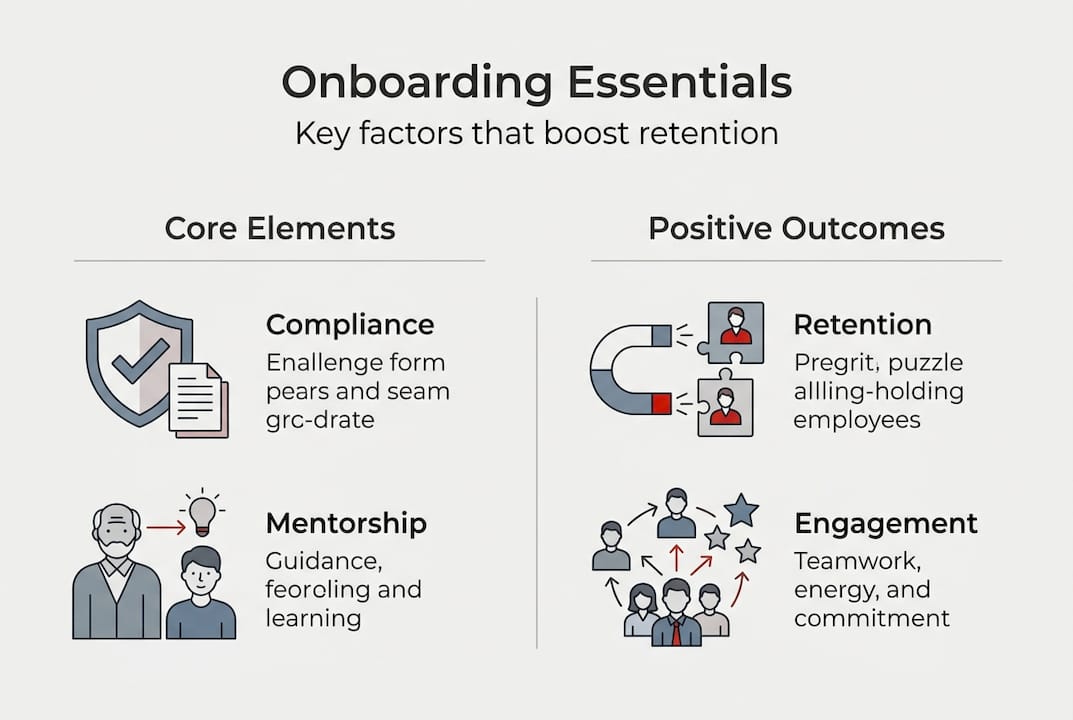
With clear benefits in mind, it is crucial to break onboarding into elements you can optimize. The most effective framework used by high-performing HR teams is the Five Cs model: Compliance, Clarification, Culture, Connection, and Check-ins. Each C addresses a distinct need, and neglecting even one creates gaps that erode the new hire experience.
Compliance covers legal paperwork, policy acknowledgments, and IT setup. This is where automation shines. Clarification ensures the employee understands their role, goals, and success metrics. Culture introduces company values, norms, and unwritten rules that make or break belonging. Connection builds relationships with teammates, managers, and cross-functional partners. Check-ins create feedback loops that catch problems before they become resignations.
Onboarding should also follow a structured timeline. Best-in-class onboarding lasts up to 12 months, with the first week being the most critical for training and first impressions. A phased approach works best: preboarding before the start date, a focused Day 1 experience, and formal 30, 60, and 90-day check-ins followed by a 12-month review.
| Element | Traditional onboarding | Streamlined onboarding |
|---|---|---|
| Paperwork | Manual, day-of signing | Digital, completed before Day 1 |
| Role clarity | Informal manager briefing | Written goals and 30/60/90-day plan |
| Culture exposure | One-time orientation | Ongoing touchpoints over 12 months |
| IT setup | Reactive, often delayed | Automated provisioning pre-start |
| Feedback | Annual review | 30, 60, 90-day structured check-ins |
| Buddy system | Rare or informal | Assigned and structured |
Pro Tip: Build a customized onboarding checklist for each role and department. A software engineer’s Day 1 looks very different from a product manager’s, and generic checklists create confusion rather than clarity. Explore all-in-one staffing tools that let you template and automate these role-specific workflows at scale.
Tools and automation: Cutting admin time and speeding results
Once you have mapped the key onboarding components, the next step is eliminating bottlenecks with the right tools. Manual onboarding is a productivity killer. HR teams spend hours chasing signatures, coordinating IT tickets, and resending the same welcome emails. Automation changes that equation fast.

Automating administrative tasks like paperwork, IT provisioning, and preboarding can reduce HR admin time by 70% and speed time-to-productivity by 50%. That means your HR team gets back roughly a full workday per new hire, and new employees start contributing weeks earlier. The right stack of essential HR tech tools makes this possible without a massive budget.
| Task | Time before automation | Time after automation |
|---|---|---|
| Paperwork collection | 3-4 hours per hire | 20 minutes (digital forms) |
| IT provisioning | 1-2 days | Same day or pre-start |
| Benefits enrollment | 2-3 hours | 30-45 minutes (self-service portal) |
| Welcome communications | 1 hour per hire | Automated sequences |
| Training assignment | Manual, 1-2 hours | Instant, rule-based assignment |
Here is a step-by-step approach to automating your onboarding:
- Map your current process and identify every manual handoff or repeated task.
- Integrate your ATS and HRIS so new hire data flows automatically without re-entry.
- Set up e-signature workflows for offer letters, NDAs, and policy documents.
- Automate IT provisioning by triggering equipment orders and software access on acceptance.
- Build preboarding sequences that send welcome messages, forms, and first-week schedules before Day 1.
- Connect your learning management system to auto-assign role-specific training modules.
- Schedule automated check-in reminders for managers at 30, 60, and 90 days.
Going paperless in your onboarding process is not just an efficiency move. It also creates an audit trail and reduces compliance risk. For distributed teams, remote onboarding tools that support async communication and virtual introductions are non-negotiable.
Pro Tip: Do not roll out automation company-wide on day one. Pilot it in one department, gather feedback from both HR and new hires, then iterate before scaling. This prevents a bad experience from becoming a company-wide problem.
Personalization and the human touch: Balancing tech with connection
Technology is powerful, but real engagement comes from making onboarding personal and relational. A new hire who receives automated emails but never has a real conversation with their manager or team will disengage fast, regardless of how slick the software is.
Personalization starts with recognizing that your workforce is not uniform. Remote employees need virtual coffee chats and digital culture moments. Hybrid employees need clarity on when and how to show up. Senior hires need strategic context, while junior hires need more hands-on guidance. Branching your onboarding workflows by role, level, and location prevents the information overload that kills early engagement.
Here are practical ways to personalize onboarding at scale:
- Role-based task lists that reflect actual job responsibilities from week one.
- Chunked information delivery so new hires receive content in digestible weekly segments rather than all at once.
- Personalized welcome videos from direct managers recorded before the start date.
- Custom learning paths tied to the skills gaps identified during hiring.
- Location-specific logistics for remote, hybrid, and in-office employees.
The buddy system is one of the highest-ROI investments in onboarding. Peer mentoring improves retention by 20% when buddies are assigned intentionally and given a clear structure for their interactions. A buddy is not just a friendly face. They are a psychological safety net who answers the questions new hires are too nervous to ask their manager.
“Assigning buddies and scheduling key connections to build relationships is one of the most cost-effective retention strategies available to HR teams.”
For guidance on structuring these relationships effectively, explore these mentor pairing tips that apply directly to onboarding contexts.
Measuring success: Key onboarding metrics and troubleshooting
After rolling out improved onboarding, close the loop by measuring outcomes and fixing what is not working. You cannot optimize what you do not measure, and most HR teams track too few metrics to catch problems early.
Poor onboarding leads to 20-39% early turnover within 45 to 180 days, and the median time-to-productivity sits at 65 days. Both numbers are movable with the right tracking. Start with these core metrics:
- 90-day retention rate: The clearest signal of onboarding effectiveness.
- Time-to-productivity: How long before a new hire reaches full contribution? Track by role.
- New hire satisfaction score: A simple 5-question survey at 30 and 90 days reveals friction fast.
- Early turnover rate: Resignations within the first six months signal systemic onboarding gaps.
- Manager satisfaction: Are managers getting the support they need to onboard their direct reports?
Common onboarding pitfalls include information overload in week one, lack of structured feedback loops, and siloed processes where HR, IT, and hiring managers do not coordinate. Each of these is fixable with process design, not just better intentions. Resources on measuring success for startups offer frameworks that translate well to onboarding metrics.
Pro Tip: Run brief exit interviews at the 30-day and 90-day marks, not just when someone resigns. These conversations surface confusion, unmet expectations, and cultural friction while there is still time to act. Pair this data with strategies from building a strong team to address root causes rather than symptoms.
For teams looking to benchmark their retention outcomes against industry standards, employee retention solutions provide additional context and tools for continuous improvement.
Enhance your onboarding with TechMoths resources
Building a world-class onboarding process is an ongoing effort, not a one-time project. TechMoths has a growing library of guides designed to support HR professionals and team leaders at every stage of that journey.
From HR management advice that covers the fundamentals of building people-first processes, to career development steps that help you support new hires beyond their first 90 days, TechMoths connects you with practical, actionable content. If you want to future-proof your onboarding for a digitally fluent workforce, the guide on digital literacy for onboarding is a smart next read. Explore these resources to keep your onboarding sharp, your team engaged, and your retention numbers moving in the right direction.
Frequently asked questions
What are the biggest time wasters in traditional onboarding?
Manual paperwork, repetitive admin tasks, and uncoordinated IT provisioning are the main sources of delay, often consuming several hours of HR time per new hire that automation can eliminate.
How long should a structured onboarding process last?
Best-in-class onboarding lasts up to 12 months, with the first week being the most critical period for training, role clarity, and first impressions.
What is the impact of peer mentorship in onboarding?
Assigning buddies or mentors with a clear structure can improve new hire retention by 20%, making it one of the simplest and most cost-effective onboarding investments available.
Which metrics should we track to ensure onboarding success?
Monitor 90-day retention, time-to-productivity, new hire satisfaction scores, and early turnover within the first six months. The median time-to-productivity is 65 days, so tracking progress against that benchmark reveals whether your process is working.
