

Strategic networking drives 70% of career growth in 2026

Most professionals believe their closest friends hold the key to their next job opportunity. Research reveals a surprising truth: acquaintances and distant contacts deliver far more valuable job leads than your inner circle. Understanding how to build and leverage these connections strategically can transform your career trajectory in ways traditional job searching never could. This article explores the science behind effective networking, reveals why weak ties outperform strong relationships in job searches, and provides actionable strategies to expand your professional network for maximum career advancement in 2026.
Table of Contents
- Why Networking Is Essential For Career Advancement
- Understanding Weak Ties And Their Power In Job Searching
- Practical Strategies For Expanding And Leveraging Your Professional Network
- Applying Networking Strategies For Career Success In 2026
- Boost Your Career With Personalized Learning And Soft Skills Training
- What Are The Best Ways To Build A Strong Professional Network?
- Why Are Weak Ties More Valuable Than Strong Ties In Job Searches?
- How Can Professionals Maintain Effective Networks In Remote Work Environments?
- How Do Informational Interviews Help Career Advancement?
- What Role Does Authenticity Play In Successful Networking?
Key takeaways
| Point | Details |
|---|---|
| Network access to jobs | Professional connections unlock 70-85% of job opportunities that never appear on public boards. |
| Weak ties advantage | Distant acquaintances provide novel job information from non-overlapping social circles more effectively than close friends. |
| Active engagement matters | Regular event participation, mentorship involvement, and informational interviews systematically expand your professional reach. |
| Industry insights value | Informational interviews deliver critical insider knowledge that accelerates career transitions and role understanding. |
| Strategic approach wins | Value-driven networking combined with authentic relationship building produces sustainable career advancement results. |
Why networking is essential for career advancement
The professional landscape has fundamentally shifted. While job boards and online applications dominate the visible job market, 70-85% of positions are filled through networking rather than traditional application processes. This statistic reveals a hidden employment ecosystem where relationships determine access to opportunities before they become publicly available. For professionals and recent graduates, understanding this reality transforms how you approach career development.
Networking extends beyond initial job placement. Research shows networking increases chances of earning promotions and achieving higher salary growth throughout your career. The professionals who actively cultivate diverse connections consistently outperform equally qualified peers who rely solely on merit and hard work. Your network becomes a strategic asset that compounds value over time, opening doors to mentorship, partnerships, and advancement opportunities invisible to those outside your professional circles.
Recent graduates face particular challenges entering competitive job markets. Without established professional relationships, traditional application methods yield frustratingly low response rates. Strategic networking addresses this gap by creating pathways to decision makers and hiring managers who can advocate for your candidacy. Following proven career development steps while simultaneously building your network creates a powerful combination for breaking into desired industries and roles.
The return on networking investment compounds exponentially. Each meaningful connection potentially links you to hundreds of secondary contacts within their networks. This multiplier effect explains why professionals with modest but strategically cultivated networks often access superior opportunities compared to those with larger but poorly maintained contact lists. Quality and intentionality matter far more than quantity.
Pro Tip: Schedule 30 minutes weekly specifically for networking activities like reaching out to former colleagues, commenting thoughtfully on industry posts, or requesting informational interviews. Consistency builds momentum that sporadic efforts never achieve.
Understanding weak ties and their power in job searching
Sociologist Mark Granovetter’s groundbreaking research challenged conventional wisdom about job searching. His studies demonstrated that weak ties provide more novel job opportunities than strong ties by connecting different social circles. Your close friends and family typically know the same people you know, creating information redundancy. Acquaintances from different contexts, former colleagues, or industry contacts operate in distinct social spheres with access to completely different job information.
This principle explains why the person who helps you land your next role often surprises you. The college acquaintance you barely remember, the former coworker from three jobs ago, or the industry contact you met once at a conference possesses information your inner circle lacks. Their weak connection to you becomes their strength, bridging otherwise disconnected networks and delivering opportunities you would never discover independently.
Network composition significantly impacts career outcomes, particularly for women in leadership. Studies reveal that gender composition and communication patterns predict women’s leadership success more reliably than individual qualifications alone. Women with networks featuring diverse connections and balanced communication patterns advance faster than those with homogeneous or imbalanced networks. Understanding these dynamics allows you to deliberately construct networks that support your specific career goals.

Remote work environments present unique challenges for building weak ties. The casual hallway conversations, lunch meetings, and after-work gatherings that naturally created weak ties in office settings require intentional recreation in distributed teams. Professionals must now deliberately schedule virtual coffee chats, participate in online industry communities, and attend digital networking events to replicate the relationship building that previously happened organically. Addressing remote work challenges includes proactively creating opportunities for weak tie formation.
Digital platforms enable weak tie cultivation at unprecedented scale. LinkedIn, industry forums, and professional communities allow you to maintain hundreds of weak tie relationships with minimal time investment. Regular engagement through thoughtful comments, sharing relevant resources, and occasional direct messages keeps you visible within extended networks. Learning to monitor your work network ensures you maintain these valuable connections systematically.
Pro Tip: Reconnect with three dormant weak ties monthly by sharing an article relevant to their interests or congratulating them on recent achievements. These low-pressure touchpoints keep relationships warm without requiring significant time commitments.
Practical strategies for expanding and leveraging your professional network
Informational interviews represent one of the most underutilized networking tools available to professionals. These conversations involve reaching out to individuals in roles or industries you find interesting and requesting 20-30 minutes to learn about their career path and insights. Informational interviews provide crucial industry insights for career transitions by revealing unwritten rules, skill requirements, and cultural expectations that job descriptions never capture. The knowledge gained accelerates your preparation and helps you speak credibly about target roles.
The process follows a straightforward framework:
- Identify professionals whose career trajectories align with your interests through LinkedIn searches or industry directories.
- Craft personalized outreach messages explaining your genuine interest in their work and requesting a brief conversation.
- Prepare thoughtful questions focusing on their experiences, challenges, and advice rather than asking for jobs.
- Follow up with thank you notes and periodic updates on how you applied their guidance.
- Offer value in return by sharing relevant articles, making introductions, or providing assistance within your capabilities.
Industry events and professional associations create concentrated networking opportunities. Regular attendance at professional events and mentorship programs systematically expands your network by placing you in environments filled with like-minded professionals. Conferences, workshops, and association meetings attract individuals invested in their professional development, creating natural common ground for relationship building. Consistent participation over time transforms you from outsider to recognized community member.
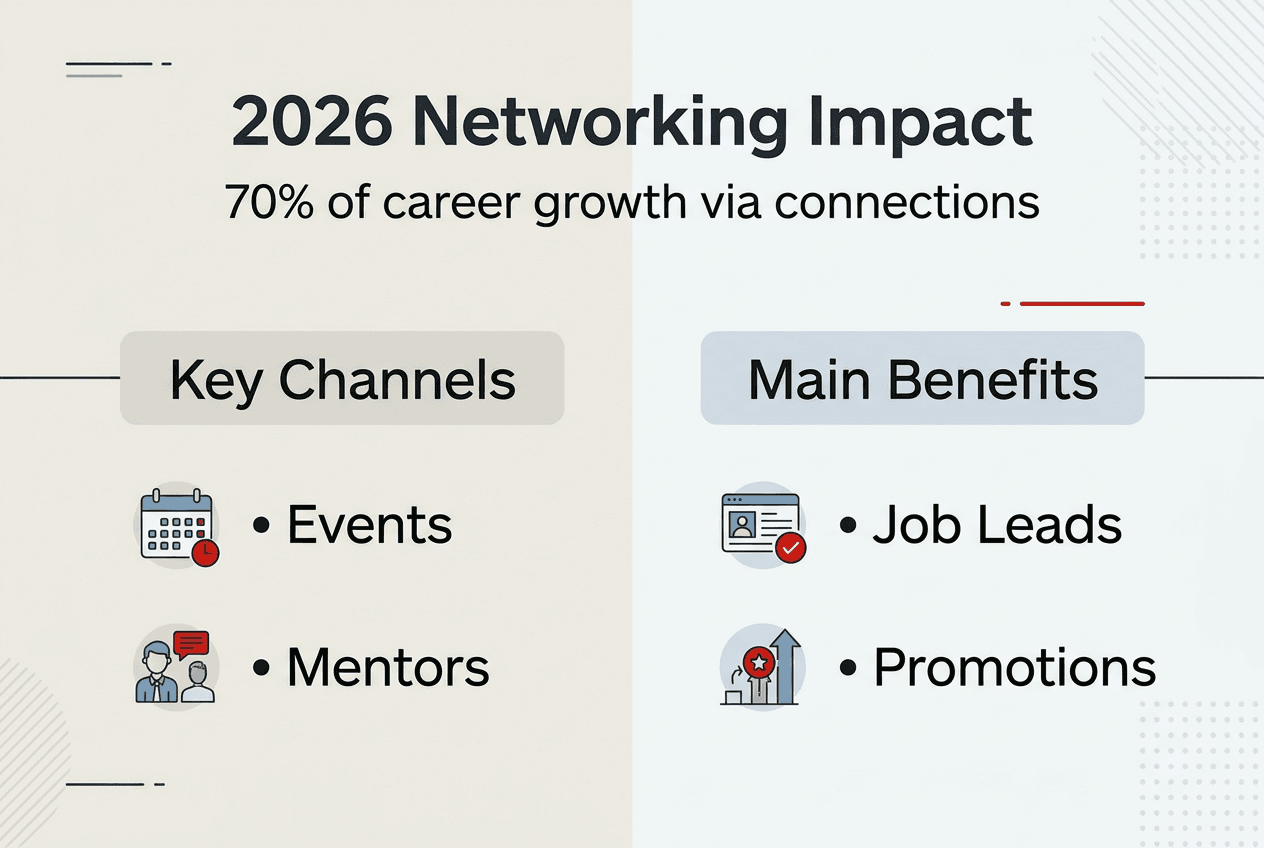
Mentorship programs offer structured networking with built-in accountability. Formal mentorship relationships provide regular touchpoints with experienced professionals while simultaneously connecting you to their extended networks. Many mentors willingly make introductions to their contacts when they see genuine commitment and progress from mentees. These programs also position you as someone serious about growth, enhancing your professional reputation within your industry.
Digital relationship maintenance requires systematic approaches in remote work environments. Calendar reminders for quarterly check-ins, using customer relationship management tools to track conversations, and setting aside dedicated networking time prevents relationships from atrophying. Professionals navigating career pivot strategies particularly benefit from maintaining diverse networks that span multiple industries and functions. When preparing career change resume tips, these connections provide insider perspectives on what hiring managers in new fields prioritize.
| Strategy | Time Investment | Primary Benefit | Best For |
|---|---|---|---|
| Informational Interviews | 2-3 hours monthly | Industry insights and direct connections | Career transitions |
| Industry Events | 4-8 hours quarterly | Broad network expansion | Building visibility |
| Mentorship Programs | 2-4 hours monthly | Structured guidance and introductions | Skill development |
| Digital Engagement | 30 minutes weekly | Maintaining weak ties at scale | Remote professionals |
Pro Tip: After every networking conversation, immediately add notes about personal details mentioned like hobbies, family, or upcoming projects. Referencing these details in future conversations demonstrates genuine interest and strengthens relationship quality.
Applying networking strategies for career success in 2026
Successful networking requires consistency and authenticity rather than sporadic intensity. Professionals who dedicate small amounts of time regularly to relationship building vastly outperform those who network frantically only when job searching. Strategic networking while staying true to your values produces sustainable career transitions that align with your goals and principles. Authenticity attracts like-minded professionals and builds trust that transactional networking never achieves.
Common networking pitfalls undermine otherwise talented professionals. Treating networking as purely transactional where you only reach out when needing something damages your reputation and limits reciprocity. Neglecting weak ties by focusing exclusively on close relationships restricts access to novel information and opportunities. Failing to follow through on commitments or introductions erodes trust and closes doors permanently. Recognizing these mistakes allows you to avoid them systematically.
Soft skills dramatically amplify networking effectiveness. Active listening, emotional intelligence, and clear communication transform surface-level interactions into meaningful relationships. Professionals who excel at making others feel heard and valued naturally build stronger networks than those focused solely on self-promotion. Understanding the personal transformation process often reveals that networking success stems from internal development as much as external techniques. Investing in improving workplace soft skills creates compounding returns across all professional interactions.
Different career stages and goals require tailored networking approaches. Recent graduates benefit from broad network building across multiple industries to discover opportunities and refine career direction. Mid-career professionals gain more value from deepening relationships within their industry and cultivating mentorship connections. Those pursuing leadership roles need networks spanning organizational levels and external industry relationships that provide diverse perspectives.
| Approach | Focus | Timeline | Outcomes |
|---|---|---|---|
| Broad Networking | Quantity and diversity | 6-12 months | Career exploration and opportunity discovery |
| Deep Networking | Quality and influence | 12-24 months | Industry authority and leadership advancement |
| Strategic Networking | Targeted connections | 3-6 months | Specific goal achievement like career transitions |
| Maintenance Networking | Relationship preservation | Ongoing | Long-term career resilience and opportunity flow |
The professionals who thrive in 2026’s dynamic job market view networking as an ongoing professional practice rather than a task to complete. They recognize that career success increasingly depends on who knows your capabilities and advocates for your advancement. Building these relationships before you need them creates a foundation that supports every career transition and advancement opportunity throughout your professional life.
Pro Tip: Create a simple spreadsheet tracking your key professional relationships with columns for last contact date, topics discussed, and next action items. Review it monthly to ensure no important connections fall dormant unintentionally.
Boost your career with personalized learning and soft skills training
Taking control of your professional development accelerates the networking strategies covered in this article. TechMoths offers comprehensive resources designed specifically for professionals committed to career advancement. Explore personalized learning tactics that help you develop skills employers value most in 2026’s competitive market. Our detailed guides on career development steps provide frameworks for advancing within tech and other dynamic industries.
Maximizing your networking effectiveness requires strong interpersonal abilities that set you apart from other qualified candidates. Discover practical soft skills improvement tips that transform how colleagues and industry contacts perceive your professional presence. These foundational capabilities amplify every networking interaction, helping you build the meaningful relationships that drive sustained career growth. Investing in continuous skill development positions you to capitalize on opportunities your network creates.
What are the best ways to build a strong professional network?
Focus on consistent engagement across diverse platforms including LinkedIn, industry forums, and professional associations. Attend conferences and local meetups regularly to build face-to-face connections that strengthen digital relationships. Seek mentorship opportunities both as a mentee and mentor to expand your network vertically and horizontally. Learning to monitor your work network helps you identify gaps and opportunities for strategic relationship building.
Why are weak ties more valuable than strong ties in job searches?
Weak ties connect you to completely different social circles with unique job leads your close friends never encounter. Strong ties typically share overlapping networks, creating information redundancy that limits new opportunity discovery. Research demonstrates that weak ties provide job advantages by bridging otherwise disconnected professional communities. Cultivating diverse acquaintanceships dramatically expands the range of opportunities accessible to you.
How can professionals maintain effective networks in remote work environments?
Leverage digital platforms for regular communication through thoughtful comments, direct messages, and virtual event participation. Schedule informational interviews and mentorship sessions online to replicate the relationship building that happened organically in office settings. Set calendar reminders for quarterly check-ins with key contacts to prevent relationships from fading. Addressing remote work challenges proactively ensures your network continues growing despite physical distance from colleagues and industry contacts.
How do informational interviews help career advancement?
Informational interviews provide insider knowledge about industries, roles, and companies that job descriptions never reveal. They create direct relationships with professionals who can advocate for you when relevant opportunities arise. These conversations help you speak credibly about target roles by understanding unwritten expectations and cultural norms. The practice also demonstrates initiative and genuine interest that distinguishes you from candidates who rely solely on formal applications.
What role does authenticity play in successful networking?
Authentic networking builds trust and reciprocity that transactional approaches never achieve. People instinctively recognize when interactions feel genuine versus manipulative, affecting their willingness to invest in the relationship. Staying true to your values while networking attracts like-minded professionals who become long-term advocates and collaborators. Authenticity also makes networking sustainable by aligning relationship building with your natural communication style rather than forcing uncomfortable behaviors.
