

How to improve team productivity: 7 strategies for managers

Many teams fall short of their goals not because of a lack of talent, but because of unclear processes and disengaged employees. The numbers back this up: managers account for 70% of the variance in team-level engagement, which directly shapes productivity, profitability, and absenteeism rates. If your team is underperforming, the solution rarely lies in working harder. It lies in working smarter, with better systems, clearer goals, and stronger leadership habits. This guide walks you through exactly how to do that.
Table of Contents
- Diagnose your team’s productivity barriers
- Set clear goals and processes for focus
- Foster engagement through effective management
- Optimize your collaboration model for hybrid, remote, or in-person teams
- Implement proven frameworks: OKRs and Agile for aligned execution
- Sustain and verify productivity gains: Troubleshooting and tracking progress
- Elevate your team’s performance further
- Frequently asked questions
Key Takeaways
| Point | Details |
|---|---|
| Manager impact is critical | Strong team leadership drives most productivity gains and engagement improvements. |
| Clarity fuels focus | Clear goals and processes raise team output and reduce wasted effort. |
| Hybrid best practices matter | Structured plans and regular check-ins make hybrid and remote teams more productive. |
| Frameworks accelerate gains | OKRs and Agile methods drive alignment, visibility, and continuous progress. |
| Continuous measurement is key | Ongoing metrics and feedback solidify improvements and sustain team performance. |
Diagnose your team’s productivity barriers
Before you can boost productivity, you need to know exactly what’s holding your team back. Many managers skip this step and jump straight to solutions, which is why so many productivity initiatives fail within weeks.
The most common culprits behind low team output include:
- Unclear goals or shifting priorities that leave people unsure what to focus on
- Poor communication between team members or across departments
- Disengagement, often tied to a lack of recognition or growth opportunities
- Meeting overload that eats into deep work time
- Insufficient resources or tools to complete tasks efficiently
Spotting these issues requires a structured audit. Use the table below to match diagnostic tools with what they reveal:
| Diagnostic tool | What it reveals |
|---|---|
| Engagement survey | Morale, motivation, and trust levels |
| One-on-one meetings | Individual blockers and unspoken concerns |
| Process mapping | Bottlenecks and redundant steps in workflows |
| Performance data review | Output gaps and trend patterns |
| Absenteeism tracking | Early signs of burnout or disengagement |
Understanding employee motivation and its connection to performance is essential at this stage. Similarly, reviewing healthy workplace essentials can reveal environmental factors that quietly drain productivity.
Pro Tip: High absenteeism and back-to-back meetings are two of the clearest warning signs that something is wrong. If your team is constantly in meetings but output is low, that’s a process problem, not a motivation problem.
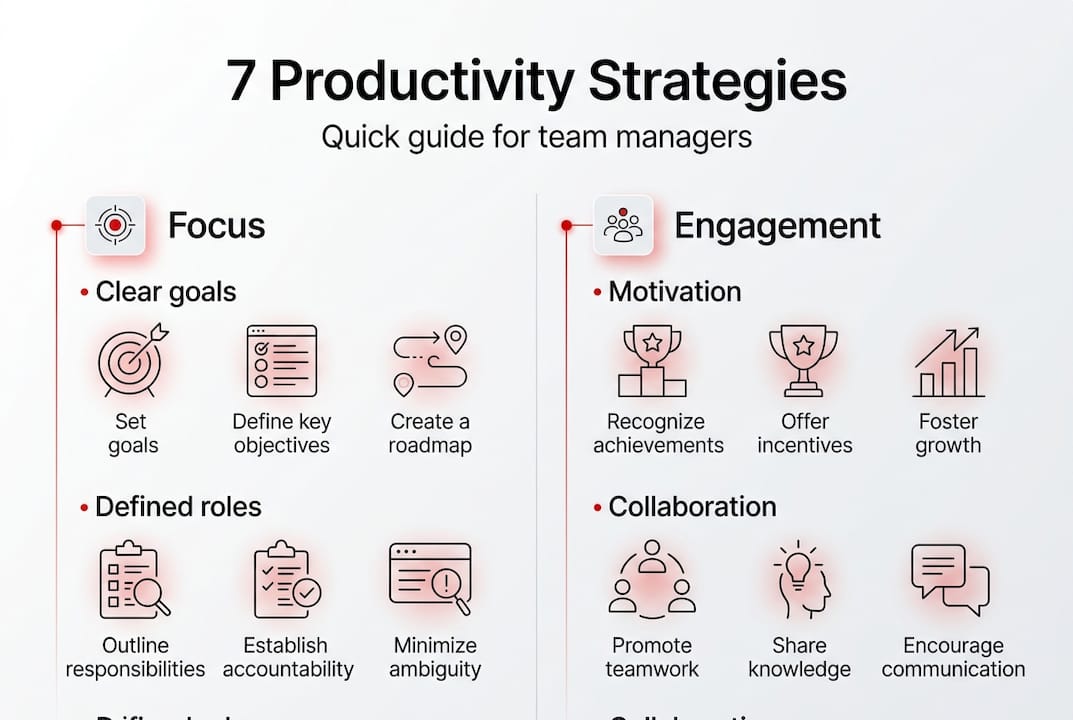
Set clear goals and processes for focus
Once you’ve diagnosed where your team struggles, the next step is creating clarity and focus through goals and structure. Vague direction is one of the most expensive problems a team can have.
Teams with clear goals are 20% more productive, and clear processes make teams 4.6 times more likely to perform at a high level. That’s not a marginal gain. That’s a structural advantage.
Here’s how to build that clarity step by step:
- Define outcome-focused goals using SMART criteria (Specific, Measurable, Achievable, Relevant, Time-bound) or OKRs (Objectives and Key Results).
- Tie goals to daily workflow so every task connects to a larger objective.
- Communicate goals visibly using shared dashboards, team boards, or weekly standups.
- Document key processes so team members can work independently without constant check-ins.
- Review and adjust goals quarterly to stay aligned with business priorities.
The difference between vague and clear goal-setting is significant:
| Approach | Example | Outcome |
|---|---|---|
| Vague goal | “Improve customer satisfaction” | No clear action or measure |
| Clear goal | “Increase NPS score from 42 to 55 by Q3” | Focused effort, trackable progress |
| Vague process | “Handle complaints quickly” | Inconsistent results |
| Clear process | “Respond to all complaints within 4 hours using the escalation checklist” | Reliable, repeatable outcomes |
Exploring team-building strategies can help reinforce goal alignment across your group. You can also learn how to boost productivity without sacrificing quality as you build these systems.
Pro Tip: Post your team’s top three goals somewhere visible, whether that’s a shared Slack channel, a project board, or a printed sheet in the office. Visibility creates accountability without micromanagement.
Foster engagement through effective management
With clarity on goals, the most potent productivity driver is how you lead and support your team day-to-day. Engagement is not a soft metric. It has hard business consequences.
“Managers account for 70% of the variance in team-level engagement, which drives productivity, profitability, and reduced absenteeism.” — Gallup
Engaged employees show up, contribute ideas, and stay longer. Disengaged ones do the minimum and leave. The practices that build engagement are straightforward but require consistency:
- Recognize contributions regularly, not just during annual reviews
- Provide specific, timely feedback so people know where they stand
- Offer growth opportunities through stretch assignments or learning resources
- Involve team members in decisions that affect their work
- Avoid micromanagement by setting expectations clearly and trusting the process
For deeper efficient management tips, especially in fast-moving environments, it helps to study how high-growth teams structure their leadership habits. You can also explore employee retention insights to understand what keeps top performers engaged long-term.
Pro Tip: Structure your weekly one-on-ones with three simple questions: What’s going well? What’s blocking you? What do you need from me? This keeps conversations focused and builds trust over time.
Optimize your collaboration model for hybrid, remote, or in-person teams
The right team engagement tactics work best when matched to how your team collaborates day-to-day. Not every team works the same way, and your approach should reflect that reality.
Hybrid teams with collaboration plans see 66% higher engagement and 29% less burnout compared to those without structured plans. Meanwhile, remote work boosts engagement but can increase distress if social connection is neglected.
Here are proven practices for each setup:
- For remote teams: Establish clear availability windows, use async communication tools, and schedule regular video check-ins to maintain connection
- For hybrid teams: Reserve in-person time for collaboration and brainstorming, not routine tasks; create explicit norms for who attends meetings and how
- For in-person teams: Protect focused work time by limiting unnecessary meetings and creating quiet zones
- For all setups: Build in intentional social interaction, whether that’s a virtual coffee chat or a team lunch, because relationships drive trust and trust drives output
Addressing remote work challenges proactively prevents small friction points from becoming major productivity drains. Equipping your team with the right remote collaboration tools also makes a measurable difference. Research also shows that games and teamwork activities can strengthen team bonds across all work models.

Pro Tip: Create a simple team collaboration charter. It should cover communication norms, meeting expectations, and how decisions get made. One page is enough. It removes ambiguity and prevents recurring friction.
Implement proven frameworks: OKRs and Agile for aligned execution
Foundational practices are powerful when supported with tools and frameworks that focus your team’s efforts and improvement. OKRs and Agile are two of the most widely adopted frameworks for exactly this reason.
Integrating OKRs with Agile practices like Scrum or Kanban creates alignment between long-term strategy and day-to-day execution. Here’s how to put it into practice:
- Define your OKRs at the team level each quarter, with 2 to 3 objectives and 3 to 5 measurable key results each.
- Break objectives into sprints of one to two weeks so progress is visible and adjustable.
- Hold weekly standups to surface blockers early and keep momentum.
- Run retrospectives at the end of each sprint to identify what worked and what to change.
- Co-create OKRs with your team rather than handing them down, which builds buy-in and ownership.
| Objective | Key result | Agile routine |
|---|---|---|
| Improve response time | Reduce average reply time to under 2 hours | Daily standup tracking |
| Increase output quality | Reduce error rate by 30% | Sprint review and retrospective |
| Strengthen team skills | Complete 2 training modules per person per quarter | Backlog item in each sprint |
For a deeper look at how this methodology drives results, explore Agile methodology for project success and how leading teams apply it.
Pro Tip: When co-creating OKRs, ask your team: “What would success look like in 90 days?” Their answers often surface the most meaningful and motivating key results.
Sustain and verify productivity gains: Troubleshooting and tracking progress
After implementing new practices and frameworks, you need to ensure those gains stick and evolve alongside your team’s goals. Improvement without measurement is just hope.
Fewer than 100 standout firms drive two-thirds of all productivity growth globally by scaling new models, shifting resources strategically, and making operational improvements. The lesson is clear: sustained productivity requires deliberate tracking and adaptation, not one-time fixes.
Watch for these common pitfalls and how to address them:
- Productivity gains stall after 4 to 6 weeks: Revisit your goals and check if priorities have shifted without a formal update
- Engagement scores drop despite new initiatives: Survey your team to find out if the changes feel meaningful or performative
- Output increases but quality drops: Slow down and audit your processes for shortcuts that are creating downstream problems
- One team member’s performance drags the group: Address it directly in a one-on-one rather than adjusting team-wide processes
- Metrics look good but morale feels low: Numbers don’t capture everything; qualitative feedback matters just as much
Tracking the right metrics matters. Focus on output per sprint, engagement scores, absenteeism trends, and error rates. Review them monthly, not just quarterly. For more on balancing speed with standards, revisit the guide on improving productivity and quality to keep both moving in the right direction.
Elevate your team’s performance further
Ready to build on your team’s productive momentum? The strategies in this guide give you a strong foundation, but sustained excellence comes from continuous learning and leadership development.
TechMoths offers a growing library of resources designed for leaders who want to keep improving. Whether you’re looking to sharpen your professional growth strategies, develop your improving soft skills in the workplace, or explore the broader personal transformation success process, there’s practical guidance waiting for you. Strong teams are built by leaders who never stop learning. Explore the full range of leadership and development content on TechMoths and take your next step forward.
Frequently asked questions
What is the single most effective way to boost team productivity?
Prioritizing employee engagement through strong management has the largest productivity impact, influencing up to 70% of performance variability across teams.
How do you keep remote or hybrid teams productive?
Use structured collaboration plans, hold regular check-ins, and prioritize relationship-building. Hybrid teams with a collaboration plan see significantly higher engagement and less burnout than those without one.
Do flexible work policies improve productivity?
No single policy guarantees results. Focusing on collaboration practices and mentorship matters more than whether your team works remotely, hybrid, or in-office.
How can I measure if productivity improvements are working?
Track engagement scores, output metrics, and regular feedback loops, then compare results against your baseline over time. Treating productivity as a strategic outcome means measuring it consistently, not just when problems arise.
