

Authentication vs Authentification: 95% Use Only Authentication

If you’ve stumbled across both ‘authentication’ and ‘authentification’ in cybersecurity reading, you’re not alone in wondering which is correct. Many tech enthusiasts assume these are interchangeable terms for identity verification. The truth is simpler and more important: over 95% of English cybersecurity documents use only ‘authentication’ exclusively. Understanding this distinction sharpens your technical communication and prevents confusion in professional settings. You’ll gain clarity on the true meanings, proper usage, and why this matters for your cybersecurity knowledge.
Table of Contents
- Foundations and Definitions
- Technical Mechanisms of Authentication
- Common Misconceptions and Corrections
- Comparison Framework: Authentication vs Authentification
- Practical Implications and Correct Usage
- Boost Your Cybersecurity Knowledge With Tech Moths
- Frequently Asked Questions
Key Takeaways
| Point | Details |
|---|---|
| Standard Term | Authentication is the universally accepted term for identity verification in English cybersecurity contexts. |
| Archaic Variant | Authentification is a French-derived term rarely used or accepted in English technical documentation. |
| Professional Impact | Using correct terminology prevents confusion in education, training, and professional cybersecurity practice. |
| Standards Alignment | Technical standards like NIST and protocols exclusively use ‘authentication’. |
Foundations and Definitions
Authentication derives from the Greek word ‘authentes’, meaning ‘one acting with full authority’. NIST defines authentication as verifying the identity of a user, process, or device, often as a prerequisite to allowing access to resources in an information system. This term became standardized across cybersecurity literature, technical protocols, and educational materials throughout the 20th century. Every major framework, from OAuth to SAML, exclusively uses this spelling and definition.
Authentification, by contrast, stems from French linguistic patterns. ‘Authentification’ is largely a French-origin word, archaic and rare in English cybersecurity usage. While it may appear in older texts or non-English contexts, modern English technical writing rejects it. The distinction matters because language precision directly impacts how effectively you can communicate complex security concepts. Misusing terms creates unnecessary barriers to understanding cybersecurity best practices and implementing them correctly.
The decline of ‘authentification’ in English coincides with cybersecurity standardization efforts. Usage declined after the 20th century as international bodies like NIST, ISO, and IETF formalized terminology. This standardization ensures that technical professionals worldwide speak the same language, reducing errors and improving collaboration. When you learn SASE architecture components or study tips to browse web securely, you’ll encounter only ‘authentication’ in authoritative sources.
Clear definitions establish the foundation for everything that follows:
- Authentication: The process of verifying the identity of a user, device, or system through credentials like passwords, tokens, or biometrics.
- Authentification: An obsolete or French variant not recognized in English cybersecurity standards.
- Identity Verification: The broader category that authentication falls under, ensuring entities are who they claim to be.
- Credential Validation: The technical mechanism through which authentication occurs, checking provided information against stored records.
Now that we have clear definitions, let’s explore how authentication works technically in cybersecurity.
Technical Mechanisms of Authentication
Authentication methods vary in complexity and security strength. Password-based authentication remains the most common approach, where users provide a secret string of characters known only to them. However, passwords alone offer limited security due to human tendencies toward weak choices and reuse across multiple sites. Token-based authentication improves on this by requiring physical or digital tokens that generate time-sensitive codes. Biometric authentication leverages unique physical characteristics like fingerprints or facial features, making it harder to forge or steal credentials.

NIST Digital Identity Guidelines define authentication exclusively and in detail with no mention of ‘authentification’. These guidelines establish three authentication factors: something you know (password), something you have (token), and something you are (biometric). Combining two or more factors creates multi-factor authentication (MFA), which significantly reduces breach risk by requiring attackers to compromise multiple independent systems. When you protect token wallets, you’re applying MFA principles to cryptocurrency security.
The technical implementation of authentication follows standardized protocols. OAuth 2.0, OpenID Connect, and SAML all specify exactly how authentication requests and responses should be formatted, transmitted, and validated. These protocols use only the term ‘authentication’ in their specifications, reinforcing the importance of correct terminology. When developers implement these protocols, they must understand the precise language to interpret documentation correctly and avoid implementation errors.
“Multi-factor authentication can prevent up to 99.9% of account compromise attacks by requiring multiple independent verification methods.”
Proper term use aligns directly with technical protocol implementation. If training materials or documentation mistakenly use ‘authentification’, learners may struggle to find relevant resources or cross-reference official standards. This terminology mismatch creates friction in the learning process and can lead to misunderstandings about how authentication systems actually work. Standardized language enables efficient knowledge transfer across teams and organizations.
Authentication mechanisms continue evolving:
- Adaptive authentication analyzes context like location, device, and behavior patterns to assess risk dynamically.
- Passwordless authentication eliminates traditional passwords in favor of biometrics or hardware tokens.
- Risk-based authentication adjusts authentication requirements based on real-time threat assessments.
- Continuous authentication monitors user behavior throughout a session rather than just at login.
Having covered technical details, let’s address common misconceptions about these terms that can muddy understanding.
Common Misconceptions and Corrections
One widespread misconception treats ‘authentification’ as a legitimate alternative spelling of ‘authentication’. ‘Authentification’ is often mistakenly used as a synonym, but is rejected by official standards in English cybersecurity. This error typically originates from non-native English speakers or those translating from French sources without recognizing that English has standardized differently. The mistake persists because spell-checkers may not flag it and casual readers might not notice the difference.
Another common confusion assumes both terms carry equal technical weight. Authoritative standards like NIST, ISO 27001, and PCI DSS exclusively accept ‘authentication’ in their requirements and guidelines. Using ‘authentification’ in compliance documentation or security policies could raise questions about the document’s credibility and the author’s expertise. This matters in professional contexts where precise language signals competence and attention to detail.
Terminology confusion impacts training and operations, with 15% of learners struggling with the terms. When instructional materials inconsistently use terminology, students waste time reconciling differences rather than learning core concepts. This confusion extends beyond vocabulary to affect understanding of how authentication systems function. Clear, standardized language accelerates learning and reduces the cognitive load on students trying to master understanding tech security.
Some believe ‘authentification’ represents a more technical or formal version of the term. This assumption has no basis in reality. The opposite is true: ‘authentication’ is the formal, technical term recognized across all professional contexts. Using ‘authentification’ actually undermines credibility by signaling unfamiliarity with standard terminology. In cybersecurity, where precision matters enormously, such errors can have real consequences for trust and effectiveness.
Pro Tip: When in doubt, search for terms in official NIST publications or RFCs. If a term doesn’t appear in these authoritative sources, it’s not part of standard English cybersecurity vocabulary. This simple check can prevent embarrassing mistakes in professional writing.
Key corrections to remember:
- Use ‘authentication’ in all English technical writing, regardless of formality level.
- Recognize ‘authentification’ only when discussing linguistic history or French sources.
- Standardize terminology across your organization’s training materials and documentation.
- Correct misuse when you encounter it to prevent confusion from spreading.
To reinforce understanding, we now provide a direct comparison highlighting key differences and practical acceptance.
Comparison Framework: Authentication vs Authentification
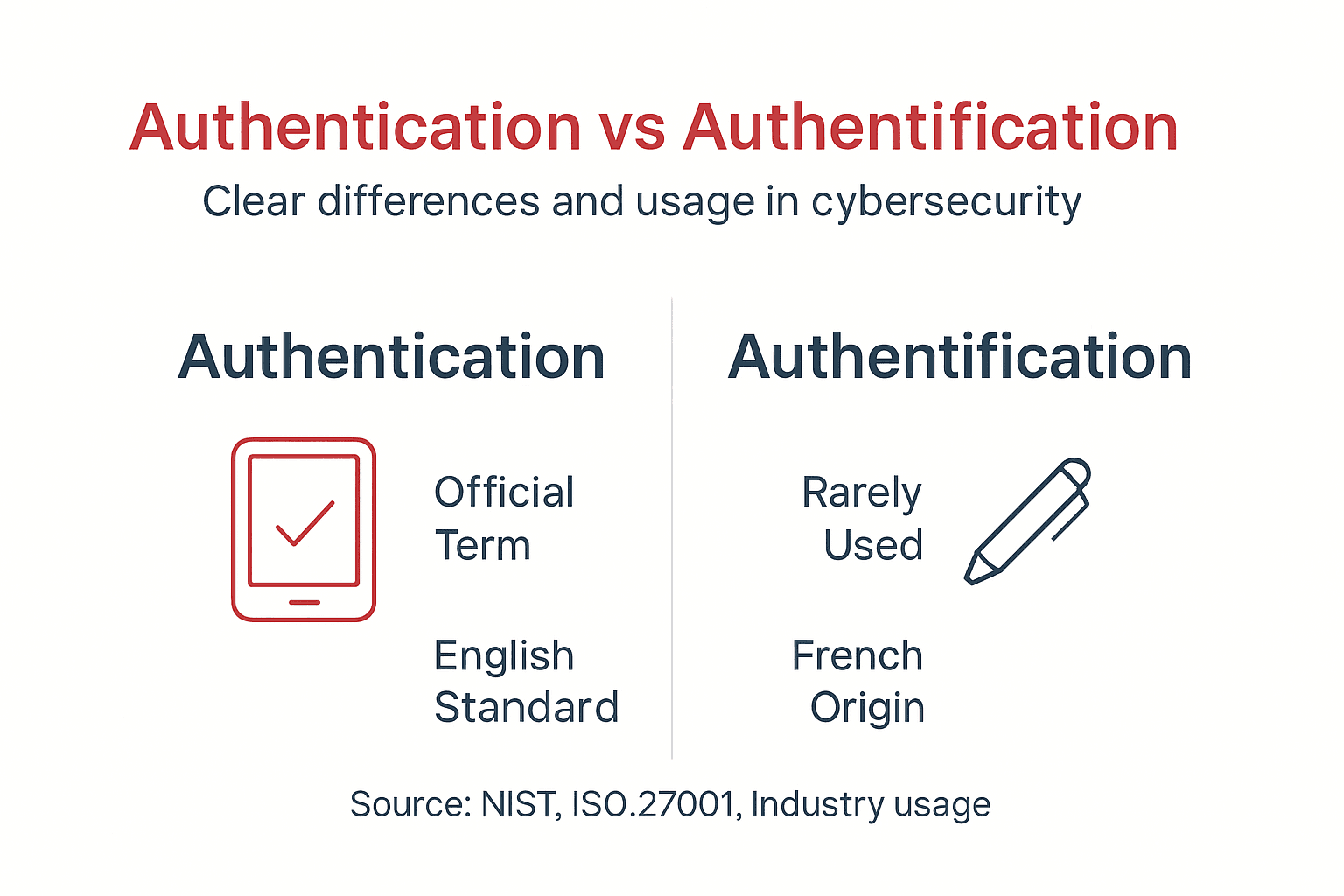
A direct comparison clarifies why ‘authentication’ dominates English cybersecurity terminology. All major Internet security protocols use only ‘authentication’ terminology with no instances of ‘authentification’. This includes OAuth 2.0, OpenID Connect, SAML, Kerberos, and countless other foundational technologies. The universal adoption of ‘authentication’ reflects decades of international collaboration to standardize technical language.
| Aspect | Authentication | Authentification |
|---|---|---|
| English Standard | Yes, universally accepted | No, archaic and rare |
| NIST Recognition | Defined and used throughout | Not mentioned |
| RFC Usage | Standard in all protocols | Never appears |
| French Usage | Less common | Standard term |
| Professional Context | Required in documentation | Signals error or non-native usage |
| Educational Materials | Exclusive term used | Causes confusion if present |
This comparison reveals clear patterns. Authentication represents the standardized, professionally recognized term across English-speaking cybersecurity communities. Every certification program, from CompTIA to CISSP, exclusively teaches ‘authentication’. Every major vendor, from Microsoft to Cisco, uses ‘authentication’ in their product documentation. The consistency across these diverse sources demonstrates true standardization.
Authentification lacks any such support structure. It appears occasionally in older texts or machine translations from French, but never in authoritative English sources. If you search cybersecurity RFCs or IEEE standards databases, you’ll find thousands of references to ‘authentication’ and effectively zero to ‘authentification’. This stark difference should guide your terminology choices without ambiguity.
Knowing approved terminology streamlines documentation workflows. When everyone uses ‘authentication’, searching technical databases, reading specifications, and implementing systems becomes straightforward. You don’t waste time wondering whether different terms refer to different concepts. The cybersecurity best practices 2026 guide relies on this standardized vocabulary to communicate clearly with diverse audiences.
Pro Tip: Create a style guide for your team that explicitly bans ‘authentification’ and requires ‘authentication’. Include this in onboarding materials to prevent new team members from introducing inconsistent terminology. Small investments in standardization pay dividends in clarity.
Finally, let’s explore practical guidance on applying the correct terminology in education and professional environments.
Practical Implications and Correct Usage
Correct terminology usage extends beyond vocabulary preferences to impact real cybersecurity outcomes. When technical documentation consistently uses ‘authentication’, readers can confidently search for additional resources, cross-reference standards, and implement systems without terminology confusion. This consistency reduces errors, accelerates training, and improves security posture. Conversely, incorrect use of ‘authentification’ causes confusion in corporate training and policy development.
In professional writing, use ‘authentication’ exclusively. Technical specifications, security policies, training manuals, and audit reports should all employ the standard term. This applies regardless of your audience’s technical level. Even when writing for beginners, using correct terminology from the start builds good habits and prepares learners for advanced materials. If you need to mention ‘authentification’ at all, do so only in historical or linguistic contexts, explicitly noting its obsolete status in English.
Organizations should audit existing materials for terminology consistency. Review training presentations, onboarding documents, and policy manuals to eliminate any instances of ‘authentification’. Replace them with ‘authentication’ and add a note to your style guide prohibiting the variant spelling. This cleanup effort prevents new employees from learning incorrect terminology and ensures everyone speaks the same technical language. Just as you’d learn correct usage tips for common English phrases, you must master technical vocabulary.
Educators bear special responsibility for terminology accuracy. When teaching cybersecurity concepts, consistently using ‘authentication’ helps students develop professional-grade communication skills. Introduce the existence of ‘authentification’ only to warn against it, explaining why the term should be avoided. This approach prevents confusion while building awareness that terminology matters in technical fields.
Practical guidelines for correct usage:
- Always use ‘authentication’ in technical writing, presentations, and verbal communication.
- Configure autocorrect on your devices to flag ‘authentification’ as an error.
- When reviewing others’ work, correct instances of ‘authentification’ and explain why.
- Reference NIST, RFC, or ISO standards when justifying terminology choices to skeptics.
- Update legacy documentation systematically to eliminate obsolete terminology.
With these guidelines, you can confidently distinguish and apply correct terminology in your cybersecurity learning and work.
Boost Your Cybersecurity Knowledge with Tech Moths
Mastering authentication terminology is just the beginning of your cybersecurity journey. Understanding precise technical language opens doors to deeper learning across all security domains. At Tech Moths, we provide comprehensive resources that break down complex topics into accessible, actionable insights. Whether you’re exploring personalized learning tactics to accelerate your education or seeking access to different education levels to match your current knowledge, our platform supports your growth.
Tech Moths offers targeted guidance for navigating education opportunities in turbulent times, ensuring you build skills that matter in today’s rapidly evolving threat landscape. Our articles combine rigorous research with practical application, helping you translate theoretical knowledge into real-world security improvements. Explore our growing library of cybersecurity content to deepen your expertise and stay ahead of emerging challenges.
Frequently Asked Questions
Is ‘authentification’ ever correct to use in cybersecurity?
Authentification is mostly obsolete in English cybersecurity and not recognized by major standards like NIST or ISO. It may still appear in French contexts or older literature, but should never be used interchangeably with ‘authentication’ in English technical communication. Stick to ‘authentication’ for professional credibility.
Why does correct terminology between ‘authentication’ and ‘authentification’ matter?
Accurate terminology ensures clear communication and effective training across cybersecurity teams. Misuse leads to misconceptions, wasted time searching for resources, and potential operational errors when implementing security systems. Standardized language accelerates learning and reduces mistakes.
What are common authentication methods in cybersecurity?
Password-based, token-based, and biometric authentication are the primary approaches used today. Multi-factor authentication combines two or more of these methods for significantly increased security. Adaptive and continuous authentication represent emerging approaches that monitor context and behavior dynamically.
How can I ensure I am using terminology correctly in professional writing?
Refer to authoritative standards like NIST guidelines and trusted cybersecurity literature from organizations like IEEE or IETF. Always use ‘authentication’ in English documents and avoid ‘authentification’ entirely. Create a team style guide that explicitly requires standard terminology.
