

Why Invest in Soft Skills: Career Value for Tech Pros

Landing your first tech job feels exciting, but moving ahead takes more than knowing the latest programming language. Employers today seek professionals with strong communication, teamwork, and adaptability skills, not just technical know-how. If you want to solve real-world problems and thrive in global teams, mastering soft skills bridges the gap between classroom learning and what companies value in the workplace.
Table of Contents
- Defining Soft Skills In The Tech World
- Core Types Of Soft Skills For Professionals
- Real-World Impact On Tech Careers
- Common Barriers And How To Overcome Them
- Long-Term Value Versus Technical Skills
Key Takeaways
| Point | Details |
|---|---|
| Importance of Soft Skills | Soft skills are crucial for success in tech, influencing hiring, career growth, and productivity. |
| Two Categories of Soft Skills | Intrapersonal skills focus on self-management, while interpersonal skills enhance teamwork and communication. |
| Long-Term Value | Soft skills remain relevant through technological changes, aiding in career resilience and adaptable learning. |
| Development for Career Growth | Investing time in soft skills, such as communication and leadership, is essential for advancing in tech roles. |
Defining Soft Skills in the Tech World
Soft skills are the human abilities that make you effective in any tech role, regardless of programming language or technology stack. Unlike technical skills, which focus on specific tools and systems, soft skills consist of problem-solving, collaboration, interpersonal, and communication abilities that help you work with people and navigate real-world challenges.
Think of it this way: your technical skills get you the job interview. Your soft skills get you hired and keep you advancing.
In tech specifically, soft skills bridge the gap between what you learned in school or bootcamp and what your employer actually needs. A developer who can debug code perfectly but cannot explain their solution to teammates creates bottlenecks. A data analyst with flawless technical abilities but poor listening skills misses critical project requirements.
What Counts as Soft Skills?
Soft skills go beyond just talking to people. Here’s what falls into this category:
- Communication: Explaining complex ideas clearly in writing, presentations, and everyday conversations
- Collaboration: Working effectively with diverse teams toward shared goals
- Adaptability: Adjusting to changing priorities, new tools, and shifting business needs
- Problem-solving: Breaking down complex issues and finding practical solutions
- Time management: Prioritizing tasks and meeting deadlines consistently
- Emotional intelligence: Understanding your own emotions and reading others’ needs
- Ethical decision-making: Choosing the right path when facing difficult trade-offs
Foundational human competencies like communication, adaptability, and ethical decision-making are critical for navigating the evolving tech world and advancing career success.
Why does your employer care about these? Because technical problems are only half the battle. The other half is working with people who have different perspectives, managing competing deadlines, and making decisions when the answer isn’t obvious.
Soft Skills Aren’t Optional in Tech
Many early-career tech professionals assume soft skills matter less in technical roles. That’s backwards. Remote work, distributed teams, and complex projects mean you’re constantly communicating across channels and time zones.

Your ability to improve communication skills directly impacts your team’s productivity and your own advancement potential. A senior engineer who cannot mentor junior developers creates a knowledge gap. A project manager without adaptability struggles when scope changes mid-project.
Soft skills distinguish average performers from standouts in tech. Two developers with identical technical abilities will have vastly different careers if one can lead effectively and the other cannot.
Pro tip: _Identify one soft skill weakness you notice in yourself, then spend 30 days deliberately practicing it in daily interactions—you’ll see measurable improvement in how colleagues respond to you.
Core Types of Soft Skills for Professionals
Soft skills split into two main categories that work together to shape how you perform at work. Understanding this distinction helps you identify where to focus your development efforts and why each type matters for your career.
Intrapersonal Skills: Managing Yourself
Intrapersonal skills are about how you manage yourself—your emotions, time, and mindset. These intrapersonal skills include self-management and emotional regulation, which form the foundation for everything else you do professionally.
When you stay calm under deadline pressure instead of panicking, that’s emotional regulation. When you prioritize your tasks instead of jumping between projects randomly, that’s self-management. These abilities determine whether you’re reliable or chaotic.
Intrapersonal skills include:
- Self-awareness: Recognizing your strengths, weaknesses, and how you affect others
- Emotional regulation: Managing stress, frustration, and anxiety without letting them control your work
- Motivation: Driving yourself toward goals even when work gets repetitive or difficult
- Resilience: Bouncing back from setbacks and learning from failures
- Time management: Organizing your work so deadlines are met consistently
These skills matter because nobody can motivate you but you. Your manager can’t regulate your emotions for you. Only you control whether you show up focused or scattered.
Here’s how intrapersonal and interpersonal soft skills differ in the tech workplace:
| Dimension | Intrapersonal Skills | Interpersonal Skills |
|---|---|---|
| Main Focus | Managing self, mindset, and emotions | Connecting with and influencing others |
| Common Challenges | Self-motivation, emotional regulation | Resolving conflicts, active listening |
| Impact on Career | Reliability, consistent performance | Team dynamics, project success |
| Development Method | Reflection, self-discipline | Practice in team settings, feedback |
Interpersonal Skills: Working With Others
Interpersonal skills are about how you interact with other people. Core soft skills for IT professionals include communication, teamwork, problem-solving, adaptability, and interpersonal interactions that directly impact team performance.
In tech, you rarely work alone. You collaborate on code reviews, attend meetings, present solutions, and coordinate across departments. Interpersonal skills determine whether these interactions strengthen or damage your relationships.
Interpersonal skills include:
- Communication: Explaining ideas clearly in emails, meetings, and presentations
- Active listening: Understanding what others actually mean, not just hearing words
- Teamwork: Contributing to group goals while supporting teammates
- Conflict resolution: Addressing disagreements without creating tension
- Empathy: Understanding others’ perspectives and concerns
- Leadership: Influencing and motivating people toward shared outcomes
Both intrapersonal and interpersonal competencies are crucial for professional success across industries, including technology sectors.
Why the distinction matters: You can’t fake interpersonal skills if your intrapersonal skills are weak. A developer with poor emotional regulation will struggle in team settings, even if they’re technically brilliant. Conversely, someone with great people skills but no self-discipline will miss deadlines and create problems.
The tips for improving soft skills in the workplace show that development in both areas accelerates your advancement. You need both to become the professional others want to work with.
Pro tip: Pick one intrapersonal skill (like time management) and one interpersonal skill (like active listening) to develop simultaneously—improving both areas reinforces each other and creates noticeable changes in how your team perceives you.
Real-World Impact on Tech Careers
Soft skills directly determine how far you advance in tech. The difference between staying in individual contributor roles and reaching senior positions often comes down to how well you communicate, collaborate, and adapt—not just how well you code.
Career Progression and Earnings
Tech professionals with strong soft skills earn measurably more than those focused only on technical depth. Workers with broad soft skills learn new skills faster, earn more, and advance into leadership compared to those with narrowly specialized technical abilities.
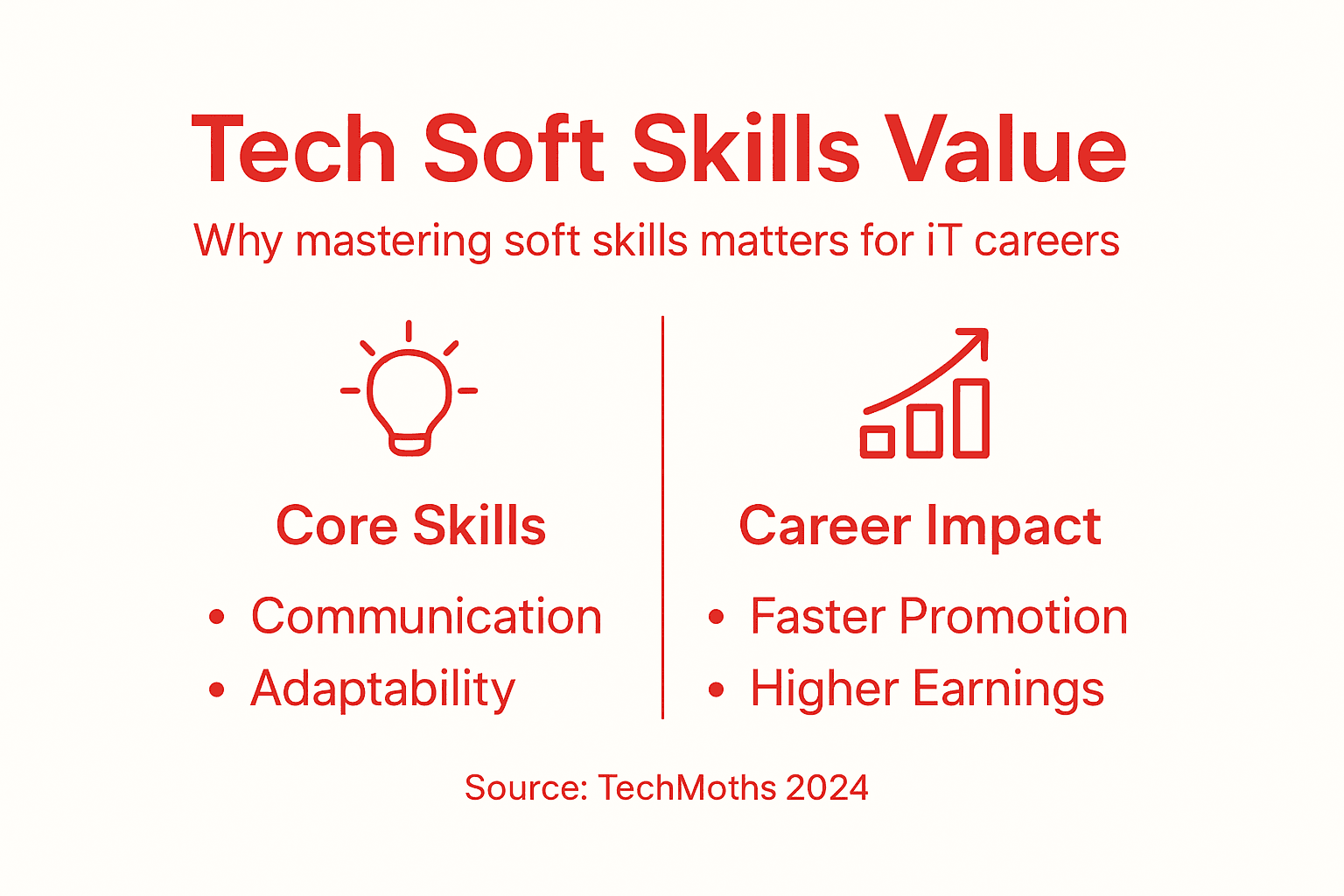
This isn’t theoretical. Companies value people who can communicate complex ideas to non-technical stakeholders, work across departments, and adapt when priorities shift. These abilities unlock promotions and higher salaries.
Consider the difference:
- Specialist with weak soft skills: Excellent at their narrow technical focus but struggles to influence decisions or lead projects
- Generalist with strong soft skills: Solid technical foundation plus ability to navigate organizational dynamics and drive change
The generalist advances faster. The specialist hits a ceiling.
Resilience Through Market Changes
Tech changes rapidly. Languages evolve, frameworks shift, market demands transform. Professionals who rely only on specific technical skills become obsolete when those skills fall out of favor.
But professionals with adaptability and strong learning skills survive transitions. When one technology becomes less relevant, they learn the next one quickly. Soft skills such as communication, collaboration, and adaptability enable better synergy and contribute to innovation and adaptability in the rapidly changing technology landscape.
When remote work reshapes how tech teams collaborate, communication skills become critical. When new frameworks emerge, your ability to learn alongside teammates matters more than expertise in the old stack.
Leadership Opportunities
Every leadership role in tech requires soft skills. You cannot manage people with technical skill alone. Leaders must motivate, listen, resolve conflicts, and communicate vision.
If you want to move from developer to tech lead to engineering manager to director, soft skills aren’t optional. They’re the actual job.
The path looks like this:
- Build technical competency in your first role
- Develop collaboration and communication skills
- Take on mentoring responsibilities
- Lead projects with cross-functional teams
- Move into formal management roles
Skip steps 2-4, and you won’t reach step 5.
Soft skills separate people who stay in individual contributor roles from those who shape organizational direction and influence.
Pro tip: Document one measurable impact you’ve had through strong communication or collaboration in the past month, then use this example when interviewing for senior roles or promotions—concrete evidence matters more than claiming you have soft skills.
Common Barriers and How to Overcome Them
Most tech professionals understand soft skills matter, yet they still struggle to develop them. The barriers are real, but knowing what blocks your progress helps you navigate around them.
The Measurement Problem
Soft skills are harder to measure than technical skills. You can test coding ability with a challenge. But how do you measure communication or teamwork objectively?
This creates a real barrier. Organizational barriers include overemphasis on technical skills in hiring, lack of structured soft skills development programs, and difficulty measuring soft skills impact. Without clear metrics, companies don’t prioritize soft skills training.
Your solution: Document specific examples. When you lead a project smoothly, note it. When you resolve a team conflict, remember it. Build a portfolio of soft skills achievements you can reference during reviews and interviews.
Educational Gaps
Most tech education focuses entirely on technical skills. Computer science programs teach algorithms and frameworks but rarely teach communication or emotional intelligence. This means you graduate without formal soft skills training.
Challenges include the intangible nature of soft skills making training difficult and insufficient integration into educational curricula. You’re expected to develop these skills on your own time.
Your solution: Treat soft skills development like technical learning. Take courses. Read. Practice deliberately. The fact that your bootcamp didn’t teach these doesn’t mean you can’t learn them yourself.
Organizational Resistance
Some teams and companies view soft skills as secondary. Technical excellence dominates the culture. Suggesting that communication or collaboration matters gets dismissed as soft.
This resistance slows adoption. Your immediate solution: Focus on your own development regardless of organizational culture. You control your growth. Over time, your advancement demonstrates the value to skeptics around you.
Time and Prioritization
You’re busy learning new frameworks, fixing bugs, and meeting deadlines. Adding soft skills development feels impossible when you’re already stretched thin.
Here’s the key insight: Soft skills develop through your current work, not additional projects. Better communication happens in your next meeting. Collaboration improves on your current team. You don’t need extra time—you need intentionality.
Focus areas to practice immediately:
- Listen more in standups without interrupting
- Write clearer code comments and documentation
- Ask clarifying questions before starting tasks
- Offer help without being asked
- Admit mistakes directly and propose solutions
Soft skills development doesn’t require special programs—it requires intentional practice within your daily work.
Pro tip: Choose one soft skill weakness and set a specific, observable goal for this week (like “ask clarifying questions in three meetings” or “write one detailed code review comment”)—small, consistent actions compound faster than vague aspirations.
Long-Term Value Versus Technical Skills
Technical skills get you hired. Soft skills keep you employed and advancing. Understanding this difference changes how you invest in your career development.
The Shelf Life Problem
Technical skills have expiration dates. The JavaScript framework you mastered becomes less relevant. The database system you specialized in gets replaced. The programming language you focused on loses market demand.
This happens constantly in tech. Your expertise becomes outdated faster than you realize. A developer who learned only Java in 2010 faced serious challenges when job markets shifted. Someone who specialized exclusively in Flash became nearly unemployable after Adobe discontinued it.
Soft Skills as Your Foundation
Soft skills work differently. Communication, collaboration, and problem-solving remain relevant regardless of which technology you use. Foundational soft skills support continuous learning and adaptability as technologies evolve, forming the base upon which specialized capabilities are built.
When new technologies emerge, people with strong soft skills learn them faster. They ask better questions. They collaborate effectively with others learning the same material. They adapt their approach when initial attempts fail.
The comparison is clear:
- Technical skills alone: You’re fast until your specialty becomes irrelevant
- Soft skills foundation: You’re slower at first, but you keep advancing regardless of what technology changes
Long-Term Earnings and Mobility
Over a 30-year career, soft skills generate higher lifetime earnings. Individuals with a broad base of soft skills consistently outperform those with narrow technical expertise in earnings, mobility, and career resilience.
This isn’t because soft skills replace technical ability. It’s because soft skills unlock different opportunities. You can move between companies more easily. You can transition into management. You can work in different industries. You’re not trapped in one narrow specialty.
Consider two career paths:
- Specialist path: Deep expertise in one technology, high pay initially, limited options when that technology declines
- Generalist path: Solid technical foundation plus strong communication and collaboration, slightly lower initial pay, unlimited options as your career develops
By year 20, the generalist typically earns more and has more control over their future.
Explore the long-term effects of prioritizing soft skills alongside technical expertise:
| Approach | Initial Career Stage | 5+ Years Later | Resilience to Change |
|---|---|---|---|
| Technical Focus Only | Quick hiring, high starting pay | Stagnation or obsolescence | Low—skills may become outdated |
| Soft + Technical Skill Growth | Moderate entry, steady growth | Promotion, broader roles | High—easier to adapt and advance |
The AI Factor
With artificial intelligence automating routine technical work, the gap widens further. AI can help with coding. It cannot replace human judgment about what should be built or how teams should work together.
This makes soft skills even more valuable. The professionals who survive AI integration are those who can lead decisions, communicate with stakeholders, and adapt to new tools. Pure technical specialists are most vulnerable.
Long-term career value comes from soft skills that remain relevant through technological change, not from technical expertise alone.
Pro tip: Audit your current skill investment: What percentage of your time goes to learning technical skills versus soft skills? If it’s more than 80-20, rebalance—spend at least 20 percent on communication, collaboration, or leadership development for better long-term returns.
Elevate Your Tech Career by Mastering Soft Skills Today
The challenge every tech professional faces is not just learning new technologies but developing the soft skills that truly unlock career growth. Whether it is boosting communication, honing emotional intelligence, or building adaptability, these human skills are what separate good developers from great leaders. If you want to overcome common barriers such as measurement difficulties and lack of formal training, you need a resource that informs and empowers your personal development journey.
Discover practical insights and proven strategies on how to sharpen your soft skills at TechMoths. Our comprehensive platform offers expertly curated content across education, career advice, and more to guide you through intentional growth. Don’t wait to be left behind as technology evolves—start transforming your professional trajectory now by visiting TechMoths and explore articles that can make a difference like tips for improving soft skills in the workplace and understanding how remote work reshapes collaboration at remote work and startup culture. Empower yourself with the knowledge that turns challenges into opportunities and ensures your advancement in a competitive tech landscape.
Frequently Asked Questions
What are soft skills and why are they important in the tech industry?
Soft skills are human abilities like communication, collaboration, and problem-solving that help you work effectively with others. In the tech industry, they are crucial for bridging the gap between technical knowledge and real-world applications, enabling better teamwork and project success.
How do soft skills impact career advancement in tech?
Soft skills significantly influence career progression in tech. Professionals with strong soft skills often advance faster than those focused solely on technical abilities, as they can communicate ideas clearly, collaborate well with colleagues, and adapt to changing environments.
What are some examples of soft skills that tech professionals should develop?
Key soft skills for tech professionals include communication, adaptability, active listening, teamwork, emotional intelligence, and problem-solving. These abilities help foster positive team dynamics and project outcomes.
How can I improve my soft skills while working in tech?
You can improve your soft skills by practicing them in your daily work. Focus on intentional communication during meetings, actively listen to colleagues, manage your time effectively, and seek feedback on your teamwork and leadership abilities.
Recommended
- Tips for Improving Soft Skills in the Workplace – TechMoths
- Tech Talent Recruitment: Finding the Right Candidates for Tech Companies
- 8 interesting high-income skills to learn at home – TechMoths
- How to improve your communication skill – TechMoths
- 7 top Tipps für Startups im Bürobereich – clever gründen | ProOffice Business Center Blog
