

Why diversify income sources for stability in 2026

Most people believe focusing on a single career offers the safest path to financial security. Yet freelancers with three or more income streams report 45% higher satisfaction and 60% greater stability. In 2026, economic volatility makes diversification no longer optional but essential for anyone seeking lasting financial health. This guide reveals why spreading your income across multiple sources protects against uncertainty and how to build this resilience without burning out.
Table of Contents
- Understanding The Importance Of Income Diversification
- Types Of Income Streams And How They Contribute To Diversification
- Challenges And Pitfalls Of Income Diversification
- Practical Steps To Diversify Your Income Sources Wisely
- Explore Resources To Support Your Income Diversification Journey
- Frequently Asked Questions
Key takeaways
| Point | Details |
|---|---|
| Risk reduction | Diversifying income prevents total financial collapse if one source disappears, spreading vulnerability across multiple channels. |
| Enhanced satisfaction | Multiple income streams create greater job fulfillment and economic confidence than single-source dependence. |
| Strategic balance | Effective diversification requires managing 2-4 complementary streams to avoid mental fragmentation and burnout. |
| Income categories | Combining active, passive, and portfolio income creates robust financial architecture with uncorrelated risk profiles. |
| Tax planning | Different income types face varying tax treatments, requiring careful planning to optimize net earnings. |
Understanding the importance of income diversification
Financial diversification operates on a simple principle: never put all your eggs in one basket. When you rely on a single employer or client, job loss or contract termination can devastate your entire financial foundation overnight.
Diversification spreads risk across assets and income streams, creating buffers against unexpected shocks. Research shows diversified freelancers weather economic downturns 3x better than those depending on single clients. This resilience stems from uncorrelated income sources that rarely fail simultaneously.
Consider these benefits of diversified income:
- Protection against industry downturns affecting your primary field
- Flexibility to pursue passion projects while maintaining financial security
- Negotiating power with clients who know you have alternatives
- Accelerated wealth building through multiple growth channels
- Reduced anxiety about economic uncertainty or workplace changes
Diversification extends beyond simply earning from multiple sources. It encompasses insurance protecting against catastrophic losses, emergency savings buffering short-term shocks, and investment portfolios generating independent returns. Each layer adds defensive depth to your financial structure.
“The best time to diversify was yesterday. The second-best time is today. Economic conditions in 2026 demand we treat income diversification as survival strategy, not luxury.”
Building multiple streams aligns perfectly with professional growth strategies that emphasize adaptability and continuous skill development. The freelancers thriving today didn’t accidentally stumble into diversification. They systematically built complementary income channels that reinforce rather than compete with each other.
Types of income streams and how they contribute to diversification
Not all income streams function identically. Understanding the three core categories helps you build balanced diversification that maximizes stability while minimizing effort waste.
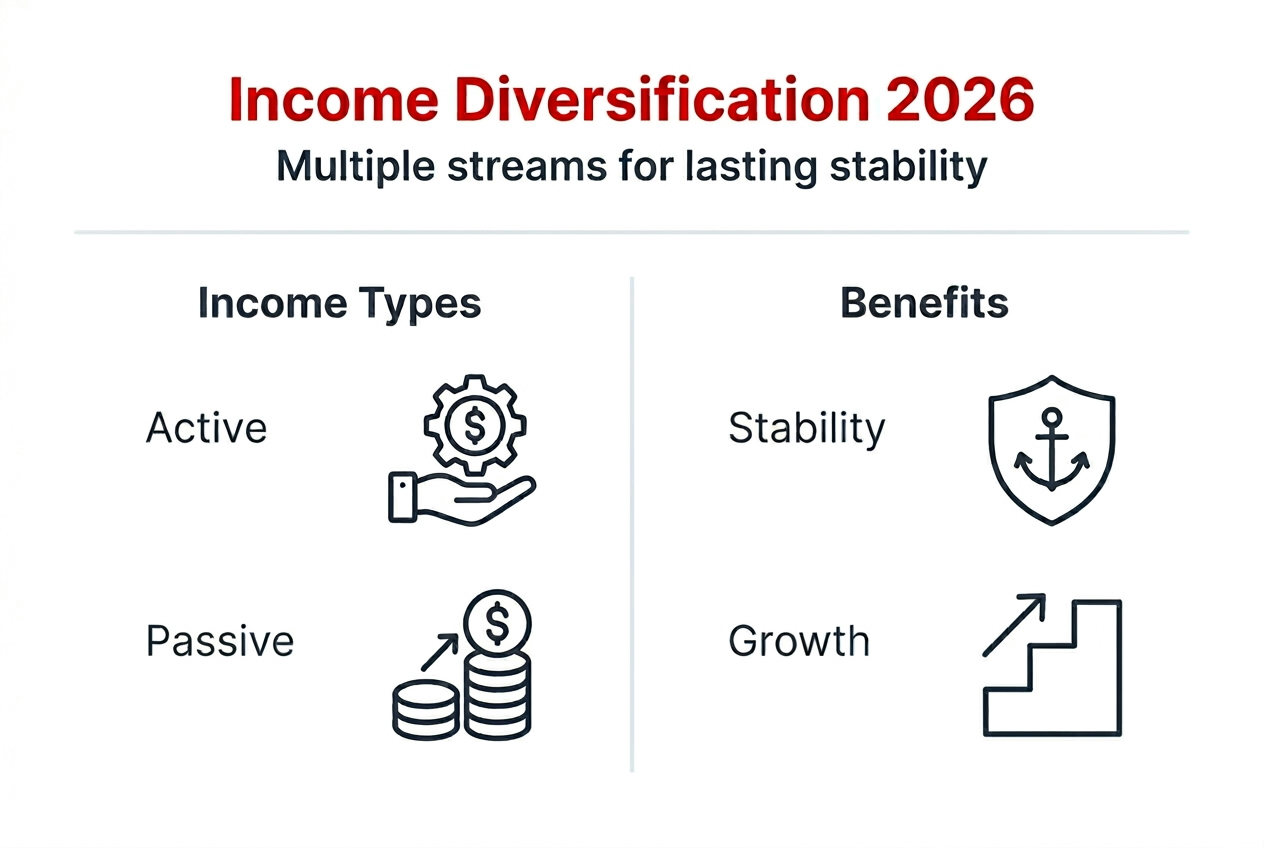
Income divides into active, passive, and portfolio streams, each serving distinct purposes. Active income requires ongoing time investment, trading your hours directly for money. Freelance consulting, contract work, and part-time employment fall here. While active income offers immediate cash flow, it scales poorly because you can only work so many hours.
Passive income generates returns with minimal ongoing effort after initial setup. Royalties from books or courses, affiliate commissions, rental properties, and automated digital products exemplify this category. These streams take months or years to establish but eventually create income while you sleep.
Portfolio income emerges from investments and diversified business ventures. Dividend stocks, index funds, real estate investment trusts, and equity stakes in businesses provide returns correlated with market performance rather than your direct labor. This category offers true wealth-building potential but requires capital to initiate.

| Income Type | Time Investment | Scalability | Risk Level | Startup Cost |
|---|---|---|---|---|
| Active (Freelance) | High ongoing | Low | Medium | Low |
| Passive (Digital Products) | High initial, low ongoing | High | Medium | Medium |
| Portfolio (Investments) | Low ongoing | Medium | Variable | High |
| Hybrid (Teaching) | Medium ongoing | Medium | Low | Low |
Effective diversification combines these categories strategically:
- Start with active income providing immediate cash flow and funding for other streams
- Gradually build passive streams that reduce time dependency
- Invest profits into portfolio income generating compound returns
- Create hybrid streams combining elements from multiple categories
Pro Tip: Focus on 2-3 complementary streams from different categories rather than five competing for the same time and skills. A freelance writer might combine client work (active), ebook royalties (passive), and dividend stocks (portfolio) for balanced diversification without overlap.
The key is selecting uncorrelated streams unlikely to fail together. Developing high-income skill development in multiple domains creates flexibility to pivot as markets shift.
Challenges and pitfalls of income diversification
Diversification promises security but demands careful navigation of significant obstacles. Understanding these challenges prevents the common trap of spreading yourself too thin while achieving nothing substantial.
Mental fragmentation poses the greatest hidden cost. Switching contexts between projects causes measurable drops in performance and decision quality. Your brain needs time to reload context, rules, and priorities when jumping between unrelated income streams. This cognitive tax accumulates quickly.
Portfolio strategies for investments fail catastrophically when applied to human attention. You cannot diversify focus the same way you diversify assets. While financial portfolios benefit from holding 20+ stocks, income diversification beyond 4-5 streams typically reduces total earnings as quality drops across all channels.
Common diversification pitfalls include:
- Launching too many streams simultaneously before any reach profitability
- Choosing unrelated income sources requiring completely different skill sets
- Underestimating time needed to establish viable passive income
- Ignoring switching costs that drain productivity across all streams
- Mistaking busy activity for productive progress toward financial goals
The initial investment phase tests patience severely. Most passive streams require 12-24 months of consistent effort before generating meaningful returns. During this period, you work harder for less money, creating temptation to abandon promising ventures prematurely.
Entrepreneurial burnout often disguises itself as success. You appear productive managing multiple ventures while actually experiencing chronic stress, declining health, and deteriorating relationships. The 60-hour work week maintaining five income streams may generate less net value than 30 focused hours building two exceptional ones.
Pro Tip: Track actual hourly earnings for each income stream quarterly. If a stream consistently pays below your target rate and shows no growth trajectory, eliminate it rather than persist from sunk cost fallacy.
Managing remote work challenges multiplies when juggling multiple income sources from home. The boundaries between different work streams blur, making it difficult to maintain energy and enthusiasm for each project.
Practical steps to diversify your income sources wisely
Building sustainable income diversification requires systematic planning rather than opportunistic chaos. Follow these proven steps to create financial resilience without sacrificing your sanity.
Start by auditing your current skills, interests, and resources. What can you offer that people value? Where do your passions and market demand intersect? This foundation determines which streams you can realistically build and maintain. Don’t chase trending opportunities misaligned with your core competencies.
Take these actions to launch diversification:
- Identify 3-5 potential income streams matching your skills and available time
- Research competition and market demand for each opportunity
- Select 2-3 complementary streams from different categories to begin
- Create 90-day action plans with specific milestones for each stream
- Launch streams sequentially rather than simultaneously to manage learning curves
- Monitor progress monthly and adjust strategies based on actual results
Timeline expectations matter enormously. Building multiple streams requires significant time before generating returns. Budget at least six months for active streams and 12-24 months for passive ones to reach sustainable profitability. This patience separates successful diversifiers from those who quit prematurely.
Freelancers with multiple clients earn 20% higher average income and experience greater stability than single-client dependents. However, client diversification represents just the first layer. True resilience requires income categories working independently.
| Stream Type | Monthly Time | Potential Income | Risk Factor | Best For |
|---|---|---|---|---|
| Freelance Clients | 80-120 hours | $3,000-$8,000 | Medium | Immediate cash flow |
| Online Course | 20 hours (after setup) | $500-$3,000 | Low | Passive scaling |
| Dividend Stocks | 2 hours | $200-$1,000 | Low | Long-term wealth |
| Affiliate Marketing | 10-15 hours | $300-$2,000 | Medium | Audience monetization |
Tax planning cannot be afterthought. Different income sources face varying tax treatment, requiring careful planning. Freelance income carries self-employment tax, passive income may qualify for different deductions, and investment income faces capital gains rates. Consult tax professionals to structure streams optimally.
Key tax considerations:
- Track expenses separately for each income stream to maximize deductions
- Make quarterly estimated payments to avoid penalties on non-W2 income
- Understand how income phaseouts affect your eligibility for credits and deductions
- Consider business structure (LLC, S-corp) if aggregate income exceeds certain thresholds
Pro Tip: Prioritize scalable streams aligning with your genuine interests rather than purely chasing dollars. Passion sustains effort through the difficult early phase when returns look discouraging. The income stream you enjoy building will ultimately outperform the one you force yourself to maintain.
Regular portfolio reviews keep diversification healthy. Quarterly assessments reveal which streams deserve more investment and which drain resources without adequate returns. Be willing to prune underperforming ventures to concentrate energy on winners.
Leverage resources like tax planning for multiple incomes and personalized learning tactics to accelerate your diversification journey with expert guidance.
Explore resources to support your income diversification journey
Building diverse income streams demands continuous skill development and strategic growth mindset. You need reliable resources offering practical frameworks rather than generic advice.
Tech Moths provides educational content specifically designed for freelancers, entrepreneurs, and professionals seeking financial stability through multiple income channels. Our personalized learning tactics help you acquire high-value skills efficiently, making each income stream viable faster.
Explore our professional growth strategies to develop the adaptability and resilience essential for managing diverse income sources. We focus on actionable insights you can implement immediately rather than theoretical concepts requiring translation.
Maintaining motivation through the challenging early stages requires more than financial tactics. Our lifestyle change process guidance helps you build sustainable habits supporting long-term diversification without burnout. Transform your approach to work, learning, and personal development with resources created specifically for 2026’s economic realities.
Frequently asked questions
What is income diversification and why is it important?
Income diversification means generating revenue from multiple independent sources rather than relying on a single employer or client. It reduces financial vulnerability by ensuring that losing one income stream doesn’t eliminate your entire livelihood. Diversification provides security against economic downturns, industry disruptions, and unexpected job loss while creating opportunities for accelerated wealth building.
How many income streams should I have to be financially secure?
Research indicates three or more distinct streams correlate with 45% higher satisfaction and significantly better financial stability. However, quality matters more than quantity. Two well-developed, complementary streams often outperform five mediocre ones competing for your attention. Focus on building 2-4 sustainable streams from different categories before expanding further.
Can over-diversification hurt my productivity and income quality?
Absolutely. Portfolio diversification strategies fail catastrophically when applied to human attention and energy. Managing too many income streams creates mental fragmentation, reduces performance across all channels, and leads to burnout. The switching costs between unrelated projects drain cognitive resources without adding proportional value.
What are some first steps to start diversifying income?
Begin by assessing your skills, interests, and available time to identify realistic opportunities. Select 2-3 complementary income streams from different categories and create specific action plans for each. Building multiple streams requires significant time and effort before generating substantial returns, so commit to at least six months for active streams and 12-24 months for passive ones before expecting meaningful income.
