

Sustainable Business: Principles, Frameworks, and Strategies

Sustainable business has become a buzzword in boardrooms and marketing campaigns, yet many entrepreneurs struggle to define what it actually means. The confusion isn’t just semantic. It leads to failed initiatives, wasted resources, and the very real risk of greenwashing accusations that damage credibility. This guide cuts through the noise to deliver a clear definition, practical frameworks, and actionable strategies you can implement today. Whether you’re launching a startup or transforming an established operation, understanding sustainable business isn’t optional anymore. It’s the foundation for long-term success.
Table of Contents
- Defining sustainable business: More than being ‘green’
- How sustainable business delivers value: Key benefits explained
- Critical challenges: Greenwashing, greenhushing, and credibility risks
- Sustainable business frameworks: Tools for standards and measurement
- Steps to build a sustainable business: A practical roadmap
- Sustainable business in action: Case studies and real-world examples
- Strategies to amplify your sustainable business journey
- Frequently asked questions
Key Takeaways
| Point | Details |
|---|---|
| Three-pillar approach | Sustainable business combines environmental, social, and governance priorities for long-term success. |
| Frameworks matter | Using recognized sustainability standards and third-party assessments builds trust and reduces greenwashing risks. |
| Communication is key | Clear, honest disclosure of sustainability efforts is as important as taking real action. |
| Everyone can start | Any business, regardless of size, can adopt and benefit from practical sustainable business strategies. |
Defining sustainable business: More than being ‘green’
Sustainable business means balancing profitability with positive environmental and social impact. It’s not about slapping a recycling logo on your packaging or hosting a tree-planting event once a year. True sustainability incorporates environmental, social, and governance considerations into every operational decision, from supply chain management to employee compensation.
The difference between genuine sustainability and greenwashing lies in measurable commitment. Greenwashing happens when companies make vague environmental claims without backing them up with data or systemic change. A business that truly operates sustainably can point to specific metrics: reduced carbon emissions, fair labor practices, transparent governance structures.
ESG serves as the framework for this approach. Environmental factors include resource efficiency and waste reduction. Social considerations cover labor practices, community impact, and diversity initiatives. Governance addresses leadership accountability, ethical decision-making, and stakeholder engagement. These three pillars work together to create value that extends beyond quarterly earnings.
Long-term thinking separates sustainable businesses from those chasing short-term wins. When you prioritize sustainability, you’re investing in resilience. You’re building systems that can adapt to regulatory changes, attract conscious consumers, and weather economic shifts. This mindset shift requires looking past immediate costs to see the cumulative benefits of responsible operations.
“Sustainable business isn’t a department or a campaign. It’s a fundamental operating philosophy that touches every aspect of how you create and deliver value.”
The key elements of sustainable business include:
- Resource efficiency: Minimizing waste and optimizing energy use across operations
- Stakeholder value: Creating benefits for employees, communities, and shareholders simultaneously
- Transparency: Openly reporting on both successes and challenges in sustainability efforts
- Innovation: Developing new products, services, and processes that reduce environmental impact
- Accountability: Setting measurable goals and tracking progress with recognized standards
Understanding these fundamentals helps you avoid the trap of unethical business practices that masquerade as sustainability. It also positions you to build authentic credibility with stakeholders who increasingly demand proof, not promises.
How sustainable business delivers value: Key benefits explained
Financial performance and sustainability aren’t opposing forces. Companies with strong ESG practices often see lower operating costs through energy efficiency and waste reduction. They also gain better access to capital, as investors increasingly screen for sustainability criteria before committing funds. The correlation between responsible practices and financial health continues to strengthen as markets mature.
Regulatory compliance becomes simpler when sustainability is embedded in your operations. Rather than scrambling to meet new environmental or social requirements, you’re already ahead of the curve. This proactive stance protects your reputation and reduces the risk of costly penalties or legal challenges that can derail growth.
Talent acquisition and retention improve dramatically when you demonstrate genuine commitment to sustainability. Top professionals, especially younger generations, actively seek employers whose values align with their own. A strong sustainability record becomes a competitive advantage in recruiting, while also boosting employee engagement and reducing turnover costs.
Stakeholder trust grows through transparent communication about your sustainability journey. When you openly share both progress and setbacks, you build credibility that marketing claims alone can never achieve. Standardized frameworks and third-party assessment provide the verification stakeholders need to trust your commitments.
The core benefits of sustainable business include:
- Cost savings: Reduced energy consumption and waste disposal expenses add directly to your bottom line
- Market differentiation: Authentic sustainability creates a unique selling proposition in crowded markets
- Risk mitigation: Proactive environmental and social management prevents costly crises
- Innovation catalyst: Sustainability challenges drive creative problem-solving and new revenue streams
- Long-term resilience: Sustainable operations adapt better to changing market conditions and regulations
Pro Tip: Start tracking your sustainability metrics now, even if they’re not perfect. Baseline data from today becomes the proof of progress tomorrow, and stakeholders value honest improvement over claims of perfection.
Competitive advantage emerges when sustainability drives innovation. Constraints often spark creativity. When you commit to reducing environmental impact, you’re forced to rethink processes, materials, and business models. This innovation frequently opens new markets or creates efficiencies that competitors haven’t discovered. The businesses that can go greener often find unexpected opportunities in the process.
Critical challenges: Greenwashing, greenhushing, and credibility risks
Greenwashing damages stakeholder trust more severely than admitting you haven’t started sustainability efforts yet. When companies exaggerate environmental claims or use misleading language, they face backlash from consumers, regulators, and investors who feel deceived. The reputational damage can take years to repair, and in some cases, it permanently alters how the market perceives your brand.

Greenhushing represents the opposite problem. Some businesses withhold sustainability communication entirely to avoid scrutiny or accusations of greenwashing. While this caution is understandable, silence prevents you from building credibility with stakeholders who want to support responsible companies. It also means you miss opportunities to learn from peer feedback and industry collaboration.
Regulatory fragmentation increases greenwashing risks because different jurisdictions define sustainability differently. What counts as a valid claim in one market might be considered misleading in another. This complexity makes it tempting to either overclaim or underclaim your sustainability efforts, both of which create problems.
Balanced communication requires using third-party frameworks that provide clear standards for what you can claim. These frameworks remove ambiguity and give stakeholders a common language for evaluating your efforts. They also protect you from accusations of greenwashing by ensuring your claims meet recognized criteria.
“The path between greenwashing and greenhushing is narrow but navigable. Transparency, backed by standardized reporting, keeps you on solid ground.”
Key strategies to build credibility include:
- Use recognized standards: Adopt frameworks like GRI or B Corp certification to validate your claims
- Report comprehensively: Share both positive results and areas where you’re still improving
- Seek verification: Third-party audits add credibility that self-reporting cannot match
- Avoid vague language: Replace terms like “eco-friendly” with specific, measurable statements
- Engage stakeholders: Regular dialogue helps you understand what matters most to your audience
The digital landscape amplifies both opportunities and risks. Social media business growth strategies can help you communicate sustainability efforts effectively, but they also mean missteps spread quickly. Similarly, reinventing remote business models offers sustainability benefits through reduced office space and commuting, but requires careful communication to ensure stakeholders understand the full impact.
Sustainable business frameworks: Tools for standards and measurement
Global Reporting Initiative (GRI) provides the most widely used framework for sustainability reporting. It offers detailed standards for disclosing environmental, social, and governance performance across industries. Using internationally recognized standards like GRI builds accountability and makes your performance comparable to peers.
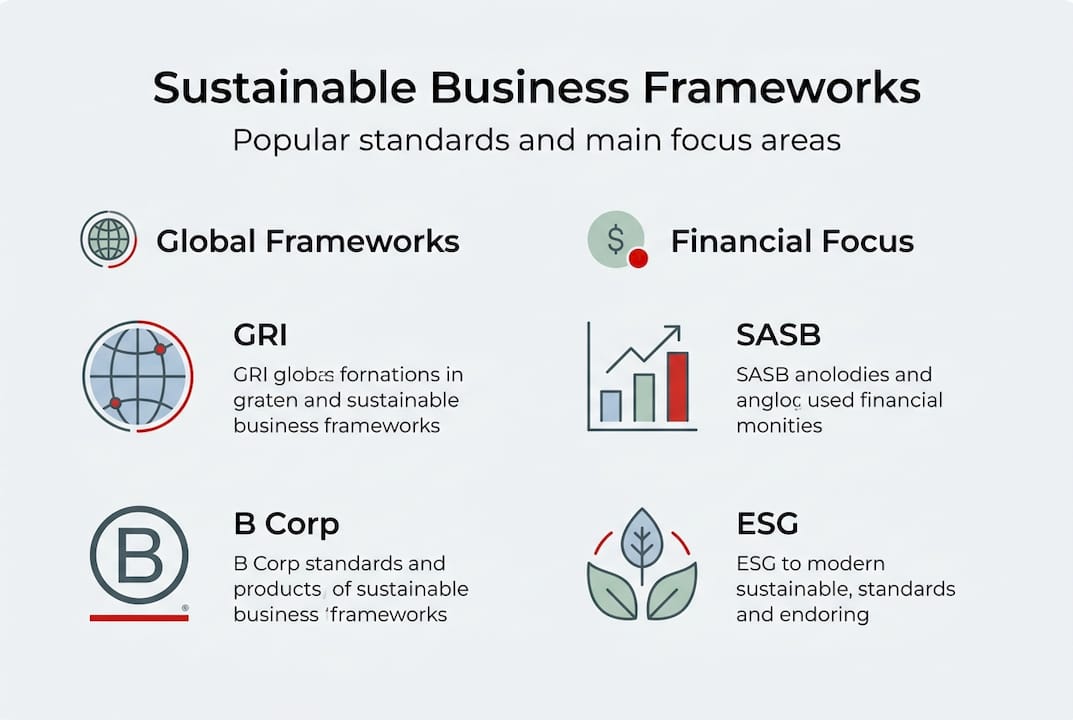
Sustainability Accounting Standards Board (SASB) focuses on financially material sustainability information. It helps you identify which ESG factors most significantly impact your industry’s financial performance. This targeted approach makes SASB particularly useful for investor communications.
B Corp Certification goes beyond reporting to verify that your entire business model creates positive impact. The rigorous assessment covers governance, workers, community, environment, and customers. Certified B Corps join a community of businesses committed to using business as a force for good.
| Framework | Primary Focus | Best For | Verification |
|---|---|---|---|
| GRI | Comprehensive ESG reporting | Organizations wanting detailed disclosure | Self-declared with external assurance option |
| SASB | Financially material sustainability factors | Investor-focused communications | Self-assessed against industry standards |
| B Corp | Holistic business impact | Companies seeking certification and community | Third-party verification required |
| CDP | Climate and environmental data | Environmental performance tracking | Self-reported with scoring system |
Transparent reporting builds trust incrementally. When you consistently share data using recognized frameworks, stakeholders can track your progress over time. This consistency matters more than perfection in any single report. Third-party assessment adds another layer of credibility by confirming that your self-reported data meets external standards.
Pro Tip: Don’t wait until you have perfect data to start using frameworks. Begin with the metrics you can measure now, then expand your reporting as your systems improve. Early adoption demonstrates commitment and gives you time to refine your approach.
Frameworks help standardize claims and minimize risks by providing clear definitions and measurement criteria. Instead of debating what “sustainable” means, you can point to specific standards that define the term. This clarity protects you from accusations of greenwashing while also making it easier to communicate with diverse stakeholders who may have different sustainability priorities.
The right business tools support framework implementation by automating data collection and reporting. Similarly, understanding the correct metric for startups helps you focus on sustainability indicators that actually drive business value rather than vanity metrics that look good but don’t create real impact.
Steps to build a sustainable business: A practical roadmap
Set measurable sustainability goals that align with your business strategy. Vague commitments like “reduce environmental impact” don’t drive action. Specific targets such as “reduce carbon emissions by 25% within three years” or “achieve 100% renewable energy by 2028” create accountability and focus your efforts.
Identify and engage key stakeholders early in your sustainability journey. This includes employees, customers, suppliers, investors, and community members. Each group has different priorities and concerns. Understanding these perspectives helps you design initiatives that create genuine value rather than checking boxes.
Choose a recognized framework that matches your industry and stakeholder needs. If you’re primarily communicating with investors, SASB might be your starting point. If you want comprehensive reporting that covers all stakeholder groups, GRI offers broader coverage. The framework you select should feel like a helpful structure, not a burden.
Effective sustainability starts with goal setting, stakeholder engagement, and ongoing communication. These foundational steps ensure your efforts address real needs rather than perceived expectations.
Implement sustainable practices in core operational areas:
- Operations: Audit energy use, waste generation, and resource consumption to identify improvement opportunities
- Supply chain: Evaluate supplier practices and establish sustainability criteria for procurement decisions
- Product design: Incorporate lifecycle thinking to minimize environmental impact from creation to disposal
- Workplace culture: Develop policies that support employee wellbeing and diversity
- Community engagement: Build partnerships that create shared value for your business and local communities
Regularly measure, report, and communicate progress to maintain momentum and accountability. Quarterly internal reviews help you catch issues early and adjust strategies. Annual public reporting demonstrates transparency and builds stakeholder trust. The rhythm of measurement creates discipline that prevents sustainability from becoming a forgotten initiative.
Pro Tip: Celebrate small wins publicly to build internal momentum. When employees see their efforts creating measurable impact, engagement increases and sustainability becomes part of your culture rather than a top-down mandate.
The businesses that successfully go greener treat sustainability as an ongoing journey rather than a destination. They build systems for continuous improvement, knowing that today’s best practices will evolve as technology advances and stakeholder expectations shift.
Sustainable business in action: Case studies and real-world examples
Patagonia has built its entire brand around environmental responsibility. The outdoor clothing company donates 1% of sales to environmental causes, uses recycled materials extensively, and actively encourages customers to repair rather than replace products. This commitment extends to transparent supply chain reporting and advocacy for environmental policies. The result is fierce customer loyalty and consistent growth in a competitive market.
Unilever transformed its operations through the Sustainable Living Plan, which set ambitious targets for reducing environmental impact while increasing social impact. The company reduced manufacturing waste, improved water efficiency, and sourced sustainable raw materials. Brands within the Unilever portfolio that emphasized sustainability grew 69% faster than the rest of the business, demonstrating clear market demand for responsible products.
Media and technology firms increasingly adopt standardized disclosure frameworks to boost trust. Microsoft committed to becoming carbon negative by 2030 and removing all historical emissions by 2050. The company publishes detailed annual sustainability reports using multiple frameworks, invests heavily in renewable energy, and created an internal carbon fee to drive accountability across divisions.
| Company | Industry | Key Initiative | Measurable Outcome |
|---|---|---|---|
| Patagonia | Retail/Apparel | 1% for the Planet, repair programs | Strong brand loyalty, consistent growth |
| Unilever | Consumer goods | Sustainable Living Plan | 69% faster growth for sustainable brands |
| Microsoft | Technology | Carbon negative commitment | Detailed framework reporting, renewable energy investment |
| Interface | Manufacturing | Mission Zero waste initiative | 96% reduction in manufacturing waste |
Interface, a carpet tile manufacturer, launched Mission Zero to eliminate negative environmental impact by 2020. The company redesigned products using recycled materials, shifted to renewable energy, and created a take-back program for old carpets. While they didn’t achieve zero impact, they reduced manufacturing waste by 96% and proved that industrial companies can dramatically improve sustainability without sacrificing profitability.
Lessons from these examples include:
- Authenticity matters: Customers and stakeholders quickly identify superficial efforts
- Integration is key: Sustainability works best when embedded in core business strategy
- Transparency builds trust: Honest reporting about both successes and challenges creates credibility
- Innovation follows commitment: Sustainability constraints often drive breakthrough solutions
These companies demonstrate that sustainable business isn’t a niche strategy for small eco-conscious brands. It’s a competitive approach that works across industries and scales. Whether you’re building strong social media for business or figuring out how to go greener, the principles remain consistent: set clear goals, measure progress, communicate transparently, and continuously improve.
Strategies to amplify your sustainable business journey
Transforming your business into a sustainable operation requires more than good intentions. You need practical resources, proven frameworks, and ongoing support to navigate the complexity. That’s where comprehensive platforms become invaluable.
TechMoths offers a growing library of guides and articles designed to help entrepreneurs and business leaders implement sustainable practices effectively. From detailed breakdowns of how to go greener to strategic insights on professional growth, the platform provides actionable information you can apply immediately.
The resources available through the TechMoths platform cover everything from foundational concepts to advanced implementation strategies. You’ll find articles on measuring what matters, building efficient operations, and communicating your sustainability story effectively. Each piece is designed to deliver practical value rather than theoretical concepts, helping you make real progress on your sustainability journey.
Frequently asked questions
What are the top three pillars of a sustainable business?
The key pillars are environmental responsibility, social impact, and strong governance. Together, these create a framework for balancing profitability with positive impact on people and the planet.
How can I prevent greenwashing in my company?
Use standardized frameworks like GRI and seek third-party verification to ensure credibility. Avoid vague claims and focus on specific, measurable commitments you can document.
Are sustainable business strategies only for large companies?
No, businesses of any size can adopt sustainable practices by starting small and scaling up. Focus on high-impact areas first, then expand as resources and capabilities grow.
What is the difference between greenwashing and greenhushing?
Greenwashing is overstating sustainability efforts; greenhushing is avoiding all communication about them. Both damage trust by preventing transparent dialogue with stakeholders.
What immediate steps can my business take to start being more sustainable?
Set measurable goals, consult standardized frameworks, and be transparent about your progress. Start with an energy or waste audit to identify quick wins that build momentum.
