

Role of Technology in Self-Improvement Today

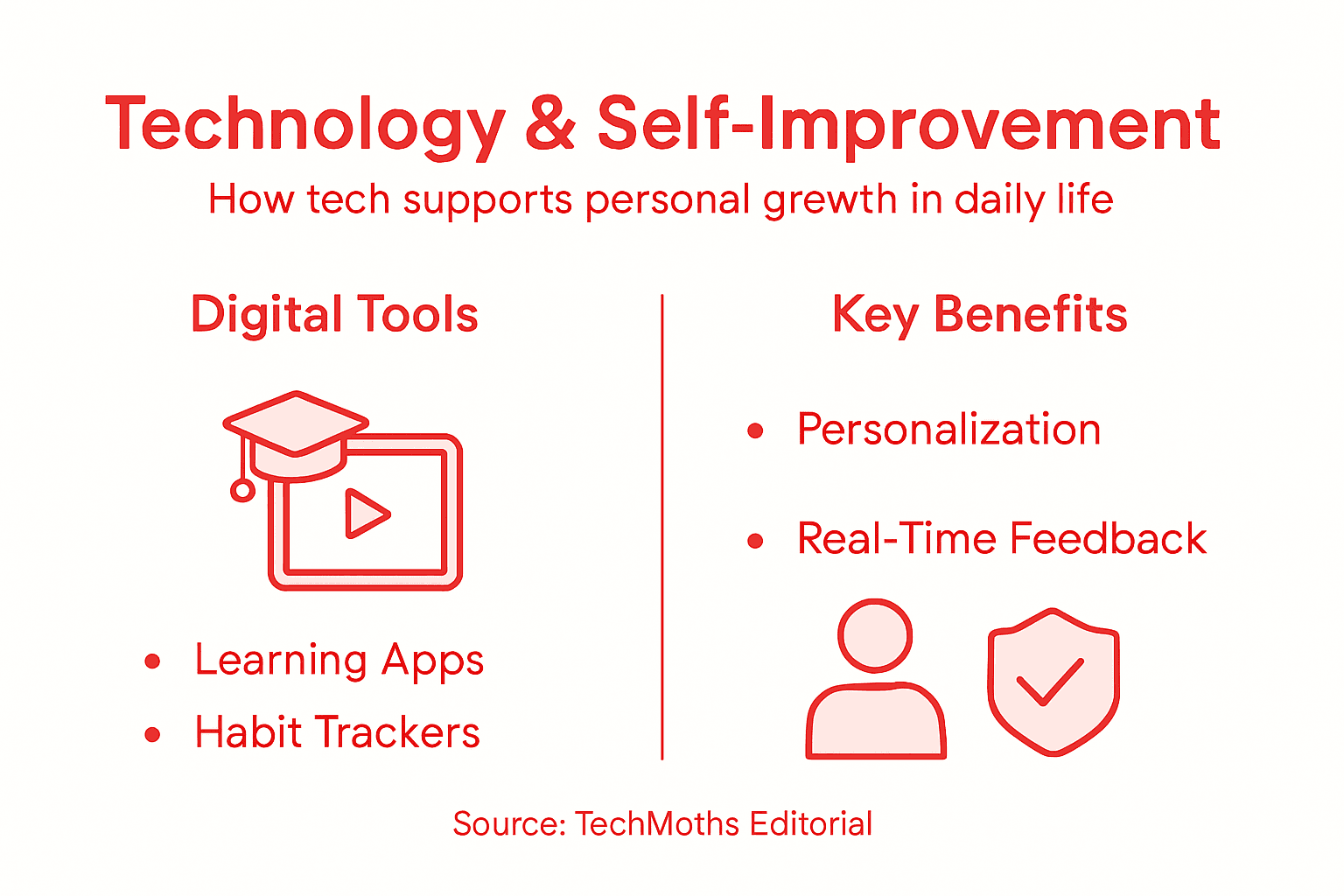
Balancing professional ambitions and personal growth in a busy schedule often feels like a puzzle. Many Millennial professionals look for practical ways to transform their routines, improve productivity, and develop new skills. Technology brings personalized learning platforms and adaptive tools that simplify self-improvement, offering customized feedback and real-time progress tracking for every unique goal. This article reveals how digital solutions reshape self-improvement, highlighting essential features and practical strategies to help you achieve continuous development without sacrificing valuable time.
Table of Contents
- Defining Technology In Self-Improvement
- Digital Tools And Apps For Growth
- Practical Benefits For Busy Professionals
- Risks Of Over-Dependence On Tech
- Common Pitfalls And How To Avoid Them
Key Takeaways
| Point | Details |
|---|---|
| Embrace Personalization | Utilize technology that adapts to your individual learning style to foster personal growth. |
| Monitor Progress | Take advantage of real-time tracking tools to visualize your development and make necessary adjustments. |
| Balance Technology Use | Schedule tech-free periods to enhance critical thinking and sustain cognitive flexibility. |
| Set Clear Goals | Develop a structured learning plan with specific, measurable objectives to maintain focus and motivation. |
Defining Technology in Self-Improvement
Technology in self-improvement represents a dynamic ecosystem of digital tools, platforms, and systems designed to enhance personal growth, learning, and skill development. At its core, this concept explores how technological innovations can systematically support individual transformation across cognitive, emotional, and professional domains.
Modern self-improvement technology encompasses a wide range of applications, from personalized learning platforms to advanced tracking systems. Personalized learning frameworks demonstrate how digital tools can scaffold individual growth by providing adaptive learning experiences tailored to unique personal needs and learning styles.
Key characteristics of technology in self-improvement include:
- Personalization of learning experiences
- Real-time performance tracking
- Adaptive learning algorithms
- Interactive skill development modules
- Data-driven feedback mechanisms
The technological approach to self-improvement fundamentally transforms traditional learning models by introducing unprecedented levels of customization and engagement. Digital platforms now enable learners to access targeted resources, track progress meticulously, and receive immediate, contextual feedback that accelerates skill acquisition and personal development.
Here’s a comparison of tech-enabled self-improvement and traditional methods:
| Aspect | Digital Tools & Platforms | Traditional Approaches |
|---|---|---|
| Personalization | AI-driven adaptive learning | Generally one-size-fits-all |
| Feedback Speed | Immediate, data-based | Often delayed, subjective |
| Progress Tracking | Automated, visual dashboards | Manual, self-recorded notes |
| Flexibility | Learn anytime, anywhere | Typically scheduled, location-based |
Pro tip: Select technology tools that offer personalized tracking and provide actionable insights into your specific learning journey.
Digital Tools and Apps for Growth
Digital tools and apps have revolutionized the landscape of personal development, offering unprecedented opportunities for targeted self-improvement across multiple domains. Self-regulated learning technologies now provide sophisticated platforms that support individual growth through personalized feedback, motivation enhancement, and adaptive learning experiences.
Modern self-improvement applications span diverse categories designed to address specific developmental needs:
- Cognitive enhancement apps
- Productivity and time management platforms
- Skill acquisition and learning management systems
- Mental health and wellness trackers
- Goal setting and personal development tools
These digital solutions leverage advanced technologies like artificial intelligence and machine learning to create intelligent learning environments that adapt to individual user patterns. By analyzing user behavior, performance metrics, and personal goals, these apps can generate customized recommendations and strategies for continuous personal growth.

Pro tip: Experiment with multiple digital tools to find the combination that best matches your unique learning style and personal development objectives.
Practical Benefits for Busy Professionals
Busy professionals face unique challenges in maintaining personal growth and skill development amid demanding work schedules. Innovation-driven strategies offer transformative approaches to self-improvement that integrate seamlessly with professional responsibilities.
Key practical benefits for time-constrained professionals include:
- Microlearning opportunities during short breaks
- Automated skill tracking and performance analysis
- Personalized learning pathways
- Flexible, on-demand educational resources
- Time-efficient skill development modules
Technology enables autonomous learning systems that adapt to individual professional contexts, allowing busy individuals to optimize their personal development without significant time investments. Advanced AI-powered platforms can analyze professional performance, identify skill gaps, and recommend targeted learning interventions that align precisely with career growth objectives.
Pro tip: Allocate just 15 minutes daily to targeted skill development using mobile learning applications to consistently advance your professional capabilities.
Risks of Over-Dependence on Tech
While technology offers remarkable self-improvement opportunities, excessive digital dependence can impair cognitive functions. The convenience of digital tools paradoxically creates potential barriers to genuine personal development by reducing critical thinking and self-directed learning capabilities.
Significant risks associated with over-reliance on technological solutions include:
- Diminished problem-solving skills
- Reduced mental resilience
- Weakened memory retention
- Decreased attention span
- Potential erosion of independent thinking
Technology should serve as a supplemental enhancement tool, not a complete replacement for personal effort and intrinsic motivation. Successful self-improvement requires maintaining a balanced approach where digital platforms support growth without completely substituting active personal engagement and critical skill development.
Pro tip: Schedule regular tech-free periods to maintain cognitive flexibility and prevent complete technological dependency in your personal development journey.
Common Pitfalls and How to Avoid Them
Navigating the complex landscape of technological self-improvement requires strategic awareness and proactive planning. Technology integration challenges reveal critical obstacles that can derail personal development efforts if not carefully addressed.
Common pitfalls in technology-assisted self-improvement include:
The following table summarizes common pitfalls in tech-driven self-improvement and suggests strategies to overcome them:
| Pitfall | Impact on Growth | Practical Strategy |
|---|---|---|
| Tech Over-dependence | Hinders independence | Schedule regular tech-free time |
| Lack of Structure | Limits progress | Set clear digital learning goals |
| Low Metacognitive Awareness | Reduces self-regulation | Use progress journals for reflection |
| Motivation Fluctuations | Stops learning momentum | Set reminders and micro-goals |
- Over-reliance on digital solutions
- Lack of structured learning approaches
- Insufficient metacognitive awareness
- Inconsistent motivation and engagement
- Technical complexity and learning curve barriers
Successful self-improvement demands intentional technological engagement that balances digital tools with personal accountability. By recognizing potential limitations and developing adaptive strategies, individuals can transform technological platforms from potential obstacles into powerful growth catalysts.
Pro tip: Create a structured digital learning plan with specific measurable goals and regular self-assessment checkpoints to maintain consistent progress and technological mindfulness.
Harness Technology for Your Best Self-Improvement Journey
Struggling to balance busy schedules and personal growth while avoiding the pitfalls of tech over-dependence Technology offers powerful tools for personalized learning and real-time progress tracking but knowing how to use these tools effectively is key. If you want to master adaptive learning algorithms, stay motivated, and overcome common challenges like distraction and lack of structure then it is time to explore expert insights and practical strategies.
Discover a wide range of enlightening articles and guides at TechMoths that empower you to create a balanced, tech-enhanced self-improvement routine. From memory improvement techniques to career advice and goal-setting frameworks our content helps you transform technology from a distraction into your personal development ally. Take the first step now by visiting TechMoths and start optimizing your growth with grounded, actionable knowledge today. Your best self is just a click away.
Frequently Asked Questions
What role does technology play in self-improvement?
Technology enhances self-improvement by providing personalized learning experiences, real-time performance tracking, and tailored feedback mechanisms, allowing individuals to accelerate their personal growth.
What are some digital tools for personal development?
Digital tools for personal development include cognitive enhancement apps, productivity and time management platforms, skill acquisition systems, mental health trackers, and goal-setting applications.
How can busy professionals benefit from self-improvement technology?
Busy professionals can benefit from self-improvement technology through microlearning opportunities, automated skill tracking, personalized learning pathways, and flexible resources that fit into their schedules.
What are the risks of relying too much on technology for self-improvement?
Over-dependence on technology can reduce critical thinking, impair problem-solving skills, and weaken memory retention. It’s essential to balance tech use with active personal engagement.
