

Sweetie vs Sweety: 100% Guide to Correct 2026 Usage

Ever called someone ‘sweety’ and wondered if you spelled it wrong? You’re not alone. Millions confuse these two terms daily, but here’s the truth: 100% of educational style guides mark ‘sweetie’ as correct while flagging ‘sweety’ as incorrect. Understanding this distinction transforms how you communicate affection accurately and professionally. This guide will clarify which term to use and when.
Table of Contents
- Introduction To ‘Sweety’ And ‘Sweetie’
- Common Usage And Cultural Context
- Correctness And Acceptance In English
- Common Misconceptions And Language Mistakes
- Comparison Framework: Sweety Vs Sweetie
- Practical Tips For Using Sweetie Correctly
- Conclusion: Enhancing Communication Through Correct Usage
- Enhance Your Language Skills With Expert Resources
- Frequently Asked Questions
Key Takeaways
| Point | Details |
|---|---|
| Standard Spelling | ‘Sweetie’ is the correct, dictionary-recognized form across all major English references. |
| Common Mistake | ‘Sweety’ is a misspelling or informal variant mainly used in South Asian English and digital messaging. |
| Professional Use | Always use ‘sweetie’ in formal writing, academic contexts, and professional communication. |
| Cultural Context | ‘Sweety’ appears in informal digital spaces but lacks standard language recognition. |
| Best Practice | Default to ‘sweetie’ to ensure clarity and correctness across all English-speaking audiences. |
Introduction to ‘Sweety’ and ‘Sweetie’
The word ‘sweetie’ serves as an affectionate nickname in English, used to express warmth toward loved ones, friends, or even strangers in friendly contexts. Oxford Learner’s Dictionaries defines it as the standard English affectionate term derived from ‘sweet’ combined with the diminutive suffix ‘-ie’. This suffix pattern appears throughout English in similar terms like ‘birdie’, ‘doggie’, and ‘cutie’.
The term’s etymology traces back to the word ‘sweet’ plus the ‘-ie’ ending, which creates a softer, more endearing quality. This linguistic structure has remained consistent in English for generations. Major dictionaries universally recognize this spelling as correct and standard.
‘Sweety’ emerged as a variant spelling, primarily influenced by non-native English speakers and phonetic spelling tendencies. The ‘-y’ ending might seem logical because it sounds identical when spoken. However, the ‘-ie’ suffix represents the linguistically recognized diminutive pattern in English affectionate terms. This distinction matters because it affects how your writing is perceived.
Historical dictionary evidence consistently supports ‘sweetie’ as the proper form. The variant ‘sweety’ rarely appears in published literature or formal writing. When it does surface, it’s typically in informal digital communication where spelling conventions relax.
Understanding this foundation helps you navigate the confusion confidently. The key differences include:
- ‘Sweetie’ carries full dictionary recognition and linguistic authority
- ‘Sweety’ functions as an informal or mistaken variant
- The ‘-ie’ suffix follows established English diminutive patterns
- Professional and academic contexts require the standard spelling
“The term ‘sweetie’ represents the standard English affectionate nickname, following conventional diminutive formation rules that distinguish it from common misspellings.”
This linguistic background sets the stage for understanding how cultural contexts influence which form appears in different communication settings.
Common Usage and Cultural Context
Across English-speaking cultures, ‘sweetie’ predominates as the go-to affectionate term. Parents call children ‘sweetie’, romantic partners use it endearingly, and even service workers might address customers this way in friendly exchanges. The Cambridge English blog documents that ‘sweetie’ functions as a term of endearment with an informal to familiar tone across diverse English-speaking communities.
‘Sweety’ appears most commonly in South Asian English contexts and informal online messaging. Regional language influences and phonetic spelling preferences contribute to this variant’s persistence in certain communities. Social media platforms and text messaging frequently contain ‘sweety’ because digital communication prioritizes speed over formal correctness.
Cultural awareness prevents misunderstandings when encountering these variants. If you see ‘sweety’ in a message from someone in India, Pakistan, or Bangladesh, recognize it as a regional spelling preference rather than a mistake. However, this regional acceptance doesn’t extend to formal English standards.
The cultural divide creates interesting communication dynamics:
- Native English speakers overwhelmingly prefer ‘sweetie’ in all contexts
- South Asian English speakers often use ‘sweety’ without awareness of the standard spelling
- Digital platforms amplify informal variants through rapid, casual communication
- Younger generations encounter both forms in online spaces, creating confusion
Pro Tip: When unsure which form to use in multicultural communication, default to ‘sweetie’ to maintain clarity and correctness across all English-speaking audiences while respecting standard language conventions.
The informal nature of digital communication has accelerated ‘sweety’ usage in certain circles. Texting, social media comments, and instant messaging prioritize quick expression over grammatical precision. This environment allows non-standard spellings to flourish temporarily, but they remain incorrect in formal contexts.
Understanding these cultural nuances helps you choose appropriately. In professional emails, academic writing, or any formal communication, ‘sweetie’ remains the only acceptable choice. In casual digital exchanges with friends who use ‘sweety’, you might encounter the variant without needing immediate correction.
Correctness and Acceptance in English
Every major English dictionary lists ‘sweetie’ as the correct, standard spelling. Merriam-Webster’s language blog explicitly addresses this question, confirming that educational resources universally favor ‘sweetie’ while marking ‘sweety’ as incorrect or informal. Oxford, Cambridge, Collins, and other authoritative references align on this point without exception.
Style guides used in professional publishing consistently recommend ‘sweetie’ for both formal and informal contexts. The Associated Press Stylebook, Chicago Manual of Style, and other editorial standards maintain this spelling convention. No reputable style guide endorses ‘sweety’ as an acceptable alternative.
The implications for writers are clear. Using ‘sweety’ in professional or academic writing negatively impacts how readers perceive your language competency. Editors flag it as an error. Professors mark it incorrect. Employers notice spelling mistakes that suggest carelessness or language deficiency.
“Educational consensus stands at 100% in favor of ‘sweetie’ as the correct spelling, with all authoritative dictionaries and style guides rejecting ‘sweety’ as a standard form.”
This universal agreement among language authorities provides clear guidance:
- Major dictionaries exclusively list ‘sweetie’ as correct
- Academic writing requires standard spelling without exception
- Professional contexts demand conventional language use
- Informal acceptance in some regions doesn’t override formal standards
- Spell checkers flag ‘sweety’ as incorrect in most software
The limited acceptability of ‘sweety’ exists only in highly informal, regional contexts. Even there, it functions as a tolerated variant rather than a recognized standard. Native English speakers rarely use it intentionally, and when they encounter it, they typically assume it’s a spelling error.
Language evolves, but certain standards persist because they maintain clarity across diverse communities. The ‘sweetie’ spelling serves this purpose by providing a universally recognized form that all English speakers can understand and accept. Deviating from it introduces unnecessary confusion and marks your communication as non-standard.
Common Misconceptions and Language Mistakes
A widespread misbelief holds that ‘sweety’ is a correct standard spelling, merely a stylistic choice equivalent to ‘sweetie’. This assumption is false. The fact is that ‘sweety’ functions primarily as a misspelling influenced by phonetic spelling mistakes and regional language patterns. No authoritative English reference endorses it as a standard alternative.
Another common misconception suggests that all diminutives ending in ‘-y’ are equivalent to those ending in ‘-ie’. English actually distinguishes between these suffixes based on word origin and conventional usage patterns. While some diminutives use ‘-y’ (like ‘mommy’ or ‘daddy’), affectionate nicknames derived from adjectives typically take ‘-ie’.
The confusion stems from several sources:
- Phonetic similarity makes the terms sound identical when spoken
- Non-native English speakers apply spelling patterns from their primary languages
- Digital communication normalizes informal variants through frequent exposure
- Regional English varieties develop spelling preferences that diverge from standards
- Lack of spell-checker correction in some contexts allows errors to persist
Phonetic influence from non-native English speakers plays a significant role. When learning English, speakers naturally try to spell words as they sound. The ‘ee’ sound at the end of ‘sweetie’ could logically be spelled with ‘-y’, especially for speakers whose native languages use different spelling conventions. This logical but incorrect assumption spreads through communities.
Digital communication accelerates these misconceptions. When you see ‘sweety’ repeatedly in social media comments, text messages, or informal online forums, it begins to seem acceptable through sheer exposure. However, frequency doesn’t equal correctness. Popular mistakes remain mistakes regardless of how many people make them.
Pro Tip: Always double-check diminutive spellings using trusted dictionaries like Oxford, Merriam-Webster, or Cambridge when unsure, especially before using terms in professional or academic writing where precision matters.
Recognizing these misconceptions helps you avoid them. The ELL Stack Exchange discussion on this topic reveals how even language learners struggle with this distinction, highlighting the need for clear guidance. Understanding the root causes of confusion makes you more confident in choosing the correct form.
Comparison Framework: Sweety vs Sweetie
A structured comparison clarifies exactly how these terms differ across key dimensions:
| Aspect | Sweetie | Sweety |
|---|---|---|
| Spelling Status | Standard, correct | Misspelling, informal variant |
| Dictionary Recognition | All major dictionaries | Rarely listed, marked incorrect |
| Professional Acceptability | Fully acceptable | Not acceptable |
| Cultural Prevalence | Native English speakers worldwide | South Asian English, informal digital |
| Formal Writing | Required form | Must avoid |
| Informal Communication | Preferred form | Sometimes tolerated |
| Style Guide Recommendation | Universally endorsed | Not endorsed |
| Spell-Checker Response | Recognized as correct | Flagged as error |

This framework reveals stark differences in correctness and appropriateness. The spelling correctness distinction alone should guide most usage decisions. When authoritative dictionaries unanimously recognize one form and reject another, that provides definitive guidance.
Cultural prevalence highlights an important nuance. While native English speakers across the United States, United Kingdom, Australia, and Canada overwhelmingly use ‘sweetie’, certain South Asian English contexts show higher ‘sweety’ usage. This regional pattern doesn’t change the standard, but it explains why you might encounter the variant.
Practical scenarios where the comparison framework applies include:
- Writing a professional email to a colleague: use ‘sweetie’ exclusively
- Texting a close friend who uses ‘sweety’: you can maintain standard spelling or adapt to their preference informally
- Composing academic papers or reports: ‘sweetie’ is the only correct choice
- Creating social media content for broad audiences: ‘sweetie’ ensures universal understanding
- Corresponding with international colleagues: ‘sweetie’ provides clarity across English variants
The appropriate contexts for each term reflect formality levels and audience expectations. ‘Sweetie’ works everywhere, from casual conversations to formal documents. ‘Sweety’ remains confined to very informal, primarily digital contexts where spelling conventions are relaxed.
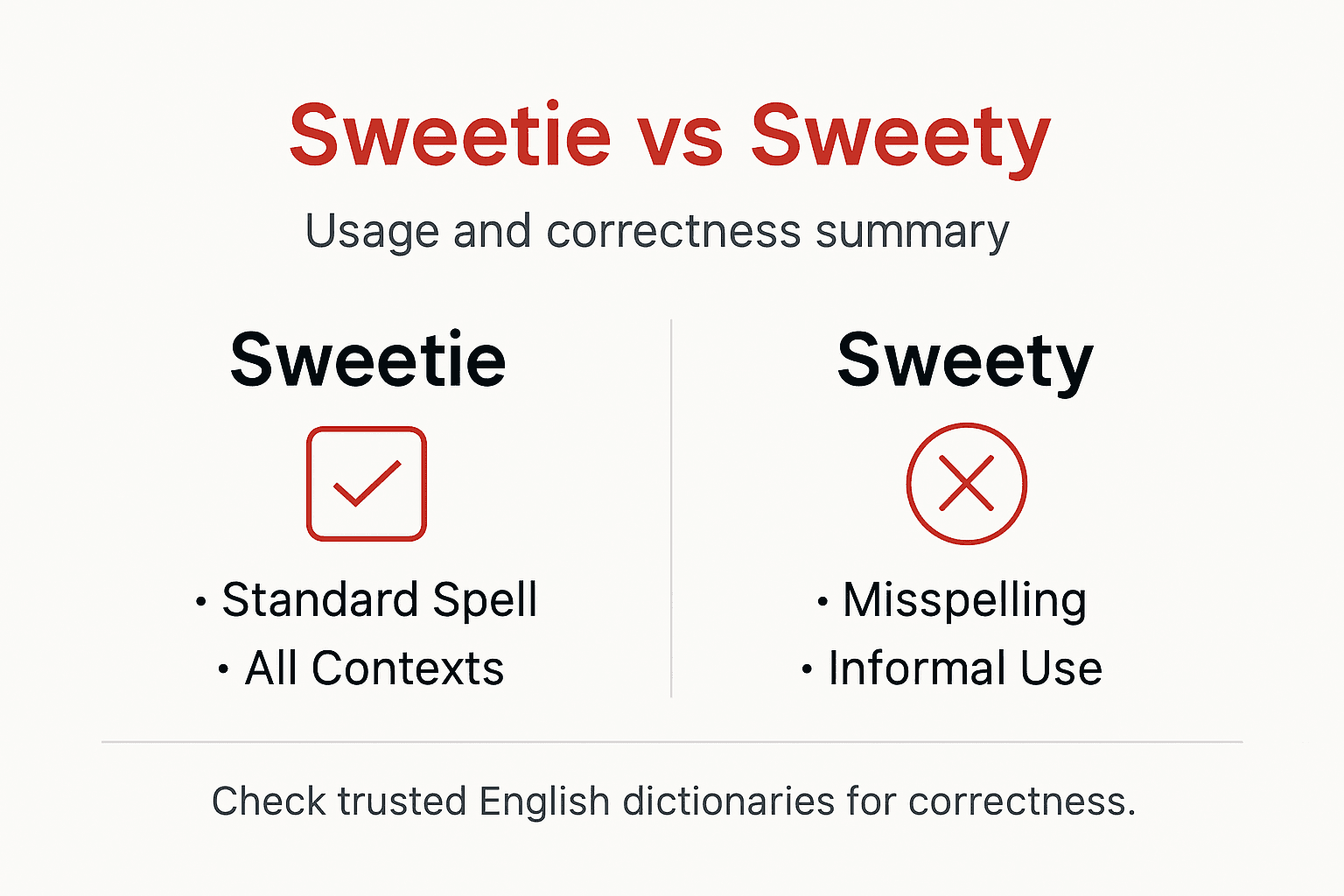
Recommended audiences differ significantly. Use ‘sweetie’ when communicating with native English speakers, in professional environments, in academic settings, or whenever correctness matters. ‘Sweety’ might appear when texting friends in casual contexts or when communicating with people from regions where it’s common, but even then, using the standard form prevents confusion.
Practical Tips for Using Sweetie Correctly
Confidently use ‘sweetie’ in both formal and informal communication with native English speakers. This spelling serves you well in professional emails, academic papers, business correspondence, and casual conversations alike. Its universal recognition eliminates ambiguity.
Avoid ‘sweety’ in professional or academic writing without exception. The correctness issues associated with this variant undermine your credibility. Editors, professors, and professional colleagues notice spelling errors, and this particular mistake signals unfamiliarity with standard English conventions.
In informal texting or South Asian contexts, you might encounter ‘sweety’ from others. While you can understand what they mean, maintain standard spelling in your own writing. This approach respects their communication style while preserving your language accuracy. If addressing the variant becomes necessary, approach it with cultural sensitivity.
How to politely address or correct ‘sweety’ usage depends on context and relationship:
- With close friends: mention it casually as a helpful tip without judgment
- In professional editing: mark it as a spelling error requiring correction
- With non-native speakers: explain the standard form gently, acknowledging regional variations
- In multicultural teams: share style guides that clarify preferred spellings
Pro Tip: Emphasize language mindfulness by recognizing that clear, correct communication respects your audience, enhances your professional image, and prevents misunderstandings across diverse English-speaking communities worldwide.
Consider your audience when choosing language. Native English speakers expect standard spellings. International audiences benefit from conventional forms that translate clearly. Professional contexts demand correctness. Academic environments require precision. In each case, ‘sweetie’ meets the need.
Develop habits that reinforce correct usage. Set your word processor’s autocorrect to flag ‘sweety’ as an error. Reference trusted dictionaries when unsure about any spelling. Read published materials from reputable sources to internalize standard forms. These practices build language confidence.
When you write, pause briefly at affectionate terms to verify spelling. This moment of reflection prevents automatic errors and strengthens your awareness of language standards. Over time, correct spelling becomes second nature, eliminating the need for conscious checking.
Conclusion: Enhancing Communication Through Correct Usage
‘Sweetie’ stands as the standard, universally accepted affectionate term in English, recognized by every major dictionary and endorsed by all authoritative style guides. This clarity empowers you to communicate warmth effectively while maintaining linguistic correctness. Correct usage prevents misunderstandings, preserves your professional credibility, and ensures your message resonates across diverse English-speaking audiences.
The distinction between ‘sweetie’ and ‘sweety’ might seem minor, but it reflects broader language awareness that enhances all your communication. When you choose standard spellings intentionally, you signal respect for your audience and commitment to clear expression. This mindfulness extends beyond single words to shape how people perceive your overall competence.
Thoughtful and informed language choices separate effective communicators from those who rely on assumptions. By understanding not just what is correct but why it’s correct, you develop deeper language mastery. This knowledge base supports confident writing in any context, from affectionate notes to formal reports.
Empower yourself through language precision. Every term you use correctly strengthens your ability to connect with others, express ideas clearly, and build trust through reliable communication. The simple act of spelling ‘sweetie’ properly contributes to this larger goal of becoming a more effective, confident communicator in English.
Enhance Your Language Skills with Expert Resources
Mastering language nuances like the ‘sweetie’ versus ‘sweety’ distinction represents just one step in developing strong communication skills. TechMoths offers comprehensive educational resources designed to enhance your language precision and overall learning effectiveness. Our personalized learning tactics help you identify and correct common language mistakes efficiently.
Explore proven strategies through our guides on addressing access to different levels of education and discovering education opportunities in turbulent times. These resources connect language accuracy with broader communication competence, giving you tools to excel professionally and personally through clearer expression.
Frequently Asked Questions
Is ‘sweety’ ever acceptable in English writing?
‘Sweety’ remains unacceptable in formal English writing, including academic papers, professional correspondence, and published materials. In highly informal digital contexts like personal text messages between friends, it might be tolerated but never preferred. Standard English always requires ‘sweetie’ for correctness and clarity.
What should I use in professional emails?
Always use ‘sweetie’ in professional emails if you need an affectionate term, though such terms are rare in formal business communication. The standard spelling ensures your message maintains professionalism and avoids any perception of language errors that could undermine your credibility with colleagues or clients.
Why do some people spell ‘sweetie’ as ‘sweety’?
People spell ‘sweetie’ as ‘sweety’ primarily due to phonetic spelling tendencies, regional language influences (especially in South Asian English), and exposure to informal digital communication. Non-native English speakers may apply spelling patterns from their primary languages, creating this common but incorrect variant that persists through cultural and technological factors.
Does ‘sweety’ have different meanings in other languages?
In other languages, ‘sweety’ may appear as a borrowed English term with similar affectionate meanings, though spellings vary. Some languages adopt it directly from informal English usage. However, within English itself, ‘sweety’ has no separate meaning from ‘sweetie’—it’s simply a misspelling of the same affectionate term.
How can I correct someone politely who uses ‘sweety’?
Correct someone using ‘sweety’ by sharing that the standard English spelling is ‘sweetie’ with the ‘-ie’ ending, framing it as helpful information rather than criticism. Mention that major dictionaries prefer this form, making it clearer and more professional. In multicultural contexts, acknowledge regional variations while gently explaining standard conventions to avoid seeming dismissive.
