
Role of Cloud Computing in Boosting SME Success

Switching from traditional IT setups to modern solutions can be confusing, especially when every decision impacts cost and performance. For small and medium enterprises, understanding the true meaning of cloud computing is critical for making informed choices. This guide breaks down what cloud computing really is, clears up common misconceptions, and highlights practical benefits so you can maximize efficiency and savings in your organization.
Table of Contents
- Cloud Computing’s Meaning and Misconceptions
- Essential Cloud Models and Service Types
- How Cloud Solutions Power SME Growth
- Key Benefits for SMEs: Efficiency and Savings
- Risks, Challenges, and Risk Mitigation
- Cost Comparison With Traditional IT Approaches
Key Takeaways
| Point | Details |
|---|---|
| Cloud Computing Offers Cost Efficiency | By eliminating significant upfront investments and utilizing a pay-as-you-go model, organizations can optimize their IT expenses. |
| Understanding Cloud Models is Crucial | Organizations should carefully evaluate cloud service and deployment models to align them with their specific operational needs and strategic objectives. |
| Cloud Benefits for SMEs | Cloud solutions empower SMEs by enhancing scalability, accessibility, and innovation while reducing overall costs. |
| Addressing Security Challenges is Essential | A comprehensive approach to cloud security involves proactive risk management and continuous monitoring to safeguard sensitive data. |
Cloud Computing’s Meaning and Misconceptions
Cloud computing represents a transformative technology that enables businesses to access computing resources without massive upfront infrastructure investments. According to the National Institute of Standards and Technology (NIST), cloud computing is a model providing convenient, on-demand network access to shared configurable computing resources.
At its core, cloud computing is not just about technology, but a fundamental shift in how organizations consume and manage computational capabilities. The model allows companies to scale resources dynamically, paying only for what they actually use. Unlike traditional IT infrastructures that require significant capital expenditure, cloud computing offers flexibility and cost-efficiency.
Key characteristics of cloud computing include:
- On-demand self-service: Users can provision computing resources automatically
- Broad network access: Services are available across multiple devices and platforms
- Resource pooling: Computing resources are shared and dynamically assigned
- Rapid elasticity: Capabilities can be scaled up or down quickly
- Measured service: Resource usage is precisely monitored and reported
Misconceptions about cloud computing often stem from security and control concerns. Many organizations misunderstand the shared responsibility model between cloud providers and consumers, leading to unnecessary hesitation. In reality, reputable cloud services offer robust security protocols that frequently surpass traditional on-premises infrastructure capabilities.
Pro tip: Before migrating to cloud services, conduct a comprehensive assessment of your specific organizational needs and potential provider security frameworks.
Essential Cloud Models and Service Types
Cloud computing offers a diverse range of service and deployment models designed to meet varying organizational needs. Cloud computing encompasses multiple service types that fundamentally transform how businesses access and utilize technological resources.
The primary cloud service models include three essential categories:
- Infrastructure as a Service (IaaS): Provides virtualized computing resources like servers, storage, and networking
- Platform as a Service (PaaS): Offers development and deployment platforms for software creation
- Software as a Service (SaaS): Delivers complete software applications directly over the internet
Deployment models represent another critical dimension of cloud computing, enabling organizations to choose architectures that align with their specific security, control, and scalability requirements. These deployment strategies include public clouds (shared resources), private clouds (dedicated infrastructure), hybrid clouds (combining public and private), and multi-cloud approaches that distribute workloads across multiple providers.
Each cloud model offers unique advantages, and the optimal choice depends on an organization’s specific technological ecosystem, compliance requirements, and strategic objectives.
Understanding these models allows businesses to design more flexible, cost-effective, and scalable technological infrastructures. By carefully evaluating their specific needs, organizations can leverage cloud computing to drive innovation, reduce operational costs, and enhance overall technological agility.
Pro tip: Conduct a comprehensive audit of your current IT infrastructure before selecting a cloud service model to ensure maximum alignment with your business goals.
Here’s a comparison of the primary cloud service models and deployment strategies:
| Cloud Model Type | Purpose | Best Use Case | Scalability |
|---|---|---|---|
| IaaS | Provides virtualized resources | Rapid infrastructure expansion | Highly scalable |
| PaaS | Platform for app development | Streamlined software creation | Scalable as needed |
| SaaS | Delivers ready-to-use apps | Everyday business operations | Instantly scalable |
| Public Cloud | Shared resources, external host | Cost-sensitive, non-critical workloads | Very high |
| Private Cloud | Dedicated resources, private host | Sensitive data, full control | Limited by internal resources |
| Hybrid Cloud | Combines public & private | Balance flexibility/security | Flexible scaling |
| Multi-Cloud | Uses several providers | Redundancy, vendor flexibility | Dynamic across vendors |
How Cloud Solutions Power SME Growth
Digital transformation strategies have become critical for small and medium enterprises seeking competitive advantages in today’s rapidly evolving business landscape. Cloud computing emerges as a powerful catalyst, enabling SMEs to overcome traditional technological and resource limitations by providing scalable, flexible infrastructure solutions.
The primary growth benefits of cloud solutions for SMEs include:
- Cost reduction: Eliminating expensive hardware investments
- Scalability: Rapidly adjusting computing resources to business needs
- Accessibility: Enabling remote work and global collaboration
- Innovation acceleration: Providing advanced technological capabilities
- Operational efficiency: Streamlining business processes and workflows
Cloud technologies democratize access to enterprise-grade technological capabilities, allowing smaller businesses to compete on equal footing with larger organizations.
Moreover, digital transformation strategies unlock significant potential by lowering technological entry barriers. SMEs can now leverage sophisticated tools previously accessible only to large corporations, transforming their operational models and strategic approach to business growth.

By embracing cloud solutions, SMEs can create more agile, responsive business ecosystems that adapt quickly to market changes and customer demands. The ability to scale resources instantaneously provides unprecedented flexibility and competitive advantage.
Pro tip: Implement a phased cloud adoption strategy, starting with low-risk workloads to build confidence and expertise before comprehensive migration.
Key Benefits for SMEs: Efficiency and Savings
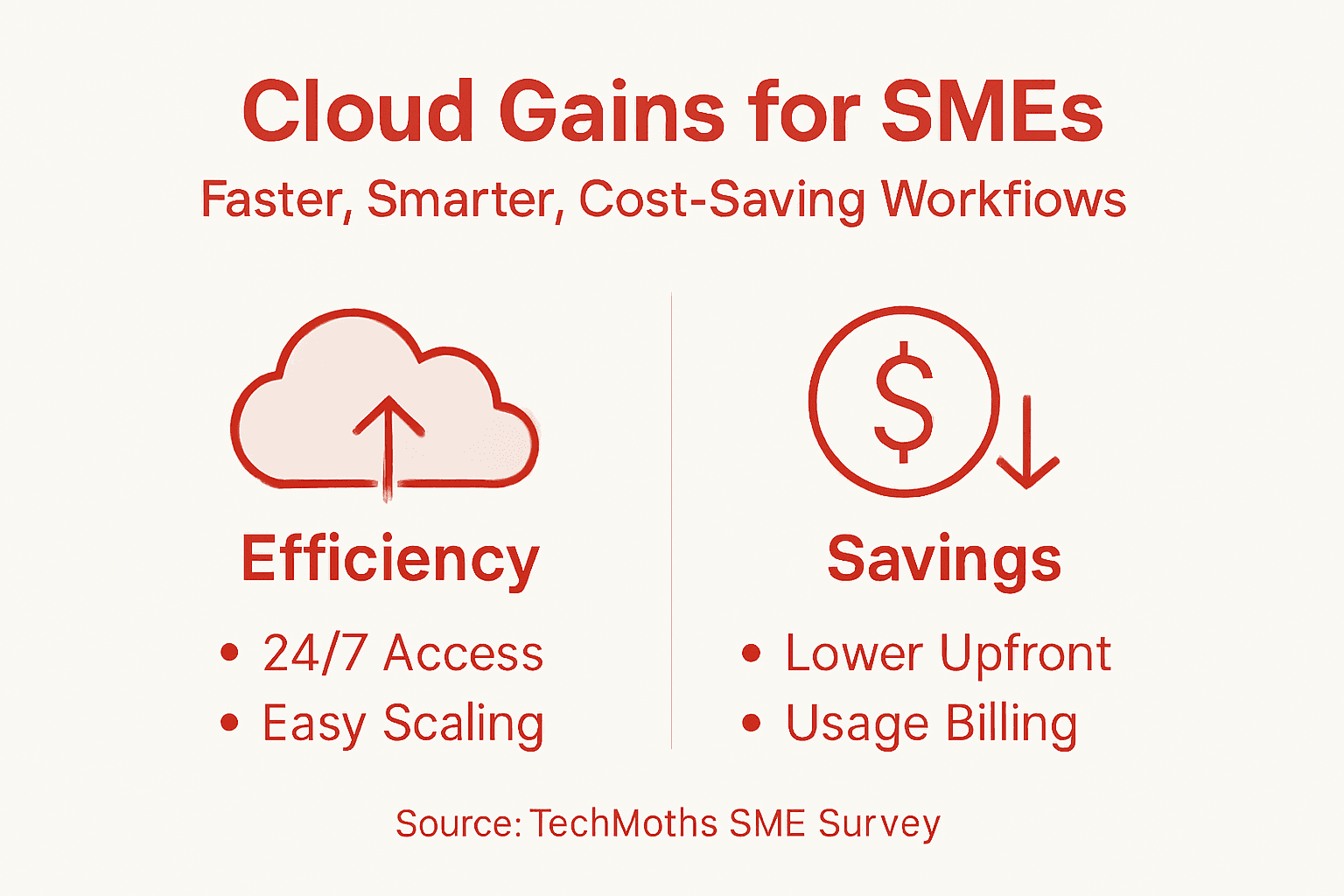
Cloud computing technologies are revolutionizing how small and medium enterprises optimize their operational efficiency and reduce costs. By eliminating substantial upfront hardware investments, cloud solutions provide SMEs with unprecedented flexibility and financial agility.
The key efficiency and savings benefits include:
- Reduced Infrastructure Costs: Eliminating expensive on-premises hardware
- Pay-as-You-Go Models: Paying only for actual computing resources used
- Scalable Resources: Instantly adjusting computing power to business needs
- Lower Maintenance Expenses: Minimizing internal IT support requirements
- Enhanced Productivity: Enabling faster, more streamlined business processes
Cloud computing transforms fixed technological expenses into flexible, manageable operational costs, allowing SMEs to redirect financial resources toward core business growth strategies.
Cloud accounting adoption further amplifies organizational performance by improving financial management and reporting capabilities. SMEs can leverage sophisticated accounting tools previously accessible only to larger corporations, enabling more strategic decision-making and resource allocation.
By strategically implementing cloud solutions, small businesses can create leaner, more responsive operational models that adapt quickly to market changes while maintaining robust technological infrastructure at a fraction of traditional implementation costs.
Pro tip: Conduct a comprehensive cost-benefit analysis before cloud migration, identifying specific workflows that will generate the most significant efficiency gains.
Risks, Challenges, and Risk Mitigation
Cloud security risks represent significant challenges for small and medium enterprises adopting cloud technologies. Understanding these potential vulnerabilities is crucial for developing robust, comprehensive protection strategies that safeguard sensitive business data and operational integrity.
Key cloud computing risks for SMEs include:
- Misconfiguration: Improperly set security parameters
- Inadequate Access Management: Weak identity verification protocols
- API Security Vulnerabilities: Potential exploitation through insecure interfaces
- Third-Party Risk: Exposure from external service provider weaknesses
- Advanced Persistent Threats: Sophisticated cyber attack strategies
The most effective risk mitigation strategies transform potential vulnerabilities into opportunities for strengthening organizational cybersecurity frameworks.
Comprehensive cloud security approaches require SMEs to implement multi-layered defense mechanisms. This involves adopting stringent encryption protocols, establishing secure access controls, conducting regular security audits, and selecting cloud providers with proven compliance standards.
Successful risk management demands a proactive, holistic approach that balances technological solutions with ongoing employee education and strategic vendor selection. SMEs must view cloud security not as a one-time implementation but as a continuous, evolving process of protection and adaptation.
Pro tip: Develop a comprehensive cloud security incident response plan that outlines clear protocols for identifying, containing, and recovering from potential security breaches.
Cost Comparison With Traditional IT Approaches
Cloud computing investments have dramatically transformed the financial landscape of technological infrastructure for small and medium enterprises. Unlike traditional IT approaches that require substantial upfront capital expenditures, cloud computing offers a more flexible and economical alternative.
Key cost differences between cloud and traditional IT approaches include:
- Capital Expenditure: Cloud eliminates massive upfront hardware investments
- Maintenance Costs: Reduced internal IT support and infrastructure management
- Scalability: Pay only for resources actually consumed
- Operational Flexibility: Instant resource adjustment without additional hardware purchases
- Technology Upgrades: Automatic updates included without separate procurement costs
Cloud computing fundamentally shifts IT spending from fixed capital expenses to dynamic, manageable operational costs.
Comparative computing models reveal significant financial advantages for businesses adopting cloud technologies. Traditional IT infrastructures require continuous investment in physical servers, networking equipment, cooling systems, and dedicated personnel, creating substantial ongoing expenses.
By contrast, cloud computing provides SMEs with a cost-effective model that transforms technological investment from a capital-intensive endeavor to a flexible, scalable operational expense. This approach enables businesses to redirect financial resources toward core growth strategies instead of maintaining complex IT infrastructures.
Pro tip: Conduct a comprehensive total cost of ownership analysis comparing your current IT setup with potential cloud solutions to identify precise financial benefits.
Below is a side-by-side cost comparison of cloud versus traditional IT for SMEs:
| Expense Category | Cloud Computing Approach | Traditional IT Approach |
|---|---|---|
| Upfront Capital Outlay | Minimal, subscription-based | High, hardware/software purchases |
| Maintenance Costs | Included in provider fees | Ongoing internal IT labor/repairs |
| Resource Flexibility | On-demand scalability | Locked into existing infrastructure |
| Upgrade Cycle | Automatic and frequent | Manual and periodic, often delayed |
| Long-Term Financial Impact | Variable, aligns with usage | Fixed and often unpredictable |
Unlock the Full Potential of Cloud Computing for Your SME Success
The article highlights how cloud computing solves critical challenges like high upfront costs, scalability issues, and security concerns that often hold back small and medium enterprises from growing. If you are striving to reduce operational expenses, boost flexibility, and accelerate innovation with cloud solutions, you need reliable insights and guidance tailored to your unique needs. Understanding models like IaaS, PaaS, and SaaS alongside deployment strategies can transform your business infrastructure and unlock competitive advantages.
Explore actionable strategies and expert advice on TechMoths to navigate your cloud journey confidently. Benefit from a wealth of educational content designed to empower your technological transformation and drive sustainable growth.
Take control of your SME’s future today by diving deeper into cloud computing advantages with TechMoths. Visit TechMoths now and discover how informed decisions about cloud adoption can reduce costs, improve security, and enhance operational efficiency. Don’t wait to give your business the edge it deserves—embrace the cloud with trusted knowledge at your fingertips.
Frequently Asked Questions
How does cloud computing benefit small and medium enterprises (SMEs)?
Cloud computing offers SMEs cost reduction, scalability, accessibility for remote work, increased innovation, and improved operational efficiency, allowing them to compete more effectively in the market.
What are the key cloud service models that SMEs should consider?
The primary cloud service models include Infrastructure as a Service (IaaS), Platform as a Service (PaaS), and Software as a Service (SaaS). Each model serves different needs, from infrastructure to application delivery.
What risks should SMEs be aware of when adopting cloud computing?
SMEs should be mindful of risks such as misconfiguration, inadequate access management, API security vulnerabilities, third-party risks, and advanced persistent threats that could affect data security and integrity.
How can SMEs effectively manage their cloud computing costs?
SMEs can manage cloud costs by utilizing pay-as-you-go models, conducting comprehensive cost-benefit analyses, and regularly assessing usage to ensure they’re only paying for the resources they actually need.
Recommended
- 8 Reasons You Need IT Support Services in Your New Business
- Startups Using Technology to Win the Hearts and Minds of Customers
- What Is the Cost of Running Your Startup on AWS? – TechMoths
- What Are The Components of SASE Architecture? – TechMoths
- Cloud POS Systems: Transforming UK Hospitality Operations
