

Role of blockchain in business: transparency & efficiency

Blockchain has moved far beyond cryptocurrency headlines to become a strategic driver of enterprise innovation. In 2026, businesses across manufacturing, finance, and supply chain operations are leveraging blockchain to eliminate inefficiencies, reduce fraud, and automate complex multi-party processes. This article explores how blockchain reshapes business operations, delivers measurable ROI, and addresses the practical challenges organizations face when integrating this transformative technology into their workflows.
Table of Contents
- Understanding Blockchain’s Foundational Role In Business Operations
- Blockchain’s Transformative Impact On Supply Chains And Asset Management
- Navigating Blockchain Adoption Strategies And Interoperability Challenges
- Real-World Enterprise Blockchain Applications And Measurable ROI
- How TechMoths Can Support Your Blockchain Journey
- Frequently Asked Questions
Key takeaways
| Point | Details |
|---|---|
| Transparency and automation | Blockchain creates shared ledgers that eliminate reconciliation costs and automate compliance across organizations. |
| Supply chain benefits | Enhanced tracking, fraud reduction, and faster recalls improve operational performance in food, pharmaceutical, and manufacturing sectors. |
| Measurable ROI | Enterprises report 41% positive ROI by integrating blockchain with governance frameworks and operational readiness strategies. |
| Adoption challenges | Interoperability, regulatory compliance, and choosing between permissioned and permissionless models require careful planning. |
| Real-world applications | Manufacturing, finance, and Oil & Gas sectors demonstrate how blockchain optimizes Lean management and delivery capacity. |
Understanding blockchain’s foundational role in business operations
Blockchain functions as a common infrastructure layer that coordinates multi-party business processes without requiring intermediaries. Organizations use blockchain as foundational technology to increase organizational transparency, automate cross-organizational processes, and remove reconciliation costs. This shift transforms how businesses manage trust, compliance, and operational efficiency.
Shared ledgers create a single source of truth accessible to all authorized participants. Disputes decrease dramatically when all parties view identical transaction records in real time. Audit costs drop because financial records, compliance data, and operational metrics become transparent and immutable. Integration with existing enterprise resource planning systems amplifies these benefits by connecting blockchain infrastructure with familiar workflows.
Businesses that define clear use cases before implementation see faster returns. Vague goals like “exploring blockchain” waste resources. Specific objectives such as automating supplier payments, tracking product provenance, or streamlining regulatory reporting generate tangible value. Cross-functional teams should identify pain points where manual reconciliation, trust verification, or data silos create bottlenecks.
Pro Tip: Start with a pilot project in one department or workflow. Demonstrate value on a small scale before expanding blockchain across the enterprise. This approach reduces risk and builds organizational buy-in.
Key operational benefits include:
- Automated settlement processes that execute when predefined conditions are met
- Reduced legal overhead from fewer contract disputes and clearer audit trails
- Enhanced collaboration across business networks through synchronized data access
- Faster compliance reporting with immutable records accessible to regulators
Blockchain works best alongside complementary technologies. Pairing blockchain with automation in business operations creates compound efficiency gains. Similarly, combining blockchain’s transparency with AI in business efficiency unlocks predictive analytics and intelligent decision-making that neither technology delivers alone.
Blockchain’s transformative impact on supply chains and asset management
Enterprise blockchain enhances supply chain transparency by establishing unified ledgers for tracking shipments and transactions, reducing fraud, and enabling faster recalls. Food safety incidents that once required weeks to trace now resolve in hours. Pharmaceutical companies verify medication authenticity at every distribution point, protecting patients and brand reputation.

Real-time visibility transforms inventory management. Buyers see exactly when suppliers ship components, manufacturers track work-in-progress across facilities, and distributors coordinate logistics with precision. This synchronization reduces carrying costs, minimizes stockouts, and optimizes warehouse space. Supply chain partners share data without exposing proprietary information to competitors.
Tokenization creates new opportunities in asset management. Physical assets like real estate, equipment, or commodities convert into digital tokens representing fractional ownership. Investors access markets previously limited to institutional players. Asset lifecycle tracking becomes transparent, with maintenance records, ownership transfers, and valuation history recorded permanently. Liquidity improves as tokens trade on secondary markets.
Empirical research confirms operational gains. Studies show blockchain adoption significantly improves Lean management practices within supply chain networks. Organizations reduce waste, accelerate delivery cycles, and enhance quality control. These improvements compound over time as partners optimize workflows based on shared blockchain data.
Pro Tip: Focus blockchain implementation on high-value or high-risk products first. Luxury goods, regulated pharmaceuticals, and perishable foods benefit most from enhanced traceability and fraud prevention.
Supply chain blockchain benefits breakdown:
| Benefit Category | Specific Improvements | Business Impact |
|---|---|---|
| Transparency | Real-time shipment tracking, provenance verification | Reduced disputes, faster issue resolution |
| Fraud Prevention | Counterfeit detection, authentication at each handoff | Protected brand value, customer safety |
| Recall Efficiency | Precise identification of affected batches | Lower costs, minimized public health risk |
| Automation | Smart contracts for payment release, compliance checks | Reduced administrative overhead, faster settlement |
Workflows become more flexible through programmable contracts. Payment releases automatically when goods reach designated checkpoints. Quality inspections trigger next-step approvals. Regulatory reporting happens continuously instead of requiring manual quarterly submissions. These automations free staff to focus on strategic initiatives rather than administrative tasks.
The connection to asset finance trends becomes clear when tokenization enables new financing models. Equipment leasing, inventory financing, and invoice factoring gain efficiency through blockchain-based asset tracking and automated payment terms. Businesses access capital faster while lenders gain unprecedented visibility into collateral value and location.
Partnering blockchain with proven business growth strategies multiplies results. Transparent supply chains enhance customer trust, supporting referral marketing and brand loyalty. Operational savings from blockchain free resources for growth investments.
Navigating blockchain adoption strategies and interoperability challenges
Successful blockchain integration requires addressing interoperability, regulatory compliance, and architectural choices. Research shows blockchain interoperability frameworks emphasize use case clarity and regulatory requirements within banking contexts. These principles apply across industries. Organizations must define exactly which processes blockchain will improve and how regulatory obligations will be met.
Adoption strategies range from single-use applications to full business transformation. Single-use implementations target one specific pain point, like tracking a single product line. Localized applications expand blockchain within one department or business unit. Broad transformation redesigns core processes across the organization. Most enterprises start small and scale based on proven results.
Permissioned versus permissionless architectures present distinct tradeoffs. Permissioned blockchains restrict participant access, offering control over who validates transactions and views data. This suits enterprises requiring confidentiality and regulatory compliance. Permissionless blockchains allow open participation, maximizing decentralization but facing scalability constraints and slower transaction speeds.
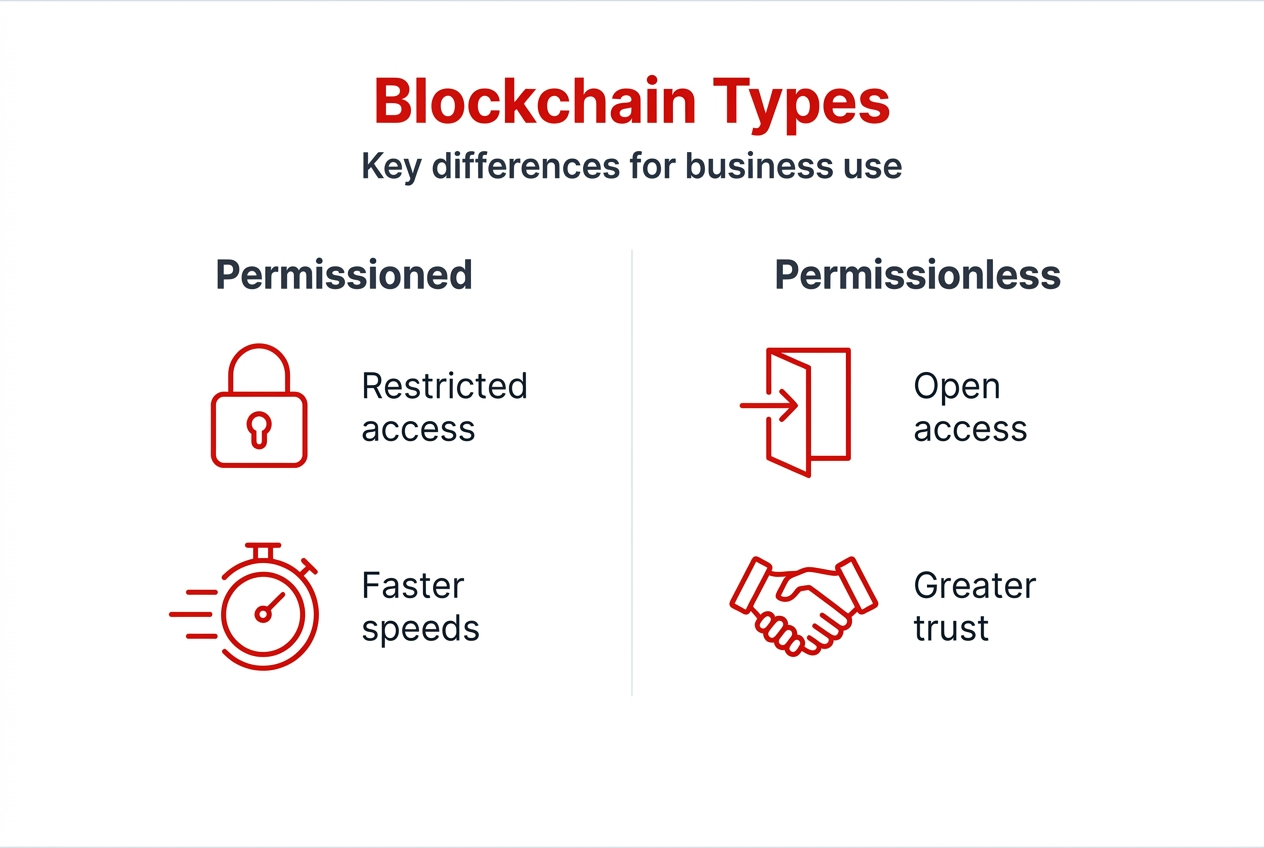
Hybrid models combining characteristics of both architectures are emerging as organizations balance control with decentralization benefits. A hybrid approach might use permissioned chains for internal operations while connecting to permissionless networks for customer-facing applications or inter-company settlements.
Pro Tip: Evaluate blockchain platforms based on transaction speed, cost per transaction, and ecosystem maturity. Ethereum offers robust smart contract capabilities but higher costs. Enterprise platforms like Hyperledger Fabric provide permissioned environments optimized for business needs.
Key adoption considerations:
- Technical infrastructure compatibility with existing enterprise systems
- Data governance policies defining access rights and privacy protections
- Partner ecosystem readiness to participate in blockchain networks
- Regulatory landscape understanding across operating jurisdictions
- Skills development to build internal blockchain expertise
Interoperability challenges extend beyond technical protocols. Business processes, legal frameworks, and organizational cultures must align for blockchain networks to function smoothly. Standardization efforts help but remain incomplete. Early adopters often create industry-specific consortiums to develop shared standards and governance models.
Knowledge gaps present significant barriers. Executives understand blockchain conceptually but struggle to identify profitable use cases. Technical teams need training in distributed ledger architecture, cryptography, and smart contract development. Legal departments must navigate evolving regulatory interpretations. Addressing these gaps through education and pilot projects builds organizational capability.
Security deserves careful attention. While blockchain offers inherent security advantages through cryptographic validation and distributed consensus, implementation mistakes create vulnerabilities. Protecting private keys, securing network endpoints, and managing access controls require rigorous protocols. Learning from token wallet security best practices helps enterprises avoid costly breaches.
| Blockchain Type | Access Control | Use Cases | Tradeoffs |
|---|---|---|---|
| Permissioned | Restricted participants | Enterprise collaboration, regulated industries | Centralization, trust in validators |
| Permissionless | Open participation | Public applications, maximum decentralization | Scalability limits, slower speeds |
| Hybrid | Selective openness | Cross-company processes, customer interfaces | Complexity, integration challenges |
Real-world enterprise blockchain applications and measurable ROI
Manufacturing operations gain competitive advantages through blockchain implementation. Counterfeit prevention protects brand value when every component carries a verified digital identity. Automated compliance reduces regulatory risk as production data flows directly to oversight agencies. Supplier payment automation improves relationships and negotiating leverage.
Finance sector applications demonstrate dramatic efficiency improvements. Settlement times that traditionally required days now complete in minutes. Cash flow improves when funds become available faster. Legal overhead decreases as smart contracts execute terms automatically and immutably. Cross-border transactions bypass correspondent banking networks, reducing fees and transfer times.
Oil and Gas companies face unique collaboration challenges across exploration, production, and distribution partners. Blockchain technology enhances supply chain efficiency and data security in this sector by creating secure collaboration platforms. Joint ventures share operational data without exposing proprietary exploration techniques. Equipment maintenance records become transparent, improving safety and asset utilization.
Financial returns validate blockchain investments. Data shows enterprises achieve 41% positive ROI after blockchain adoption. These returns stem from reduced operational costs, faster processes, and new revenue opportunities. Success correlates strongly with governance quality, operational readiness, and platform integration depth.
“Blockchain ROI materializes when organizations align technology implementation with clear business objectives, invest in organizational readiness, and establish robust governance frameworks that evolve with the technology.”
Measurable business improvements include:
- Reduced reconciliation costs through shared ledgers eliminating duplicate record-keeping and dispute resolution
- Faster cycle times as automated workflows replace manual handoffs and approval chains
- Enhanced fraud prevention with immutable audit trails deterring and detecting unauthorized activities
- Improved delivery capacity when optimized Lean management practices reduce waste and bottlenecks
- New revenue streams from tokenized assets, data monetization, and blockchain-enabled services
The connection to business analytics in 2026 becomes strategic when blockchain data feeds analytical models. Transaction patterns, supply chain flows, and customer behaviors recorded on blockchain provide rich datasets for predictive modeling. Analytics extract insights that drive continuous improvement and competitive differentiation.
Implementation timelines vary by complexity. Simple tracking applications launch in months. Comprehensive business network transformations require years. Phased rollouts manage risk while demonstrating incremental value. Quick wins build momentum for larger initiatives.
Governance structures determine long-term success. Clear decision rights, dispute resolution mechanisms, and protocol upgrade processes prevent conflicts as networks mature. Multi-stakeholder governance balances competing interests while maintaining network integrity and performance.
How TechMoths can support your blockchain journey
Navigating blockchain’s business potential requires staying current with rapidly evolving technology, regulations, and best practices. TechMoths offers expert insights on integrating emerging technologies in business contexts, helping you understand practical applications and avoid common pitfalls.
Our technology self-improvement resources guide professionals through complex technical concepts with clear, actionable explanations. Whether you’re evaluating blockchain platforms, building business cases, or leading implementation teams, accessible education accelerates your capability development.
Upskilling your organization becomes manageable with personalized learning tactics that adapt to different roles and experience levels. Technical teams need different knowledge than finance or operations staff. Tailored learning paths ensure everyone gains relevant blockchain literacy.
Leading innovation requires confidence built on solid understanding. Our professional growth strategies help entrepreneurs and executives develop the strategic thinking needed to identify blockchain opportunities, assess risks, and drive organizational change. Visit TechMoths to explore how blockchain and other transformative technologies can elevate your business performance.
Frequently asked questions
What industries benefit most from blockchain technology today?
Supply chain, finance, manufacturing, healthcare, and Oil & Gas demonstrate significant blockchain adoption and measurable benefits. These sectors leverage blockchain for fraud reduction, transparency improvements, and operational efficiency gains. Industries handling complex multi-party transactions or requiring rigorous traceability see the strongest returns.
What are the key differences between permissioned and permissionless blockchains?
Permissioned blockchains restrict participant access, providing control over validators and data visibility for compliance and confidentiality. Permissionless blockchains allow open participation, maximizing decentralization but facing scalability challenges and slower transaction speeds. Hybrid models balance these characteristics based on specific business requirements.
How can businesses measure the ROI of blockchain investments?
ROI measurement depends on clear use cases, operational readiness, and effective governance frameworks. Quantifiable benefits include reduced reconciliation costs, shorter settlement times, decreased fraud losses, and increased delivery capacity. Track both direct cost savings and strategic advantages like improved partner relationships and new revenue opportunities.
What challenges should companies expect when adopting blockchain?
Interoperability with existing systems, regulatory compliance navigation, and organizational knowledge gaps present primary challenges. Choosing appropriate blockchain architecture and platform for specific use cases requires careful evaluation. Technical integration complexity, partner ecosystem readiness, and change management across business processes demand sustained focus and resources.
