

Role of Automation in Business Operations Today

Many small-to-medium business owners find themselves stretched thin, facing mounting pressures to reduce costs and improve efficiency. As competition grows and margins tighten, finding ways to free up valuable time and resources becomes crucial. Automation offers a practical path by minimizing manual work, reducing errors, and empowering teams to focus on higher-value activities. This overview clears up common misconceptions and explores how adopting smart automation tools can help your business operate with greater consistency and agility.
Table of Contents
- Defining Automation And Common Misconceptions
- Major Types Of Business Automation Solutions
- How Automation Works In Practice
- Real-World Applications Across Industries
- Challenges, Risks, And Common Pitfalls
Key Takeaways
| Point | Details |
|---|---|
| Understanding Automation | Automation enhances business efficiency by minimizing human intervention, reducing errors, and allowing workers to focus on strategic tasks. |
| Types of Automation Solutions | Business Process Automation, Robotic Process Automation, and Hyperautomation are key types that improve operational workflows in various ways. |
| Implementation Strategies | Successful automation requires identifying repetitive tasks, selecting appropriate technologies, and continuously monitoring performance for improvement. |
| Navigating Challenges | Organizations should address risks such as data quality, cybersecurity, and workforce adaptation to successfully implement automation. |
Defining Automation and Common Misconceptions
Automation represents a sophisticated technological approach that fundamentally transforms how businesses operate by reducing human intervention in complex processes. Technological systems predetermine decision criteria through advanced mechanical, electrical, and computing devices, enabling organizations to streamline workflows with unprecedented efficiency.
At its core, automation encompasses several critical characteristics:
- Reducing manual labor requirements
- Minimizing human error
- Standardizing operational processes
- Increasing overall productivity
- Enabling consistent quality control
Contrary to popular belief, automation is not simply about replacing human workers. Business management research reveals a more nuanced perspective where machines and humans collaborate, creating symbiotic relationships that enhance organizational capabilities. The goal is augmentation – empowering workers by eliminating repetitive tasks and allowing them to focus on higher-value strategic activities.
Business automation involves integrating technological solutions that can perform tasks with minimal human oversight. These systems range from simple rule-based software to complex artificial intelligence platforms capable of making sophisticated decisions.
Automation is not about replacing humans, but about enabling humans to work smarter, not harder.
Common misconceptions about automation often stem from fear and misunderstanding. Many professionals worry that technological advancements will eliminate their jobs. However, historical evidence suggests that while automation transforms job roles, it simultaneously creates new employment opportunities in technology, maintenance, and strategic management sectors.

Pro tip: Start small with automation by identifying repetitive, time-consuming tasks in your workflow and gradually implementing technological solutions that complement your team’s existing skills.
Major Types of Business Automation Solutions
Business Process Automation (BPA) represents a critical technological strategy for organizations seeking to enhance operational efficiency. Three major types of automation have emerged as game-changers in modern business environments, each offering unique capabilities for streamlining workflows and reducing manual intervention.
The primary types of business automation solutions include:
Here’s a summary of the major business automation types and their primary advantages:
| Automation Type | Main Technologies | Key Advantages |
|---|---|---|
| Traditional BPA | Custom software, integrations | Tailored solutions, process control |
| Robotic Process Automation | Software robots, scripts | High speed, error reduction |
| Hyperautomation | AI, machine learning, analytics | Continuous improvement, adaptability |
- Traditional BPA: Involves custom software development to integrate applications and execute complex business processes
- Robotic Process Automation (RPA): Uses software robots to mimic human-computer interactions for repetitive tasks
- Hyperautomation: Combines artificial intelligence, machine learning, and advanced process automation to discover, validate, and execute processes with minimal human oversight
Robotic Process Automation has gained significant traction across various industries. Government agencies are actively exploring RPA to improve cost-effectiveness and redirect human talent toward more strategic activities. These software robots excel at performing structured, repetitive tasks with remarkable precision and speed.
Automation is not about replacing humans, but empowering them to focus on high-value, creative work.
Hyperautomation represents the most advanced frontier of business automation. By integrating artificial intelligence, machine learning, and sophisticated process management tools, organizations can create intelligent systems that continuously learn, adapt, and optimize their own performance. This approach goes beyond simple task automation, enabling comprehensive digital transformation.
Pro tip: Evaluate your current business processes by identifying repetitive, rules-based tasks that consume significant employee time, and prioritize these for initial automation efforts.
How Automation Works in Practice
Enterprise workflow automation transforms how businesses handle repetitive and complex tasks by leveraging cutting-edge technologies. Advanced automation technologies are revolutionizing organizational processes by dramatically reducing manual intervention and increasing operational efficiency.
The practical implementation of automation involves several key strategies:
- Identifying repetitive, rule-based tasks suitable for automation
- Mapping current business processes in detail
- Selecting appropriate automation technologies
- Developing software agents or robotic process automation (RPA) scripts
- Testing and refining automated workflows
- Monitoring performance and continuous improvement
Robotic Process Automation (RPA) serves as a primary mechanism for practical automation implementation. Government agencies deploy software agents that execute predefined tasks across multiple software systems, creating cost-effective and easily auditable process improvements.
Successful automation is about augmenting human capabilities, not replacing human workers.
Modern automation goes beyond traditional rule-based systems. Emerging technologies like artificial intelligence and machine learning enable software to adapt, learn, and make near-human-level decisions. These intelligent systems can understand complex workflows, predict potential issues, and dynamically adjust their operations without constant human supervision.
The most sophisticated automation approaches combine multiple technologies. Hyperautomation integrates robotic process automation, artificial intelligence, machine learning, and advanced analytics to create comprehensive, self-optimizing systems that continuously improve organizational performance.
Pro tip: Start your automation journey by documenting and analyzing your most time-consuming, repetitive business processes to identify the best initial candidates for automation.
Real-World Applications Across Industries
Industrial automation is transforming business operations across multiple sectors, demonstrating remarkable versatility and impact. Global industrial automation technologies are revolutionizing productivity by enabling sophisticated technological solutions that enhance operational efficiency.
Key industries leveraging automation include:
- Manufacturing: Robotic assembly lines and precision machinery
- Healthcare: Diagnostic imaging and patient record management
- Finance: Algorithmic trading and fraud detection systems
- Retail: Inventory tracking and self-checkout technologies
- Logistics: Automated warehousing and autonomous delivery vehicles
Manufacturing sectors have been particularly aggressive in adopting automation technologies. Robotic systems now handle complex assembly processes, quality control, and repetitive tasks with unprecedented precision. AI-driven innovations are enabling predictive maintenance and smart manufacturing techniques that dramatically reduce downtime and improve production efficiency.
Automation is not about replacing workers, but about empowering them to focus on more strategic and creative tasks.
In healthcare, automation is transforming patient care through advanced diagnostic tools, automated record-keeping systems, and robotic surgical assistants. Financial institutions leverage algorithmic technologies for risk assessment, fraud detection, and automated investment strategies.
This table highlights how automation impacts different industries through specific applications:
| Industry | Automation Example | Resulting Benefit |
|---|---|---|
| Manufacturing | Robotic assembly lines | Increased consistency, uptime |
| Healthcare | Automated patient records | Faster access, fewer errors |
| Finance | Algorithmic trading systems | Timely decisions, fraud reduction |
| Retail | Self-checkout solutions | Reduced wait times, labor savings |
| Logistics | Automated warehousing | Efficient inventory management |
The most sophisticated automation approaches integrate multiple technologies, creating intelligent systems that can learn, adapt, and optimize themselves continuously. These systems combine robotics, artificial intelligence, machine learning, and advanced analytics to deliver unprecedented operational capabilities.
Pro tip: Begin your automation strategy by identifying repetitive, rules-based processes in your organization that consume significant time and resources.
Challenges, Risks, and Common Pitfalls
Business automation presents complex challenges that organizations must carefully navigate. Key challenges involve technological and organizational complexities that require strategic planning and comprehensive risk management.
Major risks and challenges in automation implementation include:
- Data quality and integration issues
- Cybersecurity vulnerabilities
- Workforce displacement concerns
- High initial investment costs
- Ethical and regulatory compliance challenges
- Technical complexity and implementation barriers
- Potential algorithmic biases
Technological integration represents one of the most significant obstacles. Legacy systems often struggle to communicate with new automation technologies, creating complex migration challenges that can disrupt existing workflows. Potential automation risks extend beyond technical limitations to include broader societal and ethical considerations.
Successful automation requires a balanced approach that considers technological capabilities and human workforce implications.
Workforce adaptation emerges as a critical challenge. While automation can enhance productivity, it simultaneously creates uncertainty among employees who fear potential job displacement. Organizations must develop comprehensive reskilling and transition programs to support workers through technological transformations.
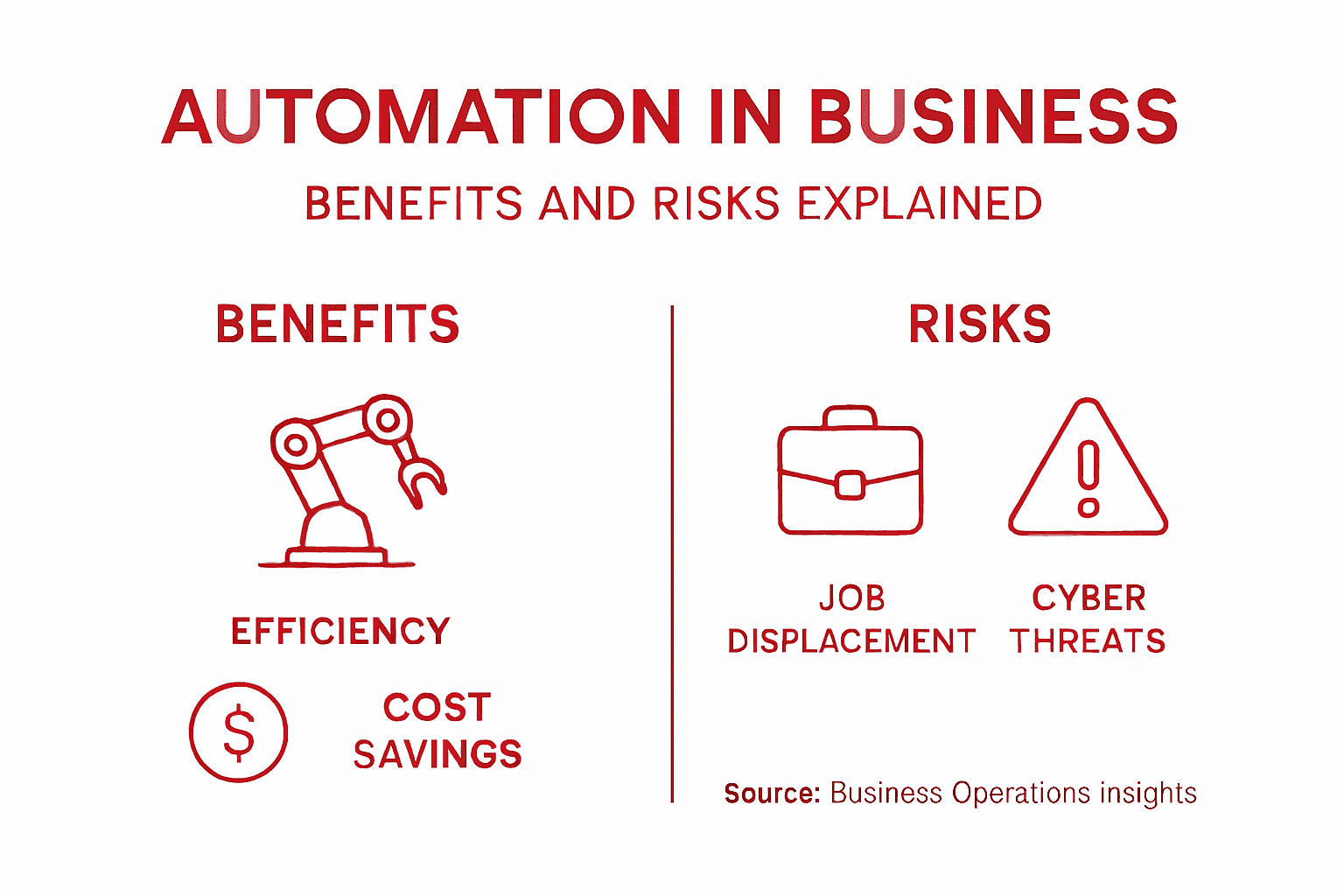
Cybersecurity represents another significant risk. Automated systems can create new vulnerabilities if not properly secured, potentially exposing organizations to data breaches, operational disruptions, and sophisticated cyber attacks. Implementing robust security protocols and continuous monitoring becomes essential in mitigating these risks.
Pro tip: Conduct a comprehensive risk assessment before implementing automation, identifying potential technical, operational, and human resource challenges specific to your organizational context.
Harness the Power of Automation to Elevate Your Business Success
Automation brings incredible opportunities to reduce repetitive tasks and empower your workforce to tackle strategic challenges. Yet many businesses struggle with navigating the complexities of technological integration, workforce adaptation, and overcoming misconceptions about automation. At TechMoths, we understand these pain points and provide a rich collection of insightful articles and practical guides that help you stay informed and make smarter decisions about adopting the latest automation strategies.
Unlock the full potential of automation today by exploring expert content on business automation solutions, learn how to address workforce concerns, and overcome technical barriers. Start your journey with TechMoths and transform your operations without losing sight of the human element. Visit TechMoths now and empower your business with knowledge that drives innovation and growth.
Frequently Asked Questions
What is automation in business operations?
Automation in business operations refers to the use of technology to perform tasks with minimal human intervention. It aims to streamline workflows, reduce manual labor, and increase overall efficiency by integrating various technological solutions.
How does automation improve productivity in businesses?
Automation improves productivity by minimizing human error, standardizing processes, and allowing employees to focus on higher-value strategic activities instead of repetitive tasks. This enhances operational efficiency and enables consistent quality control.
What are the different types of business automation solutions?
The major types of business automation solutions include Traditional Business Process Automation (BPA), Robotic Process Automation (RPA), and Hyperautomation, each offering unique capabilities for streamlining workflows and reducing human intervention.
What challenges do organizations face when implementing automation?
Organizations face several challenges when implementing automation, including data quality issues, cybersecurity vulnerabilities, workforce displacement concerns, high initial costs, and the complexity of integrating new technologies with legacy systems.
