Career growth strategies 2026: Advance in tech with AI

Tech professionals in 2026 face a paradox: AI promises to amplify productivity, yet it simultaneously disrupts traditional career ladders and eliminates familiar advancement paths. The skills that earned promotions five years ago no longer guarantee upward mobility in an industry where AI tools reshape 82% of developer workflows. This guide delivers actionable strategies to help you master essential competencies, boost visibility, leverage AI for career acceleration, and adapt to the evolving role structures that define tech careers today. Whether you’re targeting your next promotion or repositioning for long-term relevance, these tactics align with the realities of 2026’s AI-driven workplace.
Table of Contents
- Preparing For Career Growth In 2026: Master Essential Skills
- Executing Growth: Boost Visibility And Soft Skills For Promotion
- Leveraging AI To Accelerate Productivity And Career Advancement
- Adapting To Changing Career Ladders: Focus On Senior Roles And Adaptability
- Explore Career Growth Resources And Tools At Techmoths
Key takeaways
| Point | Details |
|---|---|
| Master AI/ML fundamentals | Building expertise in AI, machine learning, and agentic systems creates an irreplaceable skill stack that protects against automation. |
| Quantify your impact | Documenting achievements with metrics and building visibility through personal branding increase promotion likelihood by up to 40%. |
| Leverage AI as multiplier | Active AI tool users gain 26% productivity boosts and are 50% more likely to earn promotions than passive colleagues. |
| Adapt to senior-focused ladders | Fewer entry-level roles mean career growth now requires specialization, leadership skills, and strategic pivots toward senior positions. |
| Commit to continuous learning | Quarterly skill updates and protean career mindsets ensure you remain competitive as technology evolves rapidly. |
Preparing for career growth in 2026: Master essential skills
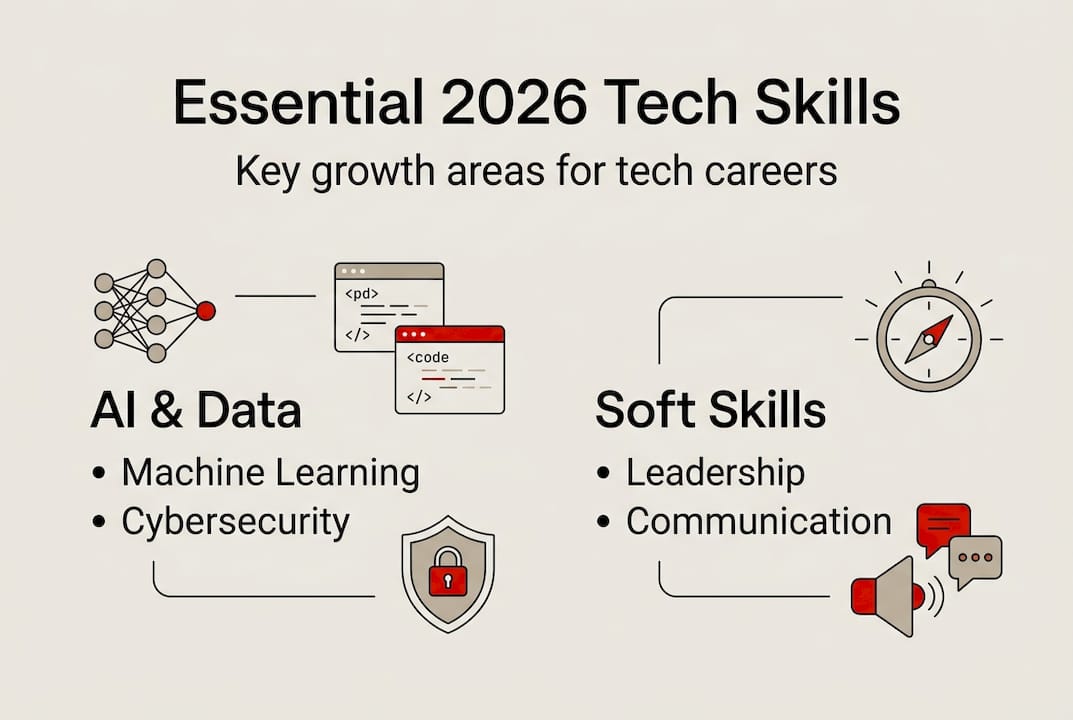
The foundation of any successful tech career in 2026 rests on a skill stack that combines AI literacy with domain-specific expertise. Mastering AI/ML, agentic AI, and specialized areas like MLOps, cybersecurity, and cloud-native engineering positions you as irreplaceable in an era where routine coding tasks face automation. Agentic AI, which enables systems to take proactive actions rather than simply respond to prompts, represents the next frontier. Understanding how to design, deploy, and optimize these autonomous systems separates leaders from followers.
The data reveals urgency: 1 in 3 workers report being held back by tech skills gaps, with 76% of learners in AI-focused courses reporting tangible career outcomes. This gap creates opportunity for those who act decisively. Focus your learning on high-impact areas that align with professional growth strategies proven to accelerate advancement.
Prioritize these skill categories for maximum career impact:
- AI and machine learning fundamentals, including model training, evaluation, and deployment pipelines
- MLOps practices for production-grade machine learning systems at scale
- Cloud-native architecture and containerization technologies like Kubernetes
- Cybersecurity principles and threat modeling for AI systems
- Data engineering and pipeline orchestration for ML workflows
Building digital literacy skills for 2026 extends beyond technical capabilities. You need to understand how AI systems make decisions, where they fail, and how to audit their outputs critically. This meta-skill, understanding AI’s strengths and limitations, enables you to deploy tools strategically rather than blindly.
Pro Tip: Set quarterly learning sprints focused on one new AI capability. Spend 5 hours per week for 12 weeks building a portfolio project that demonstrates mastery, then share it publicly to build credibility and visibility.
The professionals who thrive in 2026 treat skill development as continuous rather than episodic. They recognize that yesterday’s expertise depreciates rapidly and commit to systematic renewal. This mindset shift from credential collection to capability building distinguishes those who advance from those who stagnate.
Executing growth: Boost visibility and soft skills for promotion
Technical excellence alone no longer guarantees promotion in 2026’s competitive landscape. Documenting impact quantitatively, increasing professional visibility, and developing soft skills alongside technical expertise create the complete package that promotion committees seek. You must become your own advocate, translating technical achievements into business value that leadership understands.

Start by maintaining a brag document, a running log of projects, metrics, and outcomes that demonstrate your contribution. Track revenue generated, costs reduced, time saved, or quality improved. When review season arrives, you’ll have concrete evidence rather than vague recollections. This practice also helps you identify patterns in your highest-impact work, guiding future focus.
Follow these steps to systematically boost your promotion prospects:
- Quantify every major project with at least three business metrics that matter to leadership
- Build a personal brand through technical writing, conference talks, or open source contributions
- Develop presentation skills to communicate complex technical concepts to non-technical stakeholders
- Cultivate strategic relationships across departments to increase visibility and collaboration opportunities
- Seek feedback quarterly from managers and peers to identify blind spots early
- Document your growth trajectory and share progress updates with your manager monthly
Soft skills deliver measurable returns. Professionals who demonstrate strong communication, emotional intelligence, and leadership abilities receive 40% more interview callbacks and promotion considerations. These capabilities become increasingly valuable as you advance, since senior roles require influencing without authority, navigating ambiguity, and building consensus across diverse stakeholders.
Improving soft skills in the workplace demands intentional practice. Join Toastmasters to refine public speaking. Volunteer to lead cross-functional initiatives. Request stretch assignments that force you outside your comfort zone. Each experience builds the confidence and capability that separate individual contributors from leaders.
Pro Tip: Schedule monthly career conversations with your manager focused solely on growth and visibility, separate from project updates. Come prepared with your accomplishments, learning goals, and specific requests for opportunities that align with promotion criteria.
Plan for promotion timelines of two to three years at mid to senior levels, recognizing that advancement requires sustained excellence rather than isolated wins. Use this timeframe to build a compelling narrative of growth, impact, and readiness for increased responsibility.
Leveraging AI to accelerate productivity and career advancement
AI tools in 2026 function as force multipliers for professionals who embrace them strategically. Active AI users experience up to 26% productivity increases, and at companies like Cisco, these individuals are 50% more likely to earn promotions compared to colleagues who use AI passively or not at all. The gap between AI adopters and resisters widens daily, creating a bifurcation in career trajectories.
Generative AI excels at accelerating routine tasks: code generation, documentation, test case creation, and initial research. 82% of developers find GenAI useful, particularly for exploring unfamiliar codebases and prototyping solutions rapidly. The key lies in using AI to handle repetitive work while you focus on high-value activities like architecture decisions, stakeholder alignment, and creative problem solving.
This table illustrates how AI adoption correlates with career outcomes:
| AI Usage Level | Productivity Gain | Promotion Likelihood | Key Behaviors |
|---|---|---|---|
| Non-user | 0% baseline | Standard | Relies solely on traditional methods |
| Passive user | 5-10% | Slightly above | Uses AI occasionally for simple tasks |
| Active user | 20-26% | 50% higher | Integrates AI into daily workflows systematically |
| AI-native | 30%+ | 75% higher | Builds custom AI tools and teaches others |
Develop an AI-native work style by incorporating these practices:
- Use AI coding assistants for boilerplate generation and refactoring, then review and optimize the output critically
- Employ AI for rapid prototyping and exploring multiple solution approaches before committing
- Leverage AI to generate comprehensive test suites and edge case scenarios
- Apply AI tools to documentation tasks, freeing time for strategic thinking
- Build custom GPT workflows or agents tailored to your specific domain challenges
Focus your AI learning on machine learning fundamentals and cybersecurity applications, as these domains offer the highest career ROI in 2026. Understanding how to secure AI systems, audit model outputs, and prevent adversarial attacks positions you at the intersection of two critical needs. Staying current with AI trends in 2026 ensures your skills align with market demand.
Pro Tip: Track your AI-assisted productivity gains with specific metrics like hours saved, features shipped, or bugs prevented. Present this data during performance reviews to demonstrate how you multiply your impact through strategic tool adoption.
The professionals advancing fastest treat AI as a collaborative partner rather than a threat or a magic solution. They understand its limitations, verify its outputs rigorously, and apply it strategically to amplify their unique human capabilities. This balanced approach, combining AI efficiency with human judgment and creativity, defines the career development steps advancing tech professionals in 2026.
Adapting to changing career ladders: Focus on senior roles and adaptability
The traditional tech career ladder is transforming dramatically. AI reduces entry-level opportunities while increasing demand for senior and specialized roles, fundamentally altering advancement pathways. Junior positions that once provided stepping stones now face automation, while complex roles requiring judgment, creativity, and cross-functional leadership grow more valuable. This shift demands new strategies for career progression.
Companies increasingly hire at senior levels, seeking professionals who can immediately deliver strategic value rather than requiring extensive training. This trend creates opportunity for experienced practitioners willing to continuously upskill, but it also means career security depends on demonstrating senior-level capabilities consistently. The middle rungs of the ladder are compressing, requiring faster skill acquisition and more deliberate positioning.
This comparison shows how career structures have evolved:
| Traditional Ladder (Pre-2024) | AI-Era Ladder (2026) |
|---|---|
| Multiple junior roles feeding seniors | Fewer entry points, direct senior hiring |
| Predictable 2-3 year promotions | Skill-based advancement, variable timing |
| Specialization after 5+ years | Early specialization required |
| Linear progression within one domain | Portfolio careers across domains |
| Company-driven development | Self-directed continuous learning |
Adapt to this new reality with these strategic approaches:
- Develop T-shaped expertise: deep specialization in one area plus broad knowledge across adjacent domains
- Build leadership and mentoring capabilities early, even as an individual contributor
- Cultivate a protean career mindset, viewing yourself as a portfolio of capabilities rather than a job title
- Create strategic career pivots every 3 to 5 years to avoid skill obsolescence
- Invest in skills that complement rather than compete with AI capabilities
A protean career mindset means taking personal responsibility for your trajectory rather than relying on organizational ladders. You proactively identify emerging opportunities, acquire relevant skills before they become mainstream, and position yourself at the intersection of market needs and your capabilities. This self-directed approach provides resilience amid rapid technological change.
Career security in 2026 comes from adaptability rather than tenure. The professionals thriving today embrace change as constant, viewing disruption as opportunity rather than threat. They maintain curiosity about emerging technologies, experiment with new tools and frameworks, and regularly assess whether their skills align with market demand. Those who successfully navigate a career pivot in the tech industry share this proactive, growth-oriented mindset.
Plan strategic pivots by monitoring job postings, tracking skill demand trends, and networking with professionals in adjacent roles. When you spot an emerging opportunity that aligns with your interests and market needs, invest 6 to 12 months building relevant expertise before making your move. This deliberate approach minimizes risk while maximizing your ability to capitalize on new opportunities.
Explore career growth resources and tools at TechMoths
Navigating career advancement in 2026’s complex tech landscape requires more than individual effort. It demands access to proven frameworks, expert guidance, and practical tools that translate strategy into action. TechMoths offers comprehensive resources designed specifically for professionals seeking to accelerate their trajectories in the AI era.
Our platform provides detailed guides on career development steps for advancing in tech, covering everything from skill gap analysis to promotion negotiation tactics. Explore proven strategies for professional growth that thousands of tech professionals have used to secure senior roles and leadership positions. When you’re ready to enhance your interpersonal effectiveness, our tips for improving soft skills in the workplace offer actionable frameworks you can implement immediately. Each resource connects the concepts covered in this guide with specific, step-by-step implementation plans tailored to your career stage and goals.
FAQ
What are the most in-demand tech skills for career growth in 2026?
AI, machine learning, MLOps, cybersecurity, and cloud-native engineering top the list for 2026 career advancement. These skills address the core challenges organizations face as they scale AI systems securely and efficiently. Specializing in agentic AI systems, which can take autonomous actions, provides additional differentiation. Continuous learning through quarterly skill sprints keeps your capabilities aligned with rapidly evolving market demands and significantly increases both employability and promotion prospects.
How can I use AI to improve my job performance and promotion chances?
Incorporate generative AI tools systematically into your daily workflows to accelerate routine tasks like code generation, documentation, and testing. Active AI users gain 26% productivity increases and earn promotions 50% more frequently than colleagues who use AI passively. Document your AI-driven productivity gains with specific metrics like hours saved or features shipped, then present this data during performance reviews. Focus on using AI to handle repetitive work while you concentrate on high-value activities like architecture decisions, stakeholder alignment, and creative problem solving that showcase your strategic thinking.
What strategies help adapt to fewer entry-level tech jobs due to AI?
Focus on rapidly acquiring senior-level skills and leadership capabilities rather than following traditional junior-to-senior progression paths. Build T-shaped expertise with deep specialization in one high-demand area plus broad knowledge across adjacent domains. Embrace continuous upskilling through quarterly learning sprints and strategic career pivots every 3 to 5 years to avoid skill obsolescence. Develop a protean career mindset, taking personal responsibility for your trajectory and viewing yourself as a portfolio of capabilities. Position yourself at the intersection of emerging technologies and market needs by monitoring trends, experimenting with new tools, and networking strategically across domains.
How do I quantify my impact to increase promotion chances?
Maintain a brag document that tracks projects, metrics, and outcomes demonstrating your business contribution. Record specific numbers: revenue generated, costs reduced, time saved, quality improved, or risks mitigated. Connect technical achievements to business value that leadership understands, translating code quality improvements into customer satisfaction gains or system optimizations into cost savings. Review your brag document monthly to identify patterns in your highest-impact work, guiding future focus toward activities that align with promotion criteria. Share progress updates with your manager quarterly, framing accomplishments in terms of organizational priorities and strategic goals.
What soft skills matter most for tech career advancement in 2026?
Communication skills that translate complex technical concepts for non-technical stakeholders prove essential as you advance into senior roles. Emotional intelligence enables you to navigate organizational dynamics, build consensus, and influence without authority. Leadership capabilities, including mentoring, delegation, and strategic thinking, distinguish individual contributors from management candidates. Professionals demonstrating these soft skills receive 40% more interview callbacks and promotion considerations. Develop these abilities through deliberate practice: join Toastmasters, volunteer for cross-functional initiatives, and request stretch assignments that force you outside your comfort zone.
How often should I update my skills to stay competitive?
Commit to quarterly learning sprints focused on acquiring one new capability or deepening expertise in an emerging area. Spend 5 hours per week for 12 weeks building a portfolio project that demonstrates mastery, then share it publicly to build credibility. Monitor job postings and skill demand trends monthly to identify gaps between your current capabilities and market needs. Plan strategic career pivots every 3 to 5 years to avoid skill obsolescence and position yourself at the intersection of emerging opportunities. This continuous learning approach, treating skill development as ongoing rather than episodic, ensures you remain competitive as technology evolves rapidly and protects against the risk of capabilities depreciating faster than you can update them.
