

Business resilience guide: 7 strategies for long-term success

Most businesses that fail don’t collapse because of sudden market crashes or natural disasters. They crumble from within, lacking the internal capacity to adapt when challenges arise. Business resilience separates organizations that thrive from those that merely survive temporary stability. You’re about to discover what genuine resilience means, the core components that make it work, and practical strategies to build an organization capable of weathering any storm while maintaining growth momentum.
Table of Contents
- Key takeaways
- Understanding business resilience: definition and key components
- Types of risks and challenges businesses face
- Building resilience: practical frameworks and strategies
- The role of digital transformation in enhancing resilience
- Build your business resilience with expert support
- Frequently asked questions
Key Takeaways
| Point | Details |
|---|---|
| What resilience is | Resilience is the proactive ability to prepare for, respond to, and adapt to both gradual changes and sudden disruptions so a business can protect value and grow. |
| Five core components | Five interconnected components form the foundation including risk management, business continuity, crisis response, adaptability, and recovery. |
| Internal and external risks | Resilience requires addressing internal weaknesses and external forces such as market shifts, technology changes, and economic disruptions to protect operations. |
| Leadership and culture | Leadership commitment and a culture that embraces change give structure to resilience through plans, resources, cross trained teams, and clear communication. |
Understanding business resilience: definition and key components
Business resilience encompasses preparation, response, and adaptation to both incremental changes and sudden disruptions. Unlike simple survival tactics, resilience represents a comprehensive organizational capability that transforms challenges into opportunities for growth. This proactive approach positions your business to maintain operations, protect stakeholder value, and emerge stronger from adversity.
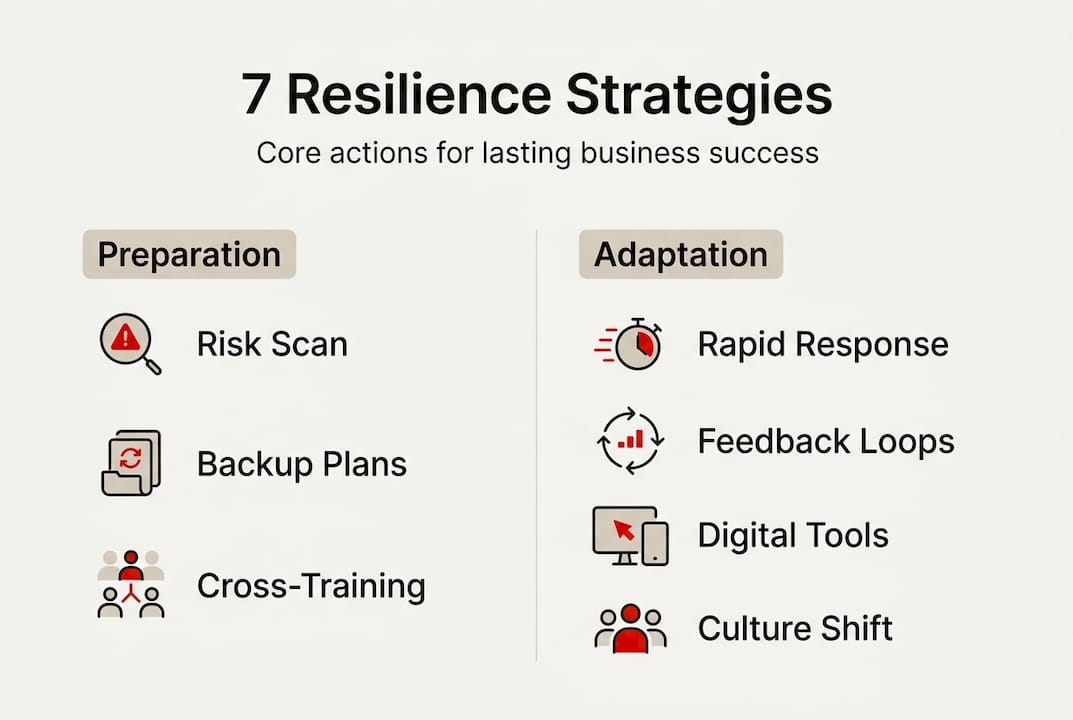
The foundation rests on five interconnected components working together. Risk management identifies potential threats before they materialize. Business continuity ensures critical functions persist during disruptions. Crisis response activates when unexpected events occur. Adaptability enables pivoting strategies as conditions change. Recovery restores normal operations while capturing lessons learned.
Internal risks stem from operational weaknesses, leadership gaps, or cultural fragilities within your organization. External risks arrive from market shifts, technological changes, economic downturns, or natural disasters beyond your control. Effective resilience addresses both categories simultaneously, creating defense mechanisms that protect from multiple angles.
Key elements that constitute strong business resilience include:
- Comprehensive risk assessment processes identifying vulnerabilities across all business functions
- Documented continuity plans with clear roles, responsibilities, and escalation procedures
- Diversified revenue streams reducing dependence on single products or markets
- Cross-trained teams capable of covering critical functions during personnel disruptions
- Financial reserves or credit facilities providing liquidity during cash flow interruptions
- Technology infrastructure supporting remote operations and data protection
- Stakeholder communication protocols maintaining transparency during crises
Leadership commitment and organizational culture determine whether resilience frameworks succeed or gather dust on shelves. Leaders must champion resilience initiatives, allocate resources, and model adaptive behaviors. Culture shapes how teams respond under pressure, whether they innovate solutions or freeze in uncertainty. Building resilience requires embedding these values into daily operations, not treating them as separate crisis management exercises.
Types of risks and challenges businesses face
Natural disasters like hurricanes, earthquakes, or floods can devastate physical infrastructure and disrupt supply chains for months. Economic shifts including recessions, inflation spikes, or currency fluctuations erode profit margins and customer purchasing power. Technological changes render existing products obsolete while creating competitive advantages for early adopters. Market disruptions from innovative competitors force rapid strategic pivots or risk irrelevance.
Internal challenges often prove more insidious because they develop slowly beneath surface stability. Operational failures from outdated processes, inadequate quality controls, or supply chain fragilities create cascading problems. Leadership issues including poor decision-making, lack of vision, or toxic management styles poison organizational effectiveness. Culture weaknesses manifest as resistance to change, poor communication, or misaligned values that undermine strategic initiatives.

| Risk Category | Internal Examples | External Examples | Typical Impact |
|---|---|---|---|
| Operational | Process failures, quality issues, supply chain gaps | Natural disasters, infrastructure failures | Service disruptions, revenue loss |
| Financial | Cash flow problems, poor cost controls | Economic recession, market volatility | Liquidity crisis, bankruptcy risk |
| Strategic | Misaligned goals, poor planning | Competitor innovation, regulatory changes | Market share loss, obsolescence |
| Reputational | Employee misconduct, product defects | Social media crises, negative publicity | Customer attrition, brand damage |
| Technology | System outages, data breaches | Cyberattacks, tech disruption | Operational paralysis, data loss |
Common challenges testing business resilience include:
- Sudden loss of key personnel through resignation, illness, or unexpected departures
- Cybersecurity breaches compromising sensitive data and customer trust
- Regulatory compliance changes requiring rapid operational adjustments
- Supply chain interruptions from geopolitical tensions or logistics failures
- Customer preference shifts demanding product innovation or service redesign
- Competitive pressure from new market entrants with disruptive business models
Adapting to evolving market conditions preserves viability when customer needs shift or technology redefines industry standards. Businesses demonstrating resilience pivot strategies, reallocate resources, and innovate solutions rather than clinging to outdated approaches. This adaptability separates organizations that grow through disruption from those that contract or collapse. Your ability to recognize emerging patterns and respond decisively determines whether challenges become catastrophic or catalytic.
Building resilience: practical frameworks and strategies
Systematic resilience building follows a structured approach ensuring comprehensive coverage without overwhelming your team. This framework transforms abstract concepts into concrete actions producing measurable improvements in organizational capacity.
Assess current vulnerabilities by conducting thorough risk audits across operations, finances, technology, and personnel. Document dependencies, single points of failure, and gaps in existing continuity plans.
Plan resilience initiatives by prioritizing identified risks based on likelihood and potential impact. Develop specific mitigation strategies, assign ownership, and establish timelines for implementation.
Implement protective measures including process improvements, technology upgrades, training programs, and policy changes. Start with quick wins building momentum before tackling complex transformations.
Monitor effectiveness through key performance indicators tracking resilience metrics. Measure response times, recovery speeds, financial buffers, and team readiness levels.
Adapt strategies based on monitoring insights, emerging threats, and lessons from disruptions. Treat resilience as an evolving capability requiring continuous refinement.
Integrating technology and data-driven insights accelerates resilience development. Analytics platforms identify patterns predicting potential disruptions before they escalate. Automation reduces human error in critical processes while freeing teams for strategic work. Cloud infrastructure provides operational flexibility and disaster recovery capabilities previously requiring massive capital investment.
Pro Tip: Leadership adaptability matters more than perfect plans because no strategy survives first contact with unexpected crises. Cultivate decision-making agility by practicing scenario responses, empowering teams to act independently, and maintaining open communication channels that surface problems early.
Agile practices foster resilient cultures by normalizing rapid iteration, transparent feedback, and collaborative problem-solving. Organizations embracing these principles respond faster to disruptions because teams already operate in adaptive modes. Daily standups, sprint retrospectives, and continuous improvement cycles build organizational muscle memory for navigating uncertainty. This cultural foundation proves invaluable when crisis demands immediate coordinated action without extensive planning cycles.
The role of digital transformation in enhancing resilience
Digital transformation serves as a resilience multiplier, enabling capabilities impossible through traditional approaches. Technology significantly enhances business resilience by providing real-time visibility, automated responses, and flexible infrastructure adapting to changing demands. Organizations leveraging digital tools detect threats earlier, respond faster, and recover more completely than competitors relying on manual processes.
| Digital Tool Category | Resilience Benefit | Implementation Example |
|---|---|---|
| Cloud Infrastructure | Business continuity through geographic redundancy | Distributed data centers ensuring uptime during regional outages |
| Analytics Platforms | Early risk detection via pattern recognition | Predictive models identifying supply chain vulnerabilities |
| Collaboration Software | Remote work capability maintaining productivity | Video conferencing and project management enabling distributed teams |
| Automation Systems | Reduced human error in critical processes | Robotic process automation handling routine compliance tasks |
| Cybersecurity Tools | Protection against digital threats | Multi-factor authentication and encryption safeguarding data |
| Mobile Technologies | Field operations continuity during facility disruptions | Mobile apps enabling sales and service from any location |
Pro Tip: Cloud technologies and robust cybersecurity form the foundation of digital resilience by ensuring data accessibility and protection regardless of physical location disruptions. Prioritize migrating critical systems to reputable cloud providers offering redundancy, automatic backups, and security certifications meeting your industry requirements.
Businesses improving resilience through technology adoption share common patterns. They start with infrastructure modernization creating stable foundations for advanced capabilities. They invest in employee digital literacy ensuring teams can leverage new tools effectively. They establish governance frameworks balancing innovation speed with appropriate risk controls. They partner with specialized IT solutions providers bringing expertise and resources beyond internal capacity.
Real-time response capabilities enabled by digital transformation compress decision cycles from days to minutes. Dashboards surface critical metrics instantly, alerting leaders to developing problems. Automated workflows trigger predefined responses to common scenarios, freeing human judgment for novel situations. Communication platforms coordinate distributed teams seamlessly, maintaining organizational coherence during physical separation. These capabilities transform how organizations experience and navigate disruptions, reducing both frequency and severity of negative impacts.
Build your business resilience with expert support
Strengthening your organization’s resilience requires both strategic insight and practical implementation support. TechMoths offers comprehensive resources helping leaders develop adaptive capabilities through evidence-based approaches. Our platform connects you with frameworks, case studies, and personalized learning tactics tailored to your specific industry challenges and organizational context.
Exploring education opportunities during uncertainty equips your leadership team with skills navigating complexity and driving transformation. Professional development focused on resilience building creates cascading benefits as trained leaders implement best practices throughout their organizations. Discover proven strategies for professional growth that translate directly into enhanced organizational capabilities and competitive advantages.
Frequently asked questions
What is the difference between business resilience and business continuity?
Business resilience represents a broader strategic capability encompassing adaptation, innovation, and thriving amid ongoing change. Business continuity specifically focuses on maintaining critical operations during disruptions through predefined plans and backup systems. Resilience includes continuity as one component while extending to cultural adaptability, strategic flexibility, and organizational learning that transform challenges into growth opportunities.
How can small businesses improve resilience without large budgets?
Small businesses build resilience by prioritizing flexible planning over expensive infrastructure, focusing on cross-training employees to cover multiple roles, and leveraging affordable cloud-based tools for data protection and remote work capability. Strong communication protocols, diversified customer bases, and community relationships provide cost-effective resilience foundations. Leadership commitment to adaptive culture often matters more than budget size in determining resilience outcomes.
What role does leadership play in business resilience?
Leadership drives organizational resilience by establishing vision, allocating resources, and modeling adaptive behaviors during uncertainty. Effective leaders communicate transparently about challenges, empower teams to make decisions independently, and champion resilience initiatives ensuring they receive sustained attention beyond initial enthusiasm. Their ability to maintain composure under pressure, learn from setbacks, and inspire confidence determines whether organizations freeze or thrive when facing disruptions.
Are there any frameworks or standards for measuring resilience?
Industry frameworks and structured assessment toolkits exist for evaluating business resilience across multiple dimensions including financial stability, operational flexibility, and cultural adaptability. Organizations use scenario analysis testing responses to hypothetical disruptions, key performance indicators tracking recovery speeds and continuity effectiveness, and maturity models benchmarking capabilities against industry standards. Continuous improvement cycles incorporating lessons from actual disruptions and near-misses provide the most valuable resilience measurements.
How long does it take to build meaningful business resilience?
Building foundational resilience requires six to twelve months of focused effort implementing core frameworks, training teams, and establishing monitoring systems. Mature resilience capabilities develop over two to three years as organizations refine strategies through experience, embed adaptive behaviors into culture, and expand protective measures across all business functions. However, incremental improvements begin immediately with each implemented mitigation strategy reducing specific vulnerabilities even before comprehensive transformation completes.
