
Why choose SaaS solutions in 2026: 50% cost savings

Many business leaders believe SaaS is automatically more secure than on-premise software or that it always saves money without careful planning. These misconceptions can lead to poor vendor choices and unexpected costs. Understanding the real benefits and challenges of Software as a Service in 2026 requires looking beyond marketing claims to examine how SaaS excels when speed, global access, and predictable operating expenses are priorities. This guide provides practical insights and expert perspectives to help you evaluate whether SaaS solutions align with your operational efficiency goals and cost management strategies.
Table of Contents
- Understanding The Core Benefits Of SaaS Solutions
- Financial Advantages And Cost Considerations Of SaaS
- Security, Compliance, And Privacy Challenges In SaaS Solutions
- Using SaaS Strategically For Operational Agility And Innovation
- Explore Tailored Tech Solutions At TechMoths
- Why Choose SaaS Solutions: Frequently Asked Questions
Key takeaways
| Point | Details |
|---|---|
| Speed and access | SaaS delivers faster deployment, global accessibility, and automatic updates that reduce IT workload. |
| Cost predictability | Subscription pricing eliminates large upfront investments and provides scalable, pay-as-you-grow expenses. |
| Security responsibility | Vendors manage infrastructure security while businesses must handle data governance and compliance requirements. |
| Privacy considerations | Multi-tenant architecture enables growth but requires careful evaluation of data isolation practices. |
| Strategic vendor selection | Success depends on thorough contract review, security audits, and alignment with business needs. |
Understanding the core benefits of SaaS solutions
Software as a Service operates on a cloud-based model where vendors host applications and make them available to customers over the internet. Unlike traditional software requiring installation on individual computers or servers, SaaS runs on the provider’s infrastructure using multi-tenant architecture. This means multiple customers share the same application instance while their data remains logically separated, creating efficiency and cost advantages for both vendors and users.
The multi-tenant model enables vendors to deploy updates universally, ensuring all customers benefit from new features and security patches simultaneously. For businesses, this translates to reduced IT workload since your team no longer manages software installations, updates, or infrastructure maintenance. You access the latest version automatically, eliminating the costly upgrade cycles that plague traditional software deployments.
Global access stands out as a defining advantage in 2026’s distributed work environment. Your team can access SaaS applications from any device with internet connectivity, supporting remote work, international collaboration, and field operations without complex VPN configurations. This accessibility accelerates decision-making when stakeholders need real-time data regardless of location.
Cost predictability through subscription pricing helps businesses forecast expenses accurately. Instead of large capital expenditures for licenses and hardware, you pay monthly or annual fees based on usage. This operating expense model preserves capital for core business investments while providing flexibility to scale services up or down as needs change.
Pro Tip: Before committing to a SaaS provider, request detailed documentation of their update schedule, maintenance windows, and how they communicate changes that might affect your workflows.
API-first architecture in modern SaaS platforms creates integration opportunities that accelerate innovation. These interfaces allow you to connect multiple applications, automate workflows, and leverage emerging technologies like artificial intelligence without building everything from scratch. The role of AI in business expansion depends heavily on these integration capabilities, enabling you to adopt advanced analytics and automation tools as your organization grows.
Key technical advantages include:
- Automatic backup and disaster recovery managed by the vendor
- Elastic scalability that adjusts computing resources to match demand
- Cross-platform compatibility eliminating device-specific software requirements
- Reduced time to value with implementation measured in days rather than months
Financial advantages and cost considerations of SaaS
SaaS solutions offer significant cost savings compared to on-premise software due to reduced upfront investment, lower maintenance costs, and scalable resource allocation. Organizations typically see 50% reductions in IT infrastructure expenses and 20-30% decreases in operational costs when migrating to cloud-based services. These savings come from eliminating server purchases, reducing data center space requirements, and minimizing the specialized IT staff needed to maintain on-premise systems.

The subscription model transforms software from a capital expense to an operating expense, improving cash flow management. Instead of spending $50,000 upfront for enterprise software licenses plus ongoing maintenance fees, you might pay $500 per user monthly. This approach preserves working capital and provides predictable budgeting, particularly valuable for growing businesses where cash flow timing matters.
Scalability represents a hidden financial advantage. Traditional software requires purchasing licenses for peak capacity even if you only need that capacity occasionally. SaaS lets you add users during busy periods and reduce subscriptions when demand drops, aligning costs directly with business activity. This flexibility proves especially valuable for seasonal businesses or companies experiencing rapid growth.
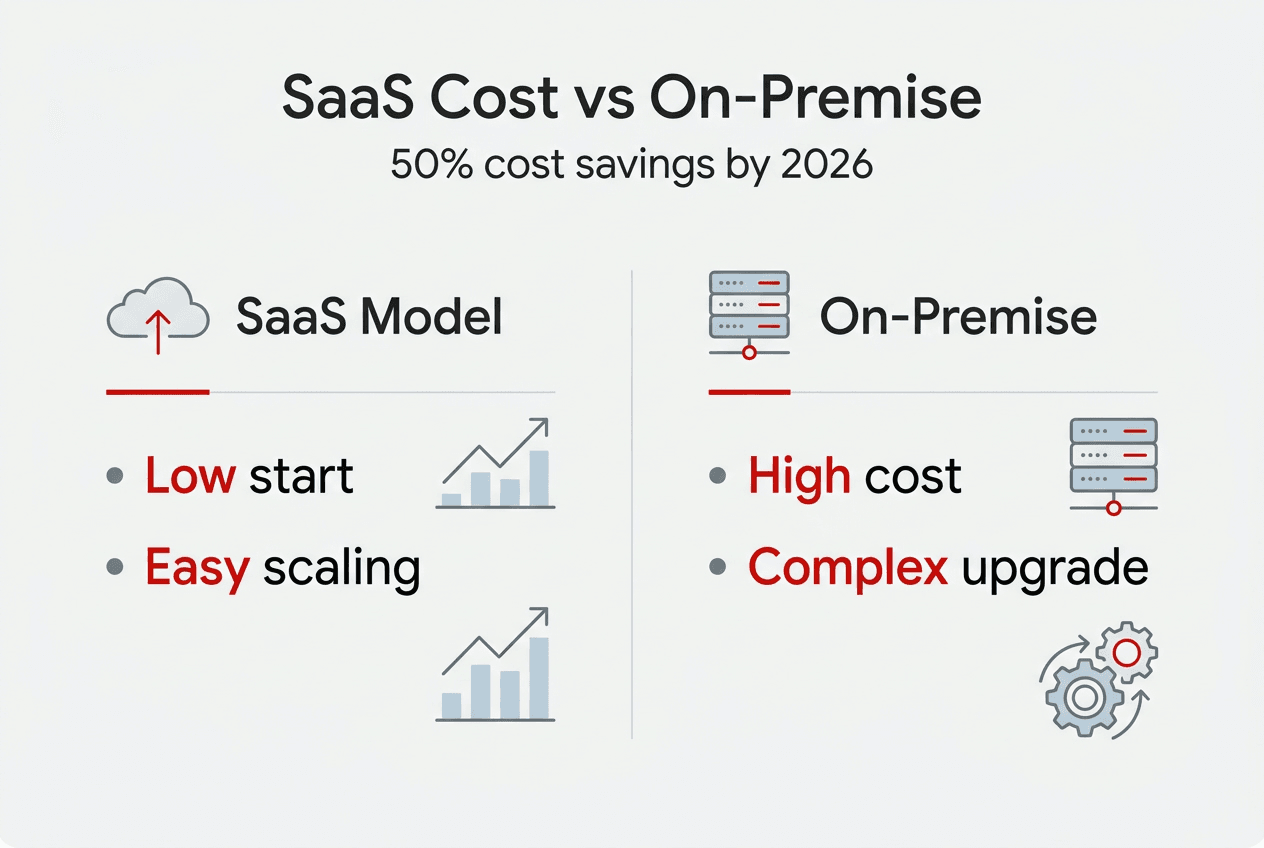
However, SaaS costs can escalate without careful management. Research shows that migrating from SaaS to self-hosted alternatives can result in significant cost savings when subscriptions accumulate across departments without central oversight. Startups particularly face risk when SaaS expenses consume a large portion of burn rate, potentially limiting runway during critical growth phases.
Vendor lock-in creates long-term cost implications that require evaluation during initial selection. Proprietary data formats, complex migration processes, and integration dependencies can make switching providers expensive or impractical. Contract terms matter significantly, especially regarding price escalation clauses, data export rights, and termination procedures.
| Cost Factor | SaaS Model | On-Premise Model |
| Initial investment | Low (first month subscription) | High ($20,000-$100,000+ for licenses and hardware) |
| Maintenance costs | Included in subscription | 15-20% of license cost annually |
| IT staffing needs | Minimal (vendor manages infrastructure) | Significant (dedicated system administrators) |
| Scalability costs | Pay per user as you grow | Large incremental investments for capacity |
| Update expenses | Automatic at no additional cost | Major upgrade projects every 3-5 years |
Pro Tip: Conduct quarterly SaaS audits to identify unused licenses, redundant tools, and opportunities to consolidate vendors, which can reduce costs by 15-25% without impacting functionality.
Effective startup management and productivity requires balancing the immediate benefits of SaaS accessibility against long-term cost trajectories. Negotiate multi-year contracts only after confirming the solution meets your needs through a pilot period. Request volume discounts as your user count grows and explore annual payment options that often provide 10-20% savings compared to monthly billing.
Security, compliance, and privacy challenges in SaaS solutions
Security is a shared responsibility in SaaS; vendors handle infrastructure security, businesses must manage data and compliance. This division means that while your provider secures servers, networks, and physical infrastructure, your organization remains accountable for user access controls, data classification, and regulatory compliance. Misunderstanding this boundary creates vulnerabilities that neither party adequately addresses.
Multi-tenant architecture delivers cost efficiency but introduces privacy considerations that require careful evaluation. When multiple organizations share the same application instance, logical data separation becomes critical. Cross-tenant data leakage is a critical privacy risk in multi-tenant architectures, particularly for businesses handling sensitive customer information or operating under strict regulatory frameworks.
Compliance challenges intensify when data crosses geographic boundaries. GDPR requires that European customer data receive specific protections regardless of where your business operates. CCPA imposes similar requirements for California residents. SaaS vendors often distribute data across global data centers for performance and redundancy, potentially creating compliance gaps if their architecture doesn’t support region-specific data residency requirements.
Your evaluation process must include detailed privacy documentation explaining how the vendor implements logical separation between tenants. Request architecture diagrams, third-party security audits, and specific information about encryption methods for data at rest and in transit. Understand which compliance certifications the vendor maintains (SOC 2, ISO 27001, HIPAA) and whether those certifications cover the specific services you plan to use.
Key security responsibilities for SaaS customers include:
- Implementing strong authentication policies including multi-factor authentication
- Managing user permissions and access controls based on least privilege principles
- Monitoring user activity logs for suspicious behavior or policy violations
- Establishing data backup procedures independent of vendor backup systems
- Creating incident response plans that account for vendor-side security events
“The biggest mistake businesses make is assuming the SaaS vendor handles all security. You must actively manage identity access, train users on phishing risks, and maintain visibility into how your data is used. Vendor security is necessary but not sufficient for comprehensive protection.” — Security Analyst, Enterprise Risk Management
Regulatory requirements often mandate that you maintain evidence of vendor security practices. This means collecting and reviewing SOC 2 reports, penetration test results, and incident response documentation annually. Your contracts should specify vendor obligations to notify you of security incidents within defined timeframes and provide detailed post-incident reports.
The technology adoption guide for small businesses emphasizes that security evaluation cannot be a one-time exercise. Vendors change infrastructure, get acquired, or experience breaches that alter your risk profile. Establish ongoing monitoring processes and build vendor security reviews into your annual compliance calendar to maintain appropriate oversight.
Using SaaS strategically for operational agility and innovation
Business environments in 2026 demand unprecedented adaptability. Accenture’s 2024 Pulse of Change Index shows a 183% jump in rate of change hitting businesses since 2019, driven by technology disruption, market volatility, and evolving customer expectations. Traditional IT approaches that require months for new capability deployment cannot keep pace with this acceleration, creating competitive disadvantages for organizations locked into rigid infrastructure.
SaaS platforms enable rapid integration of artificial intelligence and advanced analytics capabilities that would require massive investment to build internally. Modern SaaS applications increasingly embed machine learning for predictive insights, natural language processing for customer interaction, and automation for repetitive tasks. You gain access to these innovations through your subscription without hiring specialized AI talent or purchasing expensive computing infrastructure.
PwC’s 2024 Cloud & AI Business Survey links cloud-powered organizations with superior growth and productivity outcomes. Companies leveraging cloud infrastructure report faster time to market for new products, improved customer satisfaction scores, and better employee productivity metrics compared to peers relying primarily on on-premise systems. The performance gap widens as AI capabilities become more central to competitive differentiation.
Practical ways SaaS drives business agility include:
- Deploying new capabilities in days rather than months, accelerating response to market opportunities
- Scaling resources instantly during demand spikes without infrastructure procurement delays
- Enabling global team collaboration through unified platforms accessible from any location
- Reducing technical debt by eliminating legacy system maintenance that consumes IT resources
- Facilitating experimentation through low-cost pilot programs before full deployment commitments
- Accessing vendor innovation continuously as new features deploy automatically to all customers
The strategic value extends beyond operational efficiency to enabling entirely new business models. Subscription-based services, usage-based pricing, and platform ecosystems all depend on cloud infrastructure that SaaS provides. Organizations can test market hypotheses quickly, iterate based on customer feedback, and pivot strategies without sunk costs in custom software development.
“AI integration separates leaders from laggards in 2026. SaaS platforms democratize access to machine learning and predictive analytics that were previously available only to enterprises with massive R&D budgets. Small and mid-sized businesses now compete on insights rather than just price or relationships.” — Digital Transformation Consultant
Building business agility benefits requires more than just adopting SaaS tools. Your organization must develop processes that leverage the flexibility these platforms provide. This means empowering teams to configure workflows, establishing governance that balances control with autonomy, and creating feedback loops that translate user insights into platform optimization.
The intersection of SaaS with emerging AI trends 2026 creates unprecedented opportunities for operational transformation. Generative AI capabilities now embedded in productivity suites, customer service platforms, and analytics tools multiply individual contributor output while improving quality. Organizations that strategically adopt these AI-enhanced SaaS solutions position themselves to capture market share from competitors still operating with pre-AI workflows.
Explore tailored tech solutions at TechMoths
Navigating the SaaS landscape requires more than understanding benefits and risks. You need actionable strategies for vendor evaluation, implementation planning, and ongoing optimization that align technology choices with business objectives. TechMoths specializes in connecting business professionals with practical insights on technology adoption, AI integration, and operational efficiency improvements that drive measurable results.
Our platform offers detailed guidance on personalized learning tactics that help your team maximize SaaS tool adoption and proven strategies for professional growth that leverage technology for career advancement. Whether you’re evaluating your first SaaS solution or optimizing an existing technology stack, TechMoths provides the educational resources and expert perspectives you need to make confident decisions.
Pro Tip: Start with a technology audit that maps current tools to business processes, identifies gaps and redundancies, and establishes clear criteria for evaluating new solutions based on integration capabilities and total cost of ownership.
Key resources available through TechMoths:
- Comprehensive vendor comparison frameworks that go beyond feature checklists to evaluate security, compliance, and long-term viability
- Implementation playbooks that reduce deployment time and increase user adoption rates
- Cost optimization strategies that identify savings opportunities without sacrificing functionality
Why choose SaaS solutions: frequently asked questions
What are the main advantages of SaaS over on-premise software?
SaaS eliminates large upfront capital investments in hardware and licenses while providing automatic updates that keep your software current without IT intervention. You gain global accessibility, faster deployment timelines, and predictable subscription costs that scale with your business. The vendor manages infrastructure maintenance, security patches, and disaster recovery, freeing your IT team to focus on strategic initiatives rather than system administration.
How can businesses manage rising SaaS subscription costs effectively?
Conduct quarterly audits to identify unused licenses and redundant applications that serve similar functions. Negotiate multi-year contracts after pilot periods confirm value, and request volume discounts as user counts increase. Consolidate vendors where possible to reduce administrative overhead and improve integration efficiency. Establish a central approval process for new SaaS purchases to prevent shadow IT that escapes budget oversight.
What security responsibilities do businesses have when using SaaS?
You must manage user authentication, access controls, and data governance even though the vendor secures infrastructure. Implement multi-factor authentication, establish least privilege access policies, and monitor user activity logs for anomalies. Create independent backup procedures and incident response plans that account for vendor-side security events. Maintain compliance with industry regulations by collecting vendor security documentation and conducting regular risk assessments.
How does multi-tenant SaaS architecture impact data privacy?
Multi-tenant systems share application instances across customers while maintaining logical data separation, creating efficiency but requiring careful privacy evaluation. Vendors must implement robust isolation mechanisms to prevent cross-tenant data leakage, particularly important for businesses handling sensitive information. Request detailed architecture documentation, third-party security audits, and specific information about encryption and access controls. Ensure the vendor’s data residency options support your regulatory compliance requirements for GDPR, CCPA, or industry-specific mandates.
What should businesses consider when evaluating SaaS vendors?
Prioritize vendors with strong security certifications like SOC 2 Type II, ISO 27001, or industry-specific compliance attestations. Evaluate their financial stability, customer support responsiveness, and product roadmap alignment with your needs. Review contract terms carefully for price escalation clauses, data export rights, and termination procedures. Test integration capabilities with your existing systems and assess the vendor’s update communication practices. Request customer references from organizations similar to yours in size and industry to understand real-world implementation experiences.
How does SaaS support business innovation and competitive advantage?
SaaS platforms provide rapid access to emerging technologies like artificial intelligence, machine learning, and advanced analytics without requiring internal expertise or infrastructure investment. You can deploy new capabilities in days, test market hypotheses quickly, and iterate based on customer feedback without sunk costs in custom development. The continuous innovation from vendors means you automatically benefit from new features and improvements, maintaining technological parity with competitors while focusing resources on core business differentiation rather than IT infrastructure management.
