

Role of SEO in 2026: Strategies for Digital Success

Search engine optimization isn’t dying; it’s transforming into something far more sophisticated than keyword stuffing and backlink farms. The algorithms powering Google and other search engines now understand context, intent, and user behavior with unprecedented accuracy thanks to AI advancements reshaping SEO practices. For digital marketers and business owners, this evolution presents both challenges and opportunities. Understanding how SEO functions in 2026 means grasping the interplay between artificial intelligence, user experience, and content authenticity. This guide breaks down the critical strategies you need to stay competitive and visible in an increasingly complex digital landscape.
Table of Contents
- Understanding SEO Evolution In 2026
- Core Components Shaping SEO Strategies Today
- Comparing Traditional SEO With 2026’s Advanced SEO Approach
- Practical Applications: How To Future-Proof Your SEO In 2026
- Explore Related Resources For Digital Success In 2026
- Frequently Asked Questions
Key takeaways
| Point | Details |
|---|---|
| AI drives modern SEO | Search algorithms now prioritize semantic understanding and user intent over exact keyword matches |
| Quality content wins | Authentic, valuable content optimized for real user needs outperforms AI-generated filler |
| Technical SEO evolves | Site speed, mobile optimization, and structured data are essential for ranking in 2026 |
| Data guides decisions | Analytics and performance metrics inform strategic adjustments and optimization priorities |
| Integration is essential | SEO must work seamlessly with broader digital marketing channels for maximum impact |
Understanding SEO evolution in 2026
The journey from traditional SEO to today’s AI-powered landscape represents one of the most dramatic shifts in digital marketing history. Search engines no longer rely solely on matching keywords to queries. Instead, they analyze the semantic meaning behind searches, predict user intent, and evaluate content quality through sophisticated machine learning models.
Voice search queries now account for a significant portion of total searches, changing how people phrase their questions. Visual search technology allows users to find products and information through images rather than text. These developments force marketers to rethink foundational SEO practices.
“The algorithms of 2026 don’t just read your content; they understand it, evaluate its usefulness, and compare it against thousands of alternatives in milliseconds.”
Technical SEO has expanded beyond basic site structure and meta tags. You now need to optimize for:
- AI crawlers that assess content depth and relevance
- Multiple search formats including voice, visual, and traditional text
- Mobile-first indexing with emphasis on page experience
- Schema markup that helps search engines categorize your content accurately
The marketers who thrive understand that SEO trends in 2026 demand a holistic approach. You can’t optimize in isolation. Every element from content creation to technical infrastructure must work together to signal authority, relevance, and trustworthiness to search algorithms.
This evolution isn’t about abandoning fundamentals. Keywords still matter, but context matters more. Backlinks remain valuable, but quality trumps quantity more than ever. The core principle endures: provide genuine value to users, and search engines will reward you.
Core components shaping SEO strategies today
Mastering modern SEO requires balancing four critical elements that search algorithms evaluate when ranking content. Each component influences the others, creating a interconnected system where weakness in one area undermines strength in another.
Content remains the foundation, but quality and user experience drive rankings more powerfully than ever before. Your content must answer specific user questions, provide actionable insights, and demonstrate expertise. Generic articles that skim the surface get buried beneath comprehensive resources that deliver real value.
- Conduct thorough keyword research focusing on user intent, not just search volume
- Create content that addresses the complete user journey from awareness to decision
- Use AI tools to accelerate drafting but refine everything with human expertise
- Optimize for featured snippets by structuring answers clearly and concisely
- Update existing content regularly to maintain relevance and accuracy
Technical SEO encompasses the infrastructure that makes your content discoverable and accessible. Site speed directly impacts rankings because slow pages frustrate users and increase bounce rates. Mobile optimization isn’t optional; search engines prioritize mobile-friendly sites in their indexes. Structured data markup helps algorithms understand your content categories, products, and relationships between pages.

User experience factors now influence rankings as much as traditional SEO elements. Accessibility features that help all users navigate your site signal quality to search engines. Clear navigation reduces bounce rates and increases time on site, both positive ranking signals. Page layouts that prioritize content over ads improve user satisfaction scores.
AI integration represents the newest frontier. Tools can humanize AI content and edit drafts efficiently, but they require human oversight to maintain authenticity and accuracy. The most effective approach combines AI efficiency with human creativity and judgment.
Pro Tip: Run quarterly content audits to identify underperforming pages, then update them with fresh data, improved structure, and better optimization rather than creating new content from scratch.
Comparing traditional SEO with 2026’s advanced SEO approach
The gap between old-school SEO tactics and modern strategies reveals how fundamentally the discipline has changed. Traditional approaches focused on manipulating algorithms; current methods prioritize serving users while signaling value to increasingly sophisticated search systems.
Search algorithms prioritize semantic understanding and context over exact keyword density. Where you once stuffed target phrases into content awkwardly, you now write naturally while ensuring topical relevance and comprehensive coverage.
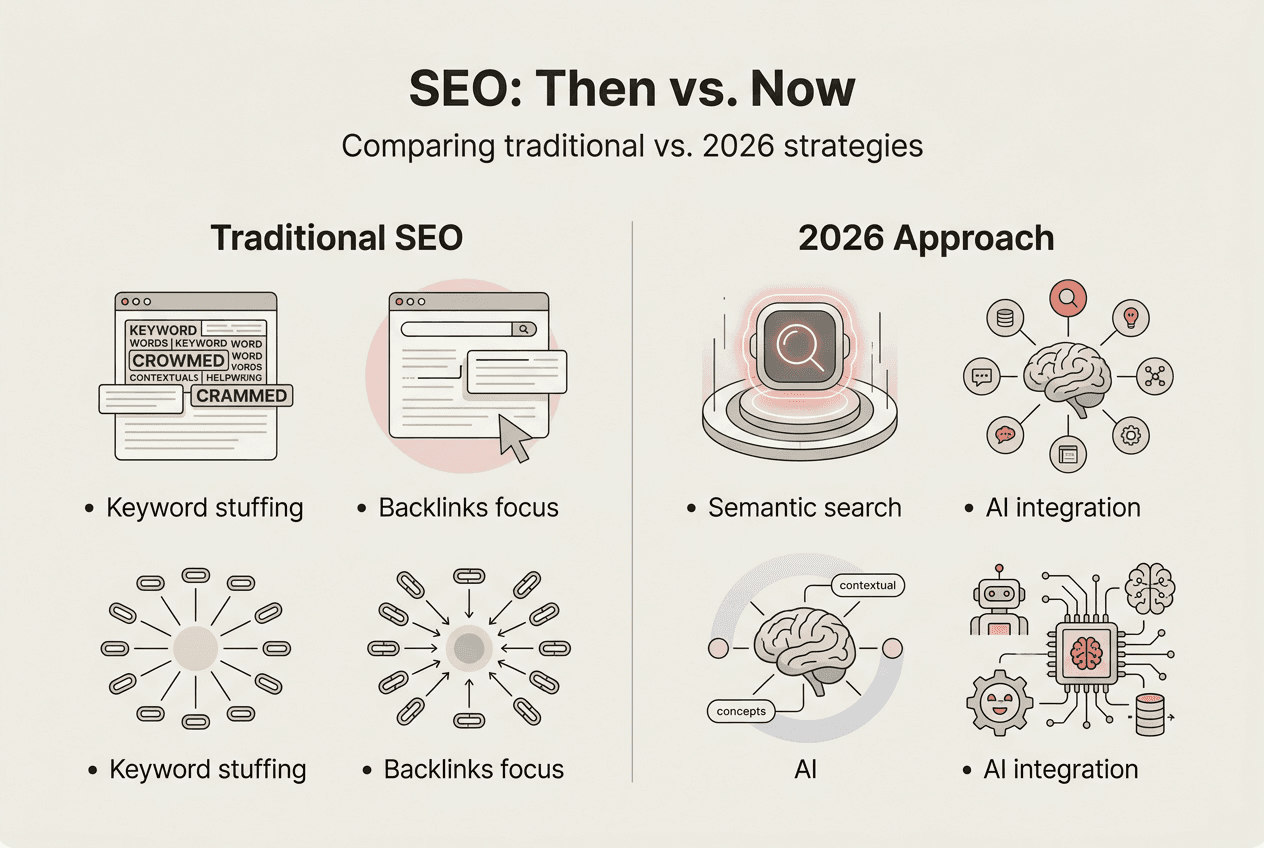
| Category | Traditional SEO | 2026 Advanced SEO |
|---|---|---|
| Keyword Strategy | Exact match phrases repeated frequently | Semantic variations and natural language |
| Content Creation | Keyword-focused articles with minimum word counts | User-intent driven comprehensive resources |
| Link Building | High volume of low-quality backlinks | Selective high-authority relevant links |
| Technical Focus | Basic meta tags and site structure | AI optimization, Core Web Vitals, structured data |
| Success Metrics | Rankings and traffic volume | Engagement, conversions, user satisfaction |
Emerging strategies that define competitive SEO in 2026 include:
- Implementing comprehensive schema markup for rich snippets and enhanced search results
- Optimizing content for voice search with conversational phrases and question formats
- Creating visual content optimized for image and video search algorithms
- Building topical authority through content clusters rather than isolated articles
- Collaborating with AI tools while maintaining authentic human voice and expertise
The shift reflects search engines’ improving ability to evaluate content quality. You can’t trick algorithms that understand language nuances and user behavior patterns. Success requires genuinely helpful content delivered through technically sound infrastructure.
Integration with digital marketing strategies has become essential. SEO doesn’t exist in a vacuum. Your search optimization must align with social media, email marketing, and paid advertising to create cohesive user experiences across channels.
Practical applications: how to future-proof your SEO in 2026
Transforming SEO knowledge into results requires systematic implementation of proven tactics adapted to your specific audience and business goals. Start with a comprehensive technical audit examining site speed, mobile usability, crawl errors, and structured data implementation.
Leverage AI tools strategically throughout your content workflow. Use them to generate initial outlines, identify content gaps, and optimize existing articles. Never publish AI-generated content without substantial human editing to ensure accuracy, add unique insights, and maintain your brand voice.
Voice and visual search optimization demands specific technical approaches:
- Structure content to answer common questions directly in the first paragraph
- Implement FAQ schema markup to increase chances of voice search selection
- Optimize images with descriptive file names, alt text, and surrounding context
- Create video content with accurate transcripts and detailed descriptions
- Focus on local SEO elements for location-based voice queries
Data and analytics guide strategic adjustments by revealing what works and what needs improvement. Track performance metrics consistently and analyze trends over time rather than reacting to daily fluctuations.
| Metric Category | Key Indicators | Optimization Focus |
|---|---|---|
| Traffic Quality | Organic sessions, new vs returning users | Content relevance and targeting |
| Engagement | Bounce rate, time on page, pages per session | User experience and content value |
| Conversions | Goal completions, conversion rate | Call-to-action placement and clarity |
| Technical Performance | Page speed, mobile usability score | Infrastructure and code optimization |
| Search Visibility | Ranking positions, featured snippet wins | Content quality and technical SEO |
Integrate SEO with broader marketing initiatives by aligning content calendars, sharing performance data across teams, and ensuring consistent messaging. Your SEO strategy should inform social media topics, email campaigns, and paid advertising while those channels drive traffic that improves SEO metrics.
Pro Tip: Set up automated reports tracking your most important SEO metrics weekly, but only make strategic changes monthly after analyzing trends, not reacting to short-term fluctuations.
Understand how AI algorithms shape marketing recommendations to better predict how search engines will evolve. Stay informed about algorithm updates and adjust tactics proactively. Build your social media strategy to complement SEO efforts by driving traffic and building brand signals that search engines recognize.
Explore related resources for digital success in 2026
Mastering SEO represents just one component of comprehensive digital marketing success. TechMoths offers extensive resources designed to help you develop skills across multiple disciplines critical for thriving in 2026’s competitive landscape.
Explore education opportunities in turbulent times to build knowledge that keeps you ahead of industry changes. Discover proven strategies for professional growth that complement your SEO expertise with broader marketing competencies. Access comprehensive guides on digital marketing strategies for 2026 that integrate SEO with social media, content marketing, and emerging technologies. These resources provide actionable frameworks you can implement immediately to strengthen your competitive position.
Frequently asked questions
What is the biggest change in SEO for 2026?
AI integration and semantic search represent the most significant shift in how search engines evaluate and rank content. Algorithms now understand context, user intent, and content quality at levels impossible just a few years ago. This means marketers must focus on genuine value and comprehensive coverage rather than keyword manipulation. The change rewards authentic expertise while making it harder to game the system with low-quality tactics.
How does AI impact SEO content creation in 2026?
AI tools accelerate content production by generating outlines, identifying gaps, and suggesting optimizations, but they cannot replace human creativity and expertise. Quality content still requires human editing to ensure accuracy, add unique insights, and maintain authentic voice. The most effective approach uses AI for efficiency while relying on human judgment for strategy and refinement. Search engines can detect purely AI-generated content and often rank it lower than human-crafted alternatives.
What are the best metrics to track SEO performance in 2026?
Track organic traffic volume, bounce rate, time on page, and conversion rates to measure how well your SEO drives business results. Monitor Core Web Vitals including page load speed, interactivity, and visual stability as these directly impact rankings. Analyze search rankings for intent-based keywords rather than just high-volume terms. Featured snippet wins and rich result appearances indicate strong optimization for modern search formats.
How can businesses adapt SEO strategies to voice and visual search?
Use natural language and question-based phrases in your content to match how people speak voice queries. Implement structured data markup including FAQ schema, product schema, and local business schema to help search engines categorize your content. Focus on local SEO optimization since voice searches often include location-based intent. For visual search, optimize images with descriptive file names, comprehensive alt text, and surrounding contextual content that explains what the image shows.
