

Why embrace agile methodology for project success in 2026

Organizations adopting Agile methods have 28% higher success rates in completing projects on time and on budget than traditional approaches. Business professionals and project managers across industries face common challenges: missed deadlines, poor team collaboration, and inflexible processes that can’t adapt to changing requirements. This comprehensive guide explains Agile methodology basics, shows how it transforms team collaboration and project efficiency, addresses common misconceptions, compares Agile with traditional approaches, and provides practical steps for successful adoption in your organization.
Table of Contents
- Introduction To Agile Methodology
- How Agile Enhances Team Collaboration
- Why Agile Improves Project Efficiency And Delivery
- Common Misconceptions About Agile Methodology
- Comparing Agile With Traditional And Hybrid Approaches
- Practical Steps For Successful Agile Adoption
- Conclusion: Making The Business Case For Agile
- Explore Resources To Master Agile Implementation
Key takeaways
| Point | Details |
|---|---|
| Agile boosts collaboration | Daily stand-ups and iterative cycles create continuous communication and accountability across teams. |
| Risk reduction through feedback | Continuous testing and stakeholder input enable early issue detection, cutting defects by up to 40%. |
| Flexibility beats rigidity | Agile adapts to changing requirements better than Waterfall’s fixed stages for dynamic projects. |
| Misconceptions hinder adoption | Agile requires planning and documentation, just streamlined and adaptive rather than eliminated. |
| Culture change drives success | Leadership support and team empowerment are essential for effective Agile implementation. |
Introduction to agile methodology
Agile methodology represents a flexible, iterative approach to project management that prioritizes customer collaboration, working deliverables, and adaptive planning over rigid processes. The Agile Manifesto, created in 2001 by software development pioneers, established four core values: individuals and interactions over processes and tools, working software over comprehensive documentation, customer collaboration over contract negotiation, and responding to change over following a plan. These values are supported by twelve principles that emphasize continuous delivery, welcoming changing requirements, frequent collaboration, and sustainable development practices.
The methodology evolved from frustrations with traditional Waterfall approaches that couldn’t accommodate mid-project changes without significant cost and time penalties. Agile frameworks like Scrum and Kanban emerged as practical implementations of these principles, introducing concepts like sprints (fixed time periods for completing work increments), iterations (cycles of planning, development, and review), and cross-functional teams empowered to make decisions.
Key Agile terminology includes:
- Scrum: A framework using sprints, daily stand-ups, and defined roles like Scrum Master and Product Owner
- Kanban: A visual workflow management system focusing on continuous delivery and limiting work in progress
- Sprints: Time-boxed periods (typically two to four weeks) for completing specific work increments
- User stories: Short descriptions of features from an end user perspective
- Retrospectives: Regular team meetings to reflect on processes and identify improvements
The iterative and adaptive nature of Agile contrasts sharply with linear models where all requirements are defined upfront and changes are costly. Instead, Agile teams work in short cycles, delivering functional increments and adjusting based on feedback. This approach has proven remarkably effective, similar to how organizations can leverage benefits of research funds and grants to iteratively develop innovations. Recent data confirms that organizations adopting Agile methods have 28% higher success rates in completing projects on time and on budget than traditional approaches, demonstrating measurable efficiency gains.
How agile enhances team collaboration
Daily stand-ups promote quick updates and rapid issue resolution by bringing teams together for focused 15-minute meetings. These brief synchronization sessions allow team members to share progress, identify blockers, and coordinate efforts without lengthy status meetings. The format creates transparency and accountability, ensuring everyone understands current priorities and can offer assistance when colleagues face obstacles.
Iterative work cycles fundamentally change how teams interact by creating natural checkpoints for feedback and adjustment. Rather than working in isolation for months before revealing results, Agile teams demonstrate progress every sprint. This visibility builds trust and enables stakeholders to provide input when it’s most valuable, not after significant resources have been committed to the wrong direction.
Defined roles within Agile frameworks foster team cohesion and remove impediments systematically:
- Scrum Master: Facilitates processes, removes blockers, and shields the team from external distractions
- Product Owner: Maintains the product backlog and ensures work aligns with business priorities
- Development Team: Self-organizing group responsible for delivering working increments
Continuous feedback loops reduce misalignment with client requirements and increase customer satisfaction by incorporating stakeholder input throughout development. Instead of discovering mismatched expectations at final delivery, Agile teams course-correct incrementally. This ongoing dialogue prevents costly rework and ensures the final product truly meets user needs.
Enhanced collaboration through Agile practices boosts team morale and project transparency. Team members feel more engaged when they understand how their work contributes to larger goals and when they have autonomy to make decisions. The collaborative environment created by agile team structure best practices reduces silos and encourages knowledge sharing across disciplines.

Pro Tip: Start daily stand-ups by having each person answer three questions: What did I complete yesterday? What will I work on today? What blockers am I facing? This simple structure keeps meetings focused and productive.
Why agile improves project efficiency and delivery
Continuous testing represents one of Agile’s most powerful mechanisms for improving quality and reducing risk. Early Agile adopters report continuous testing cuts defect rates by up to 40%, ensuring quality and accelerating feedback loops. By integrating testing throughout development rather than saving it for a final phase, teams catch issues when they’re cheapest and easiest to fix. This approach prevents the accumulation of technical debt that plagues traditional projects.
The iterative approach reduces risk by allowing earlier detection of project issues through continuous testing and stakeholder feedback. Each sprint delivers a potentially shippable increment, meaning problems surface quickly rather than remaining hidden until late-stage integration. Teams can pivot or adjust based on real data instead of assumptions, dramatically reducing the likelihood of catastrophic failures near deadlines.
Incremental delivery shortens release cycles and increases flexibility by breaking large initiatives into manageable chunks. Instead of waiting months or years for a complete product, organizations can begin capturing value from early releases while continuing to enhance functionality. This phased approach also reduces financial risk by allowing earlier return on investment and the option to halt development if market conditions change.
Quantified results demonstrate Agile’s impact:
- 40% reduction in defect rates through continuous integration and testing
- 28% higher on-time, on-budget completion compared to traditional methods
- Faster time to market enabling competitive advantages and revenue generation
- Improved stakeholder satisfaction from frequent demonstrations and incorporation of feedback
Faster delivery cycles help organizations meet evolving customer requirements in dynamic markets. When competitors move quickly and customer preferences shift rapidly, the ability to adapt becomes a strategic advantage. Agile’s focus on delivering working software frequently means organizations can respond to opportunities and threats more nimbly than competitors locked into rigid plans, similar to how companies boost productivity while maintaining quality through systematic process improvements.
Improved quality leads to higher stakeholder satisfaction and reduced maintenance costs. Products developed iteratively with continuous feedback tend to better match actual user needs, resulting in higher adoption rates and fewer post-launch modifications. The emphasis on sustainable pace also prevents team burnout, maintaining productivity over longer periods.
Common misconceptions about agile methodology
The belief that Agile means no planning represents perhaps the most damaging misconception. Agile does not eliminate planning but transforms it from a one-time upfront activity into an ongoing adaptive process. Teams still plan releases, sprints, and daily work, but they embrace changing priorities based on new information rather than rigidly following outdated plans. This adaptive planning actually requires more discipline and skill than traditional approaches.
Another widespread myth suggests Agile eliminates documentation. In reality, Agile streamlines documentation to focus on what adds value. Teams produce user stories, acceptance criteria, technical specifications, and process documentation, but avoid creating documents that become obsolete before anyone reads them. The principle values working software over comprehensive documentation, not working software instead of any documentation.
Many believe Agile applies only to software development, limiting its potential impact:
- Marketing teams use Agile to manage campaigns and content creation
- Manufacturing organizations apply Agile principles to product development and process improvement
- Financial services leverage Agile for regulatory compliance projects and customer experience initiatives
- Healthcare providers implement Agile for clinical process optimization and technology deployments
These misconceptions lead to resistance or incorrect implementations that undermine Agile’s benefits. When leaders expect Agile to mean chaos without planning, they avoid adoption or impose excessive controls that negate flexibility. When teams think documentation is forbidden, they fail to capture critical knowledge and create confusion.
Understanding real Agile principles is key to success and requires education beyond superficial awareness. Organizations must invest in training that covers both mechanics (ceremonies, artifacts, roles) and mindset (collaboration, adaptability, continuous improvement). Similar to avoiding mistakes with technology partner selection, avoiding Agile adoption mistakes requires thorough preparation and realistic expectations.
Pro Tip: Create a team working agreement during your first sprint that explicitly defines how you’ll handle planning, documentation, and decision making. This prevents misunderstandings and ensures everyone shares the same Agile interpretation.
Comparing agile with traditional and hybrid approaches
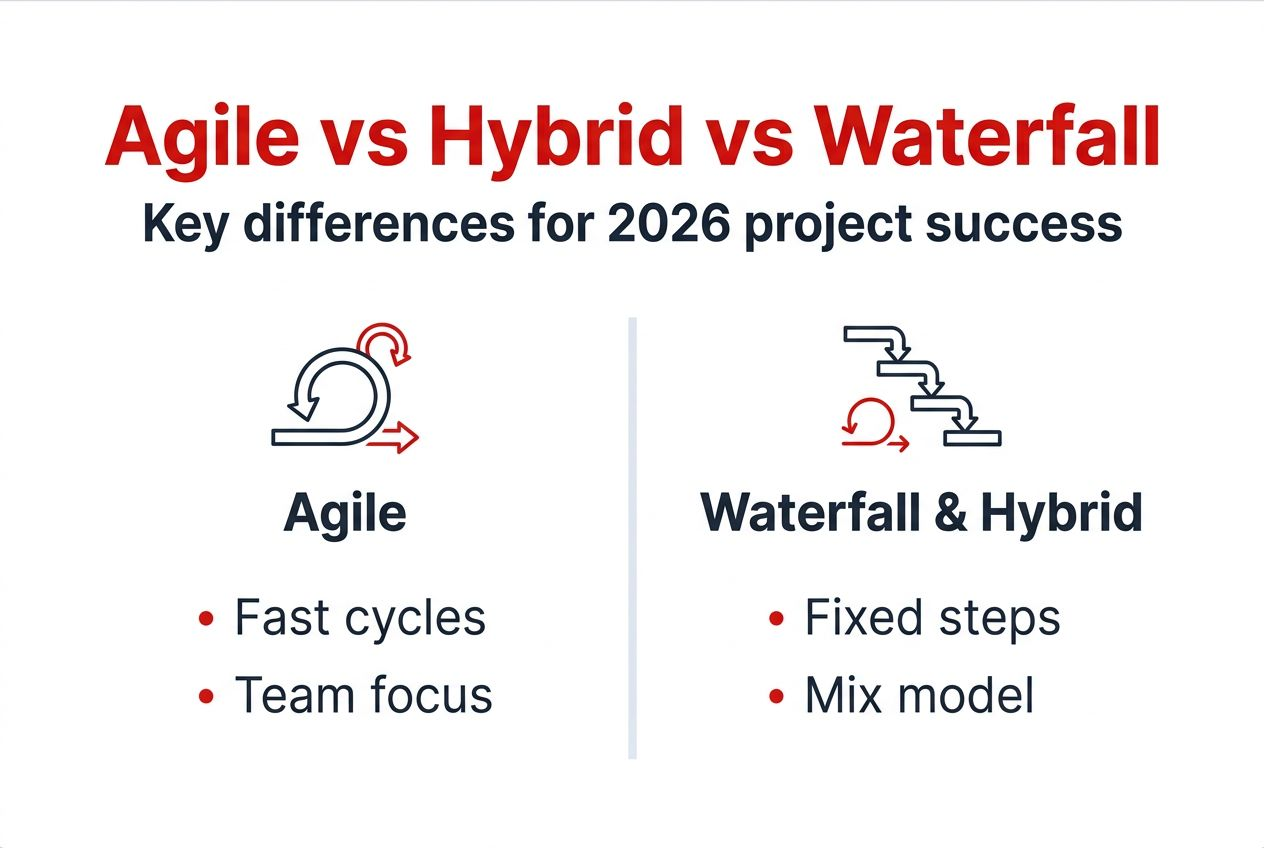
Agile offers flexibility and frequent feedback through iterative development, while Waterfall follows fixed sequential phases with limited accommodation for changes. Waterfall requires comprehensive upfront requirements and design, proceeding through development, testing, and deployment in discrete stages. This approach works well for projects with stable requirements and regulatory constraints requiring extensive documentation, but struggles when requirements evolve or early assumptions prove incorrect.
Hybrid approaches combine Agile flexibility with Waterfall’s compliance-friendly structure by using Waterfall for planning and governance while applying Agile for execution:
- Planning and budgeting follow traditional waterfall gates and approvals
- Execution within phases uses Agile sprints and iterative delivery
- Governance and reporting maintains traditional project management office oversight
- Testing and deployment can be either Agile continuous or Waterfall staged
The ideal choice depends on project complexity, regulatory needs, and organizational culture readiness. Highly regulated industries like pharmaceuticals or aerospace may require Waterfall’s extensive documentation for compliance, while dynamic markets favor Agile’s adaptability. Organizations transitioning from traditional methods often find hybrid approaches provide a comfortable bridge, similar to how business agility improves team outcomes incrementally rather than through disruptive transformation.
| Aspect | Agile | Waterfall | Hybrid |
|---|---|---|---|
| Iteration | Short sprints with frequent releases | Single release after all phases | Phased releases with internal iterations |
| Planning | Adaptive, continuous refinement | Comprehensive upfront planning | Upfront milestones, adaptive execution |
| Feedback | Continuous stakeholder involvement | Primarily at phase gates | Structured reviews plus sprint demos |
| Compliance | Lightweight documentation | Extensive formal documentation | Documentation at phase gates |
| Team roles | Cross-functional, self-organizing | Specialized, hierarchical | Mixed with some autonomy |
Agile fits dynamic, mid-sized projects where requirements will evolve and stakeholder collaboration is feasible. Projects developing innovative products or entering uncertain markets benefit from Agile’s learning-oriented approach. Teams comfortable with ambiguity and empowered decision making thrive in Agile environments.
Hybrid suits regulated industries requiring audit trails and formal approvals while still needing some flexibility. Large enterprises with established governance frameworks often adopt hybrid models to maintain corporate oversight while gaining Agile’s execution benefits. Success requires clear boundaries about which elements follow which methodology, supported by proper agile team structure design principles.
Practical steps for successful agile adoption
Securing leadership buy-in to champion and resource Agile adoption represents the critical first step. Without executive support, teams lack the authority to make necessary changes and face resistance from stakeholders accustomed to traditional approaches. Leaders must understand that Agile requires investment in training, tools, and cultural transformation, not just process changes. They should actively participate in ceremonies and model Agile values like transparency and adaptability.
Start with pilot projects to trial and adjust Agile processes before scaling organization-wide:
- Select a suitable pilot: Choose a mid-sized project with engaged stakeholders and team members open to experimentation
- Provide intensive support: Assign an experienced Agile coach to guide the team through initial sprints
- Measure and learn: Track metrics like velocity, defect rates, and stakeholder satisfaction to demonstrate value
- Capture lessons: Document what worked, what didn’t, and what needs adjustment for broader rollout
- Celebrate wins: Share success stories to build momentum and overcome skepticism
Train teams incrementally to internalize Agile practices without overwhelming them with too much change at once. Begin with foundational concepts and ceremonies, then layer in advanced techniques like estimation, backlog refinement, and continuous integration. Hands-on practice matters more than classroom learning, so emphasize learning by doing with support available when teams encounter challenges.
Foster culture emphasizing trust, empowerment, and continuous improvement rather than blame and rigid control. Agile requires psychological safety where team members feel comfortable surfacing problems and experimenting with solutions. Leaders must shift from command and control to servant leadership, removing obstacles rather than dictating solutions. This cultural shift often proves more challenging than adopting new processes.
Avoid common failures like skipping cultural readiness assessment or misunderstanding Agile as simply faster Waterfall. Organizations that rename traditional roles without changing behaviors or that measure success using outdated metrics undermine Agile adoption. Similar to how technology adoption for small businesses requires thoughtful planning, Agile transformation needs careful attention to change management and realistic timelines.
Pro Tip: Create an Agile transformation roadmap with clear phases, success criteria, and checkpoints. Treat your Agile adoption as an Agile project itself, with regular retrospectives to adjust your approach based on what you’re learning.
Partner with experts who understand both Agile mechanics and organizational change, such as performance management companies experienced in guiding cultural transformations. External coaches bring objectivity and experience from multiple implementations, helping you avoid common pitfalls.
Conclusion: making the business case for agile
Agile delivers 28% higher success rates in completing projects on time and on budget, providing measurable improvement over traditional approaches. This performance advantage translates directly to competitive benefits through faster time to market, reduced waste, and higher customer satisfaction. Organizations operating in dynamic markets cannot afford the rigidity of approaches that lock them into plans that may be obsolete before implementation completes.
Teams report higher motivation and engagement when using Agile frameworks that provide autonomy and purpose:
- Empowerment through self-organizing teams increases ownership and accountability
- Visibility into how individual work contributes to larger goals enhances meaning
- Collaboration breaks down silos and builds stronger working relationships
- Learning through retrospectives and experimentation develops skills and capabilities
Agile’s adaptability suits a wide range of industries beyond information technology, from manufacturing to healthcare to financial services. Any domain facing changing requirements, complex stakeholder needs, or innovation imperatives can benefit from Agile principles. The methodology scales from small teams to large programs through frameworks like SAFe and LeSS, similar to how research funding benefits support innovation at various scales.
Organizations see reduced defects through continuous testing, better risk management via incremental delivery, and faster market response through adaptive planning. These improvements compound over time as teams mature in their Agile practices and organizational impediments are systematically removed. The cultural benefits of transparency, collaboration, and continuous improvement extend beyond individual projects to transform how work gets done.
“Agile is not just about delivering projects faster. It’s about creating organizations that learn and adapt continuously, responding to change as a core competency rather than an exception to be managed.”
Investing in Agile adoption drives business growth and operational excellence by building capabilities that compound over time. Organizations that master Agile develop talent retention advantages as skilled professionals seek environments offering autonomy and purpose. The methodology’s emphasis on boosting productivity without sacrificing quality aligns perfectly with competitive pressures facing modern businesses. As remote and distributed work becomes standard, Agile’s collaboration frameworks provide structure for digital reinvention of business models that transcend geographic boundaries.
Explore resources to master agile implementation
Successfully implementing Agile requires ongoing learning and access to proven frameworks. TechMoths offers comprehensive guides to support your transformation journey. Explore detailed strategies for building an agile team structure from scratch, ensuring your organization has the right roles, responsibilities, and relationships to thrive.
Develop leadership capabilities through our proven strategies for professional growth that align with Agile values of continuous improvement and servant leadership. Understanding how to guide teams through change while maintaining psychological safety proves essential for Agile success. Additionally, apply personalized learning tactics to customize your team’s Agile training based on their current capabilities and learning preferences, maximizing adoption and minimizing resistance.
FAQ
What industries benefit most from agile methodology?
Agile benefits software development, marketing, manufacturing, finance, and healthcare due to its adaptability to changing requirements. Any industry facing dynamic markets, complex stakeholder needs, or innovation imperatives can leverage Agile principles. The methodology works particularly well for projects requiring flexibility and rapid iteration based on feedback.
How does agile differ from waterfall in handling project changes?
Agile embraces change through iterative cycles and continuous feedback, adjusting priorities every sprint based on new information. Waterfall follows fixed sequential stages where changes require formal change control processes and often significant rework. Agile treats change as expected and valuable, while Waterfall views it as an exception requiring management approval.
What are common pitfalls to avoid when adopting agile?
Common pitfalls include lack of leadership support, skipping necessary culture change, and misunderstanding Agile as requiring no planning or documentation. Organizations fail when they rename roles without changing behaviors or measure success using traditional metrics. Avoid these issues by securing executive buy-in, investing in training, fostering empowerment, and learning from common technology adoption mistakes before implementation.
Can agile methodology be applied to non-software projects?
Yes, Agile principles apply successfully in marketing campaigns, product development, construction projects, and organizational change initiatives. Any project benefiting from flexibility, collaboration, and iterative delivery can adopt Agile frameworks. Marketing teams use Agile for content creation, manufacturers apply it to product development, and service organizations leverage it for process improvement.
