
AI in education: Boost teaching and engagement in 2026

You might be surprised to learn that 84% of U.S. high school students use generative AI tools like ChatGPT for schoolwork. While this raises concerns about cheating and critical thinking, the reality is far more nuanced. AI doesn’t replace teachers. Instead, it augments instruction by personalizing learning, automating tedious tasks, and boosting student engagement when used responsibly.
Table of Contents
- Introduction To AI In Education
- Mechanisms Of AI-Driven Personalized Learning
- How AI Enhances Student Engagement And Learning Outcomes
- AI’s Role In Reducing Teacher And Administrative Workload
- Common Misconceptions And Challenges In AI Adoption
- Ethical And Equity Considerations In AI Use
- Policy And Implementation Landscape In U.S. Education
- Practical Steps For Integrating AI In Educational Settings
- Explore Tailored AI Learning Solutions With TechMoths
- Frequently Asked Questions About AI In Education
Key takeaways
| Point | Details |
|---|---|
| AI augments teaching | Enables personalized learning paths and automates grading, freeing educators for meaningful instruction. |
| Student engagement rises | Adaptive tools and interactive content motivate learners and improve outcomes through tailored feedback. |
| Ethics and equity matter | Deliberate policies and training address bias, privacy risks, and access gaps to ensure fair implementation. |
| Success requires preparation | Phased rollouts, educator training, and continuous feedback loops maximize AI’s benefits in schools. |
Introduction to AI in education
Artificial intelligence is reshaping how U.S. schools approach teaching and learning. AI applications span K-12 and higher education, supporting personalized instruction, interactive engagement tools, and administrative efficiency. These technologies analyze student performance data in real time, adjust lesson difficulty, and provide instant feedback that traditional methods can’t match.
Despite this potential, most U.S. states are currently in exploratory or pilot stages evaluating AI in education, with only a few implementing large-scale systematic assessments of AI’s impact on student learning outcomes. The adoption landscape varies dramatically. Some districts are piloting adaptive learning platforms, while others remain hesitant due to infrastructure limitations or ethical concerns.
Ethical and equity considerations must guide AI integration from day one. Without deliberate attention to fairness, AI risks widening existing achievement gaps between well-resourced and underserved schools. Privacy protections for student data, transparency in algorithmic decision-making, and equitable access to technology are non-negotiable foundations.
Key AI applications in modern education include:
- Personalized learning platforms that adapt content to individual student needs
- Intelligent tutoring systems offering real-time feedback and support
- Automated grading and assessment tools reducing teacher workload
- Predictive analytics identifying at-risk students early for intervention
- Administrative automation streamlining scheduling, attendance, and communication
This gradual, varied adoption reflects both excitement about AI’s promise and caution about its challenges. Schools that succeed will balance innovation with equity, ensuring every student benefits.
Mechanisms of AI-driven personalized learning
AI enables personalized learning by adapting content to individual student needs, tracking progress in real time, and offering tailored feedback, thus improving learning efficiency and outcomes. Instead of one-size-fits-all instruction, AI analyzes how each student learns best and adjusts accordingly.
Platforms like Coursera and Khan Academy exemplify this approach. They use algorithms to modify lesson pace, content complexity, and practice exercises based on student performance. If a learner struggles with fractions, the system provides additional practice and alternative explanations before moving forward. If another student excels, they skip ahead to more challenging material.
This customization proves especially valuable for neurodiverse learners. AI-powered adaptive learning systems offer personalized pacing and tailored interventions that accommodate different cognitive styles and processing speeds. Students with ADHD might receive shorter, more frequent tasks, while those on the autism spectrum benefit from predictable routines and clear instructions.
Three primary AI personalization mechanisms stand out:
- Real-time performance tracking that identifies knowledge gaps instantly
- Dynamic content adjustment matching difficulty to current skill levels
- Individualized feedback loops reinforcing strengths and addressing weaknesses
| Feature | Adaptive Learning Platforms | AI Tutoring Systems | Admin AI Tools |
|---|---|---|---|
| Primary function | Adjust curriculum pacing and content | Provide one-on-one support and feedback | Automate grading and scheduling |
| Student interaction | Self-paced lessons with built-in assessments | Conversational Q&A and problem-solving help | Minimal direct interaction |
| Teacher role | Monitor progress dashboards and intervene | Complement classroom instruction | Focus time on pedagogy |
| Best for | Differentiated instruction at scale | Struggling students needing extra help | Reducing administrative burden |
Pro Tip: Focus on integrating adaptive systems that align with your existing curriculum goals rather than replacing proven teaching methods entirely. This maximizes impact while maintaining instructional coherence.
Explore personalized learning tactics that boost student loyalty and engagement. Stay ahead of 2026 education AI trends shaping classrooms nationwide. Understand how AI-generated content transforms educational materials.
How AI enhances student engagement and learning outcomes
AI enhances a student’s learning ecosystem by adding value to existing media time rather than replacing human interactions or productive struggle, expanding engagement and personalized learning. This additive approach means AI supplements traditional instruction with interactive, personalized elements that keep students motivated.
AI-driven tutoring systems provide timely feedback that encourages learners to persist through challenges. When a student submits an essay draft, AI tools can highlight structural issues, suggest vocabulary improvements, and point out logical gaps within seconds. This immediate response accelerates the revision cycle and builds writing confidence.

Evidence shows improved motivation and measurable gains from personalized AI experiences. Students report feeling more in control of their learning when they can progress at their own pace. Teachers observe higher completion rates and deeper understanding when lessons adapt to individual readiness levels.
Key engagement methods enabled by AI include:
- Interactive simulations and games that make abstract concepts tangible
- Adaptive quizzes adjusting difficulty to maintain optimal challenge levels
- Personalized learning paths letting students explore topics matching their interests
- Real-time progress dashboards providing visibility into achievement and growth
- Intelligent recommendations suggesting next steps based on performance patterns
A striking statistic illustrates this shift: 84% of U.S. high school students now use generative AI tools for schoolwork, indicating widespread adoption despite ongoing debates about appropriate use.
The role of AI in business mirrors education trends, demonstrating cross-sector transformation. AI trends 2026 generative AI shows how these technologies reshape entire industries. Apply startup management efficiency principles to educational AI implementation.
Student engagement thrives when AI creates the right balance between support and challenge, personalization and rigor. The goal isn’t to make learning easier but to make it more responsive to individual needs.
AI’s role in reducing teacher and administrative workload
AI tools help automate and streamline administrative tasks in education, reducing teacher workload and allowing educators to focus more on instruction and student interaction. Grading multiple-choice tests, tracking attendance, and scheduling parent conferences consume hours that could be spent developing engaging lessons or mentoring students.
Automation transforms these routine tasks. AI grading systems evaluate objective assessments instantly, providing students with immediate results and teachers with aggregated performance data. Scheduling algorithms optimize classroom assignments, resource allocation, and meeting times based on complex constraints.
Streamlined communication tools facilitate better coordination with students and families. Chatbots answer common questions about homework deadlines, supply lists, and school policies 24/7. Automated reminders ensure parents stay informed about upcoming events and student progress without teachers manually sending messages.
Steps to implement AI automation tools effectively:
- Identify high-volume, time-consuming tasks suitable for automation like attendance tracking or basic quiz grading.
- Select tools with intuitive interfaces that integrate with existing systems such as your learning management platform.
- Pilot the technology with a small teacher group to identify issues before school-wide rollout.
- Provide hands-on training sessions focused on practical workflows rather than technical specifications.
- Establish feedback channels so educators can report bugs, request features, and share best practices.
- Monitor time savings and reallocate educator hours toward high-impact activities like differentiated instruction.
Pro Tip: Prioritize AI tools with intuitive interfaces to minimize training time and maximize adoption rates among busy educators.
Leverage AI content editing techniques for faster lesson material preparation. Learn to humanize AI content when generating educational resources.
When administrative burden decreases, teacher satisfaction and retention improve. Educators enter the profession to inspire young minds, not to manage paperwork. AI helps them reclaim that original purpose.
Common misconceptions and challenges in AI adoption
Many educators mistakenly believe AI will replace teachers or reduce human interaction in classrooms; however, AI is more effectively used as an augmentative tool that supports and enriches pedagogy rather than replaces human roles. This fundamental misunderstanding creates resistance where collaboration would serve students better.
Faculty surveys reveal widespread concerns about AI’s impact on critical thinking and original writing skills, despite recognition of AI’s increasing prevalence in higher education settings. These worries are valid but manageable through clear guidelines, explicit instruction in AI literacy, and assignments designed to require authentic thinking AI cannot replicate.
Common misconceptions with factual clarifications:
- Myth: AI makes teachers obsolete. Reality: AI handles routine tasks so teachers can focus on mentorship, creativity, and social-emotional learning.
- Myth: Students will stop thinking critically if AI does work for them. Reality: Well-designed AI use prompts deeper analysis by handling basic research and allowing focus on synthesis.
- Myth: AI is only for tech-savvy teachers. Reality: Modern educational AI tools prioritize user-friendly interfaces requiring minimal technical expertise.
- Myth: AI creates lazy learners. Reality: Adaptive systems maintain appropriate challenge levels that prevent both boredom and frustration.
Challenges requiring deliberate attention include:
- Equitable access varies dramatically between well-funded and underserved districts, risking wider achievement gaps
- Algorithmic bias can perpetuate stereotypes if training data reflects historical inequities
- Digital literacy gaps mean some students and teachers lack skills to use AI effectively
- Academic integrity concerns arise when students submit AI-generated work as their own
- Privacy risks emerge from collecting and analyzing sensitive student performance data
Avoid AI startup mistakes when implementing educational technology. Understanding common pitfalls accelerates successful integration.
Addressing these misconceptions and challenges requires honest dialogue, professional development, and policies balancing innovation with responsibility. Schools that acknowledge concerns while pursuing opportunities will navigate AI adoption most successfully.
Ethical and equity considerations in AI use
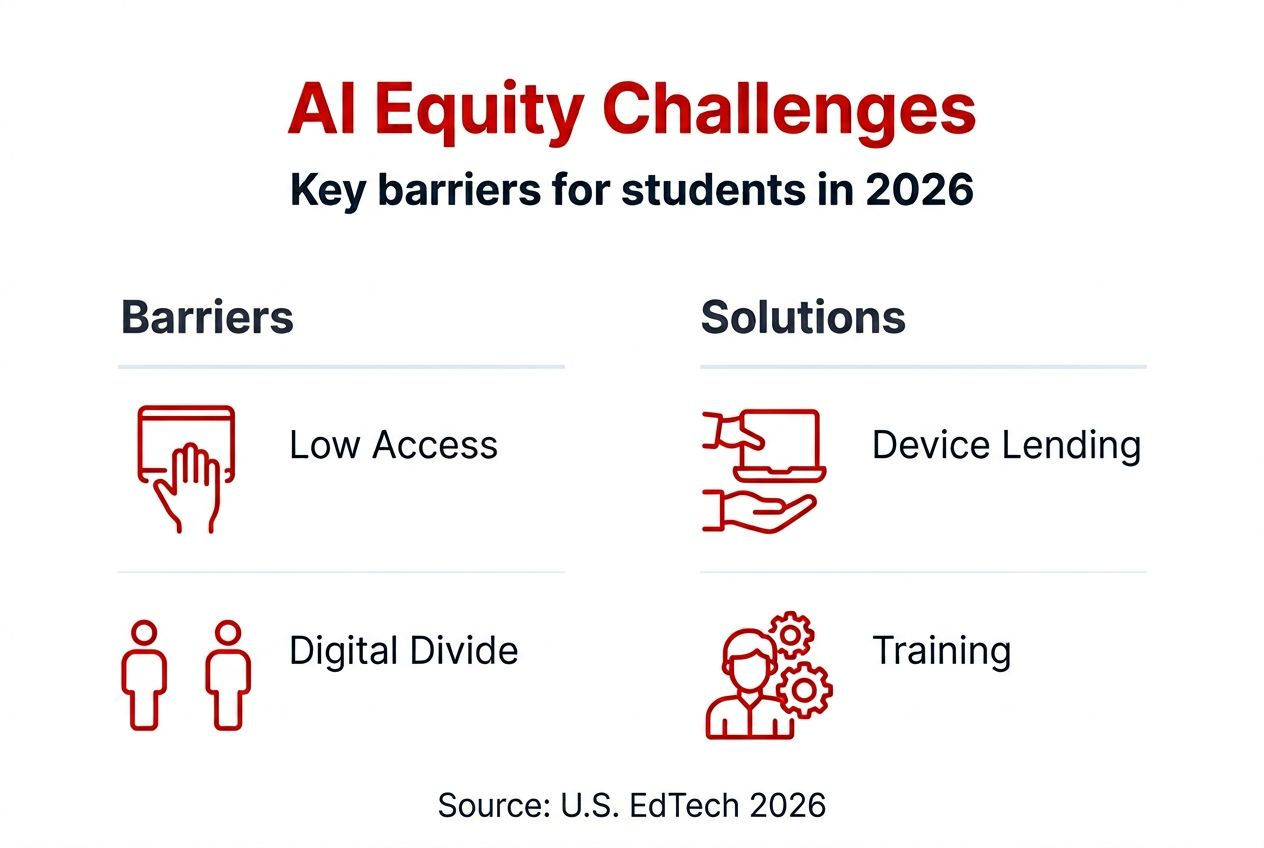
The digital divide limits equal AI benefits for students from varied socioeconomic backgrounds. Rural schools often lack reliable broadband infrastructure needed for cloud-based AI platforms. Low-income families may not afford devices for home access. These disparities mean AI could widen rather than narrow achievement gaps without deliberate intervention.
AI algorithms can reflect and amplify societal biases affecting fairness in education. If training data overrepresents certain demographics or achievement patterns, recommendations may disadvantage underrepresented groups. Facial recognition systems used for attendance have shown lower accuracy for students of color. Predictive analytics flagging at-risk students may reinforce deficit-based thinking.
Privacy concerns require stringent data protection and transparent policies. Schools collect sensitive information about academic performance, behavior, learning disabilities, and family circumstances. AI systems analyzing this data must comply with FERPA regulations and obtain informed consent. Parents deserve clear explanations of what data is collected, how algorithms use it, and who can access results.
Key ethical and equity challenges with mitigation strategies:
- Infrastructure gaps: Secure funding for broadband expansion and device lending programs ensuring all students can access AI tools at school and home.
- Algorithmic bias: Audit AI systems regularly for disparate impacts across demographic groups and require vendors to demonstrate fairness testing.
- Privacy risks: Limit data collection to educational necessities, anonymize datasets where possible, and establish clear retention and deletion policies.
- Digital literacy divides: Provide AI training for students and families, not just teachers, building community-wide capacity.
- Vendor lock-in: Choose platforms using open standards and interoperable data formats preventing dependence on single providers.
Address access to different levels of education to ensure AI benefits reach all students equitably.
Ethical AI implementation in education demands proactive attention to fairness, transparency, and accountability. Schools cannot afford to adopt powerful technologies without examining who benefits and who might be harmed.
Policy and implementation landscape in U.S. education
Most U.S. states are currently in exploratory or pilot stages evaluating AI in education, with limited systematic outcome assessments. This early phase means best practices are still emerging. Some states have issued guidance on acceptable AI use, while others remain silent as districts navigate uncharted territory independently.
School districts differ widely in adoption and integration strategies based on resources, leadership priorities, and community readiness. Urban districts with dedicated technology departments may pilot multiple AI platforms simultaneously. Small rural districts might rely on vendor-provided tools bundled with existing software. Charter networks sometimes move faster than traditional public schools due to greater operational flexibility.
Best practices for effective AI integration include:
- Engage stakeholders including teachers, students, families, and community members in planning and decision-making processes from the start.
- Establish clear evaluation plans with measurable goals for student learning, teacher satisfaction, and operational efficiency before purchasing tools.
- Create feedback loops allowing continuous input from users to refine implementation and address emerging challenges quickly.
- Develop comprehensive policies addressing acceptable use, academic integrity, data privacy, and equity considerations specific to your context.
- Invest in ongoing professional development rather than one-time training, recognizing AI literacy as an evolving competency.
- Start small with pilots in willing classrooms before scaling district-wide, learning from early adopters’ experiences.
The policy landscape will mature as more states and districts gain experience. Early movers have opportunities to shape standards but also bear risks of missteps. Late adopters can learn from others’ successes and failures but may fall behind in preparing students for AI-integrated futures.
Successful implementation requires patience, flexibility, and commitment to equity. Quick wins matter less than sustainable systems serving all learners well.
Practical steps for integrating AI in educational settings
Assess your institution’s AI readiness by evaluating infrastructure and staff capacity. Survey teachers about their comfort with technology and interest in AI tools. Audit your network bandwidth, device availability, and software systems. Identify champions who can lead pilot programs and mentor colleagues.
AI literacy and training for educators is critical to effectively integrate AI tools into teaching, supporting responsible and informed use. Professional development should cover both technical skills and pedagogical strategies. Teachers need to understand what AI can and cannot do, recognize bias and limitations, and design assignments preventing misuse.
Conduct pilots with clear goals and phased scaling timelines. Choose one or two specific use cases rather than attempting comprehensive transformation immediately. Define success metrics like time saved on grading, student engagement scores, or learning gains. Collect data throughout the pilot to inform expansion decisions.
Develop policies addressing ethics, equity, and academic integrity before widespread adoption. Specify acceptable and unacceptable AI uses for students and staff. Establish data governance procedures protecting privacy. Create consequences for violations while leaving room for learning from mistakes.
Step-by-step guide for phased AI implementation:
- Form a diverse implementation team including teachers, administrators, IT staff, students, and parents to ensure multiple perspectives.
- Identify priority needs where AI offers clear value such as personalized math practice or automated feedback on writing drafts.
- Research and vet AI tools aligning with your needs, prioritizing vendors with strong privacy protections and equity commitments.
- Launch a small pilot with volunteer teachers who receive dedicated support and training throughout the trial period.
- Gather feedback from pilot participants and students, documenting successes, challenges, and unexpected outcomes.
- Refine implementation based on lessons learned, adjusting training, policies, and tool configurations as needed.
- Expand gradually to additional teachers and grade levels, building capacity through peer mentoring and communities of practice.
- Monitor outcomes continuously using established metrics, remaining willing to discontinue tools that don’t deliver promised benefits.
Pro Tip: Incorporate continuous feedback loops from educators and students to refine AI use and catch problems early before they become entrenched.
Apply AI content editing strategies when developing curriculum materials. Explore how to humanize AI content for more engaging student resources. Understand AI algorithms in recommendations to grasp how educational platforms personalize content.
Thoughtful, incremental integration serves students better than rushed adoption driven by hype. Take time to build foundation for sustainable, equitable AI use.
Explore tailored AI learning solutions with TechMoths
Implementing AI in education requires more than just technology. It demands expertise in pedagogy, equity, and change management. TechMoths offers resources to navigate this complex landscape successfully.
Discover expert strategies for personalized learning tactics that boost student loyalty and achievement through AI-powered customization. Our guides help you design adaptive learning experiences matching diverse student needs while maintaining rigorous standards.
Address equity gaps with insights on access to different levels of education, ensuring technology benefits all learners regardless of background. We provide frameworks for evaluating and mitigating bias in educational AI systems.
Stay competitive with comprehensive coverage of 2026 education trends AI, equity, and hybrid learning transforming classrooms nationwide. Our research keeps you informed about emerging tools, policy developments, and implementation best practices.
Whether you’re launching your first AI pilot or scaling district-wide, TechMoths delivers actionable intelligence supporting smarter decisions and better outcomes for students and educators alike.
Frequently asked questions about AI in education
What are examples of AI tools currently used in U.S. classrooms?
Popular AI tools include Khan Academy’s adaptive math platform, which adjusts problem difficulty based on student performance. Grammarly helps students improve writing through real-time feedback on grammar and style. Teachers use tools like Gradescope for automated assignment grading and Turnitin for plagiarism detection.
How can educators ensure AI use maintains academic integrity?
Establish clear policies defining acceptable AI assistance for different assignment types. Design assessments requiring original thinking, personal reflection, or in-class demonstrations that AI cannot replicate. Teach students to cite AI tools as sources and emphasize learning process over just correct answers. Regular discussions about ethical use build student accountability.
What policies support equitable AI access in schools?
Effective policies include device lending programs ensuring all students have necessary hardware at home. Broadband subsidy initiatives help low-income families afford internet access. Professional development requirements ensure all teachers, not just tech enthusiasts, gain AI literacy. Equity audits of AI tools before adoption identify potential bias or accessibility barriers.
How should schools prepare teachers for AI integration?
Provide ongoing professional development covering both technical skills and pedagogical applications. Create teacher learning communities where educators share AI strategies and troubleshoot challenges together. Offer release time for experimentation with new tools before expecting classroom implementation. Pair tech-comfortable teachers with those needing more support through mentorship programs.
Are there privacy risks with student data and AI?
Yes, AI systems often collect detailed information about student performance, behavior, and learning patterns. Schools must ensure vendors comply with FERPA regulations protecting educational records. Review data sharing agreements carefully, limiting collection to educational necessities. Provide transparent explanations to families about what data is collected and how algorithms use it.
Can AI really improve learning outcomes or is it just hype?
Research shows AI-powered personalized learning can improve outcomes when implemented thoughtfully. Adaptive platforms help students master concepts at their own pace, reducing frustration and boredom. However, AI is a tool, not a magic solution. Effectiveness depends on quality implementation, teacher facilitation, and alignment with sound pedagogical principles. Poor execution can waste resources without benefiting students.
